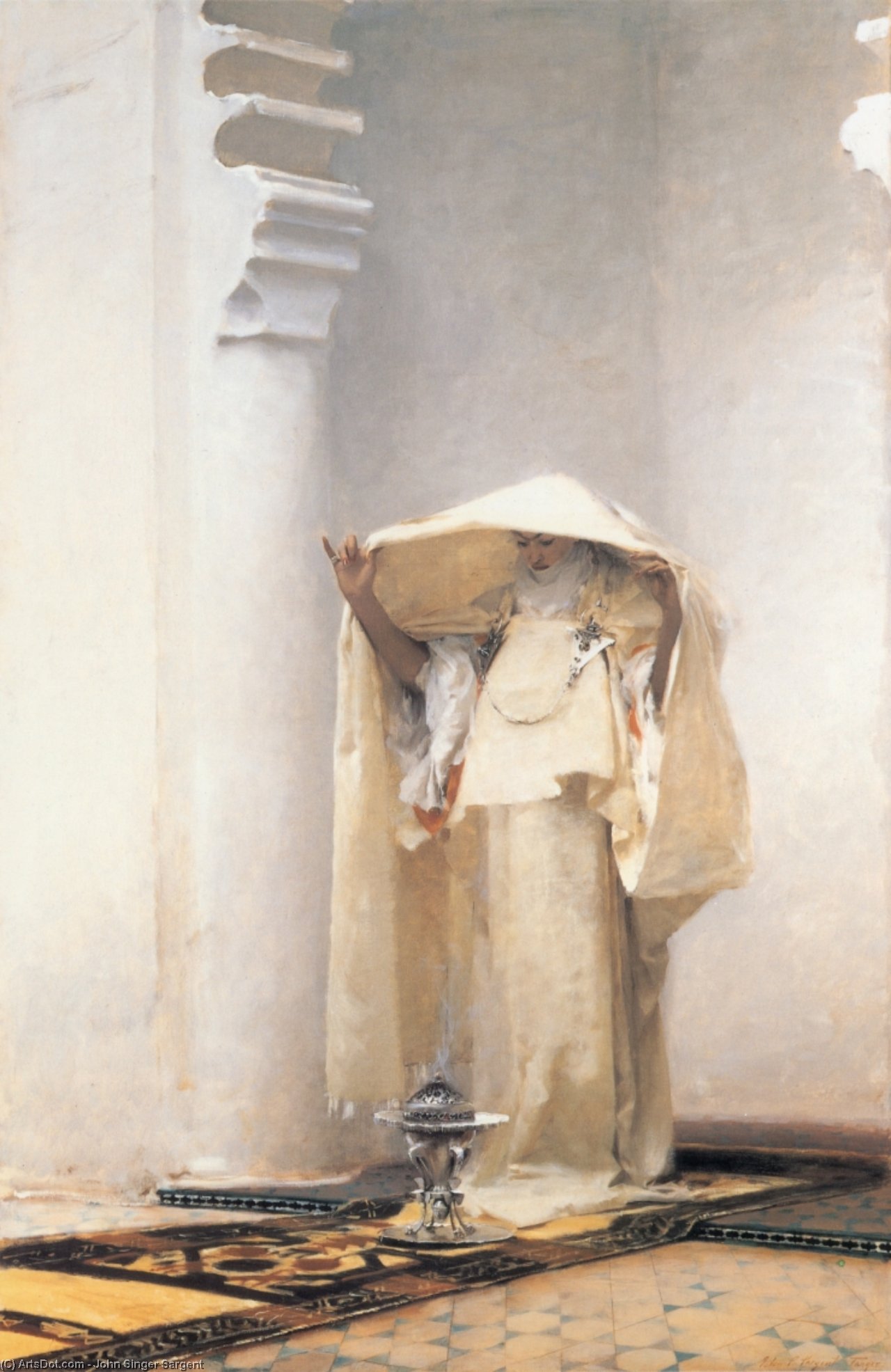
A Portrait Steeped in Atmosphere: Exploring John Singer Sargent’s Fumee d'Ambre Gris
The painting “Fumée d’ambre gris” – French for ‘Smoky Amber Gray’ – is a captivating portrait by John Singer Sargent, capturing a moment of quiet contemplation within the opulent setting of late Victorian society. Executed around 1904, this artwork transcends mere likeness; it delves into psychological depth and masterful artistic execution, offering viewers an enduring glimpse into the artist's vision.
- Subject Matter: Sargent’s subject is a man standing before a wall adorned with architectural details – pillars supporting a vaulted ceiling – creating a dramatic backdrop that emphasizes his posture and gaze. The pose itself speaks volumes about inner stillness, as he raises his arms above his head, suggesting an upward yearning or perhaps simply absorbing the grandeur of his surroundings.
- Style: Sargent’s signature style is characterized by its luminous palette and effortless brushwork. He eschewed academic conventions, prioritizing tonal harmony and capturing fleeting impressions of light – a technique he honed during his travels across Europe. This approach aligns perfectly with Impressionism's influence, yet distinguishes itself through Sargent’s refined sensibility.
Technique: Light and Texture—A Symphony of Color
Sargent employed a layering technique that is quintessential to his oeuvre. He began with thin washes of color – primarily muted amber tones – establishing the foundational atmosphere before applying subsequent layers of glaze, achieving remarkable depth and luminosity. The subtle gradations of tone convey not only visual beauty but also an emotional resonance; the smoky gray hue evokes a sense of melancholy yet simultaneously radiates warmth. Notice particularly how Sargent captures the texture of the wall surface—the rough stone juxtaposed against the smooth sheen of varnish—adding tactile dimension to the composition.
Historical Context: The Gilded Age and Artistic Innovation
“Fumée d’ambre gris” emerged during the height of the Gilded Age, a period marked by immense wealth and conspicuous consumption in America. Sargent's aristocratic clientele commissioned portraits to solidify their social standing, reflecting the era’s obsession with appearances and status. However, unlike many artists of his time who slavishly adhered to established artistic formulas, Sargent actively pushed boundaries. He embraced Impressionistic principles—particularly capturing fleeting moments of light—demonstrating a willingness to experiment and forge his own path within the broader artistic landscape.
Symbolism: Gesture and Emotion—Beyond Surface Appearance
The man’s raised arms are arguably the most significant symbolic element of the painting. They represent not merely physical posture but also an expression of emotion – a desire for transcendence, perhaps, or simply a profound absorption in beauty. The vase positioned prominently in the foreground serves as a visual anchor and subtly reinforces the theme of contemplation. Amber itself carries connotations of warmth, resinous fragrance, and hidden depths—mirroring Sargent’s artistic ambition to convey more than just what is seen; he strives to capture the essence of human experience.