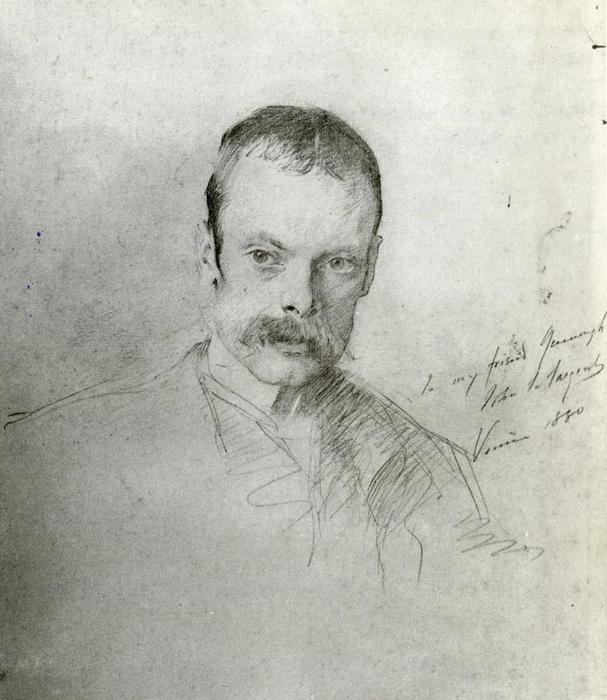
Captured in exquisite black and white by John Singer Sargent during the opulent Victorian era, this detailed portrait depicts Gordon Greenough—a man of quiet contemplation dressed impeccably—inviting viewers to appreciate the artist’s masterful technique and timeless elegance.
A Portrait Steeped in Elegance: Examining John Singer Sargent’s “Gordon Greenough”
The drawing "Gordon Greenough," executed by John Singer Sargent in 1880, stands as a quintessential example of Impressionistic portraiture—a genre that sought to capture fleeting moments of beauty and emotion rather than striving for photographic realism. Measuring 27 x 22 cm, this monochrome masterpiece resides within the broader context of Sargent’s prolific output during his formative years in Europe, specifically amidst the opulent social circles of Paris and London. It's a piece that speaks volumes about both artistic innovation and the cultural sensibilities of its time.
- Subject Matter: The portrait depicts Gordon Greenough, an American businessman known for his involvement in the textile industry. Sargent skillfully rendered Greenough’s face with meticulous detail—the subtle contours of his jawline, the expressive curve of his eyebrow, and the carefully shaded mustache—demonstrating a mastery of tonal gradation that is characteristic of Impressionistic technique.
- Style & Technique: Sargent employed a loose brushstroke style, prioritizing capturing light and atmosphere over precise representation. Unlike academic portraiture which aimed for idealized beauty, “Gordon Greenough” embraces an understated realism, focusing on conveying the sitter’s inner state through subtle gestures and facial expressions. The artist utilized oil paints on canvas, applying thin layers of pigment to build up texture and luminosity.
Historical Context: The Gilded Age and Artistic Experimentation
Sargent's work flourished during the Gilded Age (roughly 1870-1900), a period marked by unprecedented economic prosperity in America alongside extravagant displays of wealth and social ambition. Artists like Sargent actively challenged traditional artistic conventions, rejecting the rigid formalism of academic painting in favor of exploring new approaches to capturing human experience. This stylistic rebellion was fueled by influences from Impressionism—particularly Claude Monet and Pierre-Auguste Renoir—who championed plein air painting (painting outdoors) and prioritized capturing transient effects of light.
- Symbolism: While seemingly simple in its composition, “Gordon Greenough” carries subtle symbolic weight. The closed eyes suggest contemplation and introspection – a deliberate choice by Sargent to portray Greenough not merely as an outward appearance but as a man wrestling with internal thoughts. Furthermore, the formal attire—the suit and tie—represents social status and adherence to established norms, reflecting the values of the era.
- Emotional Impact: The drawing’s muted palette contributes significantly to its emotional resonance. The predominance of grey tones evokes feelings of serenity and thoughtfulness, inviting viewers to consider Greenough's inner life alongside his external presentation. Sargent’s ability to convey psychological depth through visual means underscores the enduring power of Impressionistic art.
Why Reproduce This Artwork?
A high-quality reproduction of “Gordon Greenough” offers more than just a decorative element; it provides an opportunity to engage with a pivotal moment in artistic history. ArtsDot’s meticulous reproductions capture the essence of Sargent's technique and aesthetic vision, allowing collectors and interior designers alike to appreciate the beauty and intellectual richness of this iconic portrait. Bringing this timeless image into your home or workspace elevates design sensibilities and celebrates the legacy of Impressionistic art.