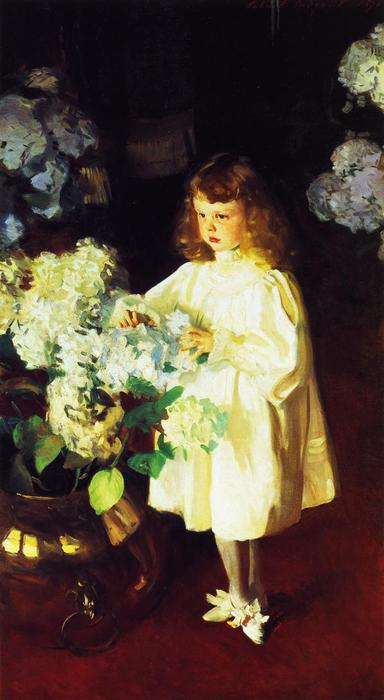
A breathtaking portrait by John Singer Sargent depicting Helen Sears, Sarah Choate Sears’ daughter, capturing her youthful innocence against a dramatic crimson backdrop. Explore the masterful realism and luminous color palette of this iconic masterpiece housed at Boston's Museum of Fine Arts.
A Portrait Steeped in Innocence: Exploring John Singer Sargent’s Helen Sears
The painting “Helen Sears” by John Singer Sargent stands as a testament to the artist's mastery of capturing fleeting moments of beauty and emotion—a hallmark of his oeuvre during the opulent Victorian era. Completed in 1895, this oil on canvas masterpiece resides within the Museum of Fine Arts in Boston, offering visitors an unparalleled glimpse into Sargent’s artistic process and his profound connection with his subject matter.
The Inspiration Behind the Canvas
Sargent's creative impetus stemmed from his friendship with Sarah Choate Sears, a celebrated photographer who herself possessed considerable artistic talent. Recognizing Sarah’s daughter, Helen—a mere six years old—as an embodiment of youthful charm and vulnerability, Sargent embarked on a project to immortalize this precious stage of life. The photograph taken by Sarah served as a crucial reference point, informing Sargent's compositional choices and bolstering his determination to convey the essence of childhood innocence.
Compositional Genius: Elevated Perspective and Silhouette
What immediately distinguishes “Helen Sears” is Sargent’s innovative use of perspective—a deliberate elevation that places Helen against a backdrop of deep crimson carpet. This technique isn’t merely stylistic; it serves to create a striking silhouette, emphasizing Helen's delicate form and highlighting the luminous quality of her dress and face. The tilted canvas adds dynamism to the scene, subtly disrupting conventional portraiture conventions and drawing the viewer’s eye towards the central figure.
Technique and Color Palette: Mastering Light and Texture
Sargent’s technical prowess is evident in his meticulous rendering of texture—particularly the creamy smoothness of Helen's skin tone contrasted against the velvety richness of her gown. He skillfully employs oil paint to achieve a remarkable level of luminosity, capturing the subtle interplay of light and shadow that defines Sargent’s signature style. The muted color palette—dominated by earthy hues and soft pastels—reflects the artist’s sensitivity to tonal nuances and contributes to the painting's overall atmosphere of tranquility and contemplation.
Symbolism Within Innocence: Flowers as Tokens of Childhood
Beyond its formal brilliance, “Helen Sears” resonates with symbolic significance. The flowers held delicately in Helen’s hands represent not only beauty but also the blossoming potential inherent in youth—a motif frequently explored by Victorian artists to convey ideals of purity and virtue. Their placement within the vase adds visual interest while reinforcing the painting's overarching theme of innocence and unspoiled joy.
A Legacy of Elegance: Sargent’s Enduring Influence
“Helen Sears” exemplifies Sargent’s enduring legacy as one of the most influential portrait painters of his time, securing its place among the treasures of American art history. Its captivating composition, masterful technique, and evocative symbolism continue to inspire artists and collectors alike—a testament to Sargent's ability to transcend mere representation and capture the very soul of his subjects. You can find high-quality reproductions at /en/art/show/art-8xxfr3-en/
- Artist: John Singer Sargent
- Year Created: 1895
- Location: Museum of Fine Arts, Boston