A Moment Suspended in Time
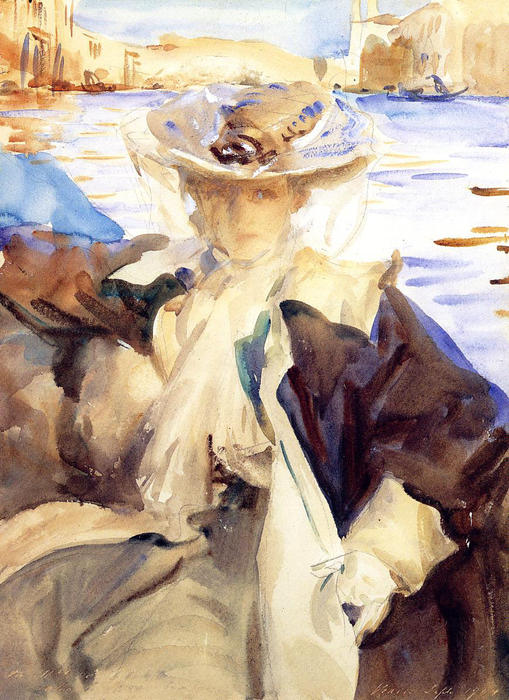
In the delicate, translucent layers of John Singer Sargent’s 1904 watercolor, "Jane de Glehn in a Gondola," we find much more than a mere portrait of a socialite; we encounter a profound meditation on the ephemeral nature of beauty. The painting captures Jane de Glehn, the celebrated American soprano, as she drifts through the sun-drenched waterways of Venice. There is an undeniable magic in how Sargent renders this scene, moving beyond simple documentation to evoke the very essence of a summer afternoon. As the gondola glides through the canal, the viewer is transported into the heart of the Gilded Age, witnessing a moment of quiet luxury and aristocratic grace that feels both intimately personal and timelessly universal.
The atmosphere of the piece is defined by a sense of diffused luminescence. Sargent, a master of light, utilizes the unique properties of watercolor to create a hazy, dreamlike quality where sunlight filters through lush foliage and dances upon the water's surface. The background, though subtly rendered with soft, verdant hues, suggests an expansive Venetian landscape, complete with distant gondolas that lend a sense of depth and life to the composition. This interplay of light and shadow does not merely illuminate the subject; it breathes life into the environment, making the air itself feel heavy with warmth and the scent of the lagoon.
Mastery of the Impressionist Brush
Technically, this work stands as a testament to Sargent’s extraordinary command over the Impressionist idiom. Eschewing the rigid boundaries of photographic realism, he employs short, broken brushstrokes that allow colors to blend optically in the eye of the beholder. This technique creates a shimmering, kinetic surface that mimics the rhythmic movement of the water and the flickering play of light. The way the pigments bleed into one another captures the fluidity of the canal, making the boat feel as though it is truly in motion.
The composition is masterfully balanced through an intentional use of asymmetry. By positioning Jane de Glehn slightly off-center, Sargent prevents the eye from resting too statically, instead guiding the viewer’s gaze across the canvas to explore the surrounding scenery. This subtle tension fosters a feeling of spontaneity, as if we have stumbled upon a private, fleeting second of repose. For the collector or interior designer, this dynamic arrangement ensures that the painting serves as a captivating focal point, capable of injecting movement and a sense of airy elegance into any sophisticated space.
An Invitation to Serenity
Beyond its technical brilliance, "Jane de Glehn in a Gondola" resonates on an emotional level through its themes of tranquility and femininity. The subject’s poised demeanor, draped in the soft textures of her attire, embodies a refined serenity that invites contemplation. There is a poetic melancholy present in the way Sargent captures such a fleeting moment—a reminder of the transient nature of experience and the beauty found in life's quietest intervals.
For those looking to adorn a home or gallery with art that inspires peace, this reproduction offers an unparalleled opportunity. It is a piece that does not demand attention through loud colors or jarring subjects, but rather earns it through subtle sophistication and emotional depth. Whether placed in a sunlit study or a grand living area, the painting brings with it the romantic spirit of Venice and the enduring legacy of one of history's greatest portraitists, making it an exquisite acquisition for any lover of fine art.