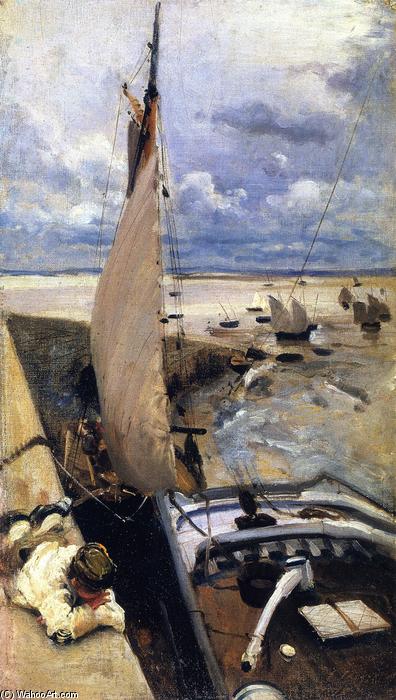
Low Tide at Cancale Harbor: A Moment Frozen in Impressionistic Light
John Singer Sargent’s “Low Tide at Cancale Harbor” isn't merely a depiction of a coastal scene; it’s an exquisitely crafted distillation of atmosphere and observation—a hallmark of Sargent’s distinctive artistic approach. Painted in 1877, this canvas captures the quiet drama unfolding along the Breton shoreline, offering viewers a glimpse into a bygone era defined by refined leisure and artistic experimentation. The painting's success lies not just in its visual beauty but also in its masterful execution, reflecting Sargent’s dedication to capturing fleeting impressions with remarkable accuracy.
- Subject Matter: The artwork portrays Cancale Harbor, a picturesque fishing village nestled on the coast of Brittany, France. Sargent skillfully renders the harbor's activity—boats bobbing gently in the low tide water and figures engaged in daily life—creating a scene brimming with palpable energy despite its tranquil appearance.
- Style: “Low Tide at Cancale Harbor” firmly establishes Sargent within the Impressionist movement. Unlike academic painting’s emphasis on meticulous detail and idealized forms, Impressionism prioritizes capturing light and color as perceived by the eye. Sargent achieves this goal through loose brushstrokes and vibrant hues, eschewing sharp outlines in favor of blending colors to convey a sense of immediacy and spontaneity.
- Technique: Sargent employed a technique known as alla prima—painting directly onto wet canvas without underpainting—allowing him to build up layers of color quickly and effectively. This method is evident in the textured surface of the painting, where brushstrokes coalesce to create luminous patches of pigment that shimmer with reflected light.
Historical Context: The late Victorian era witnessed a burgeoning interest in plein air painting—working outdoors directly from nature—fueled by advancements in pigments and varnishes. Sargent’s embrace of Impressionism coincided with this trend, aligning him with fellow artists like Claude Monet and Camille Pissarro who sought to revolutionize artistic representation. Cancale Harbor itself was undergoing transformation during this period, transitioning from a traditional fishing community to one increasingly influenced by tourism and the burgeoning Belle Époque culture.
Symbolism & Emotional Impact: Beyond its aesthetic qualities, “Low Tide at Cancale Harbor” speaks to broader themes of observation and perception. Sargent’s careful attention to detail—the subtle variations in color and texture—encourages viewers to contemplate the beauty inherent in everyday life. The painting evokes a feeling of serenity mingled with anticipation, mirroring the quiet grandeur of the Breton landscape and capturing the spirit of a moment suspended in time. It's a testament to Sargent’s ability to transform ordinary subjects into emotionally resonant artworks.
- Consider incorporating this artwork into interior design schemes that aim for understated elegance and coastal charm.
- Its luminous palette and textured surface would complement spaces bathed in natural light, enhancing their visual appeal.
- Reproductions of “Low Tide at Cancale Harbor” offer a beautiful way to bring a touch of Impressionistic artistry into any home.