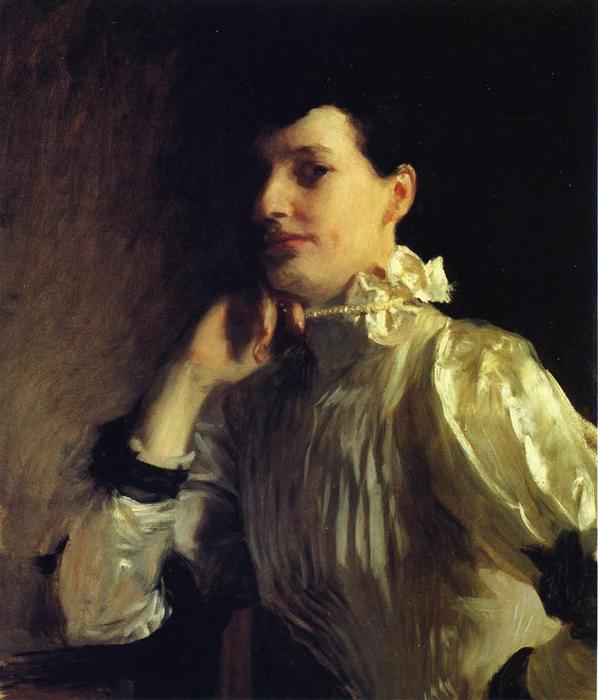
A Portrait of Refined Society: John Singer Sargent’s Mabel Marquand, Mrs. Henry Galbraith Ward
John Singer Sargent's "Mabel Marquand, Mrs. Henry Galbraith Ward," painted in 1893, isn’t merely a likeness; it’s a carefully constructed tableau of the late Victorian era’s opulent social landscape. This oil on canvas, measuring a modest 68 x 55 cm, currently resides within the Metropolitan Museum of Art, yet its impact resonates far beyond the walls of that institution. The painting captures Mabel Marquand, a woman whose name represented considerable influence and sophistication in American high society, seated with an air of quiet dignity. Sargent masterfully utilizes a dark background – a deliberate choice that serves to amplify the luminosity of her white gown and the subtle shimmer of her pearl necklace, instantly drawing the viewer’s eye to her face and the intricate details of her attire.
The Realist's Touch: Technique and Composition
Sargent’s signature style is powerfully evident in this portrait. He eschews romanticism or dramatic gesture, instead embracing a rigorous realism that meticulously renders every fold of fabric, the delicate curve of her hand resting on her chin, and the subtle play of light across her skin. The brushwork itself is remarkably controlled – short, precise strokes build up layers of color and texture, creating an illusion of depth and volume. Notice how he subtly suggests the weight of the chair beneath her, grounding her in a tangible reality while simultaneously conveying a sense of poised elegance. The careful attention to detail isn’t simply decorative; it's integral to the painting’s overall effect, reinforcing the impression of a woman accustomed to luxury and refined taste.
Symbolism and Social Context
“Mabel Marquand, Mrs. Henry Galbraith Ward” is deeply embedded within its historical context – the Gilded Age in America. The portrait speaks volumes about the social conventions of the time, where wealth and lineage were paramount. The white gown, a symbol of purity and status, combined with the pearl necklace, a traditional emblem of feminine adornment, immediately establishes Mabel Marquand’s position within this elite circle. The dark background can be interpreted as representing the shadows of societal expectations placed upon women of her era – a subtle acknowledgment of the constraints alongside the privilege she enjoyed. Sargent doesn't offer overt commentary, but through his skillful observation and rendering, he invites us to contemplate the complexities of social standing and female identity in the late 19th century.
Emotional Resonance: A Moment Frozen in Time
Despite its formal subject matter, the portrait possesses a remarkable emotional resonance. Mabel Marquand’s expression is not one of overt joy or sorrow, but rather a quiet contemplation – a sense of self-awareness and inner strength. Her gaze, directed slightly off-camera, suggests a thoughtful observer, perhaps reflecting on her place in the world. Sargent captures this subtle nuance with extraordinary skill, creating an image that feels remarkably intimate despite its formal presentation. It’s a portrait not just *of* a woman, but *as* a woman – embodying both grace and resilience within the confines of her social role. The painting invites us to consider the quiet dignity and unspoken narratives behind the polished facade of Victorian society.
For those seeking a high-quality reproduction of this iconic work, ArtsDot.com offers meticulously crafted handmade oil paintings that faithfully capture Sargent’s artistry. Own a piece of art history and bring the elegance of the Gilded Age into your home.