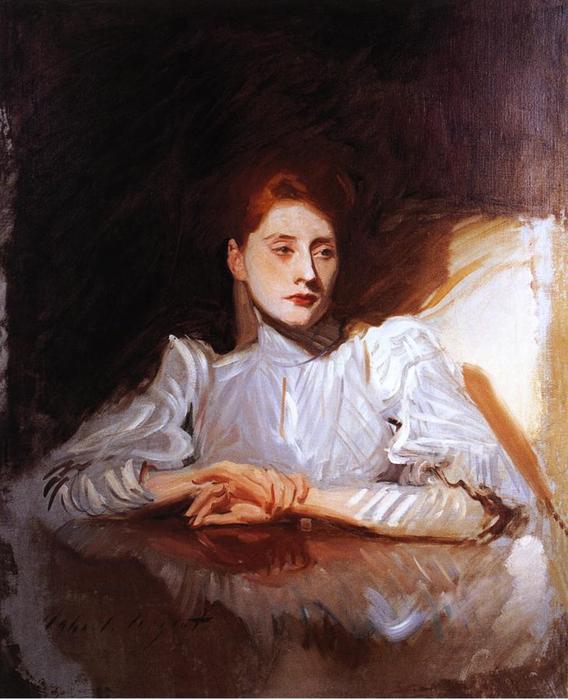
Madame Helleu by John Singer Sargent (1889): This captivating portrait captures the quiet dignity of Madame Helleu, seated at a window with clasped hands, rendered in Sargent’s masterful Realism style—a testament to his ability to convey emotion and nuance. Explore reproductions at ArtsDot.
Explore the art of John Singer Sargent! Discover iconic portraits like 'Madame X', Impressionistic landscapes & Gilded Age elegance from this American master.
A Portrait Steeped in Shadow and Grace: Examining John Singer Sargent’s Madame Helleu
The painting “Madame Helleu,” completed by John Singer Sargent in 1889, transcends mere representation; it embodies the spirit of its era—the opulent Belle Époque—and stands as a masterful achievement of portraiture. More than just capturing a likeness, Sargent delves into psychological depth, presenting a woman bathed in muted tones against a backdrop that speaks volumes about mood and atmosphere. This essay explores the intricacies of the artwork’s composition, stylistic choices, historical significance, and enduring emotional resonance.
Composition and Technique: Mastering Light and Texture
Sargent's technique is characterized by meticulous observation and an unwavering commitment to realism blended with Impressionistic influences. He employs a palette dominated by cool blues and greens—a deliberate decision that contributes to the painting’s pervasive sense of melancholy. The artist skillfully renders textures, particularly in Madame Helleu’s dress and the windowpane reflections, conveying a palpable physicality absent from many portraits of the time. Sargent's brushstrokes are delicate yet decisive, layering pigment to build up form and capturing subtle nuances of light—a hallmark of his style that distinguishes him from more conventional artists. The placement of Madame Helleu at the table, positioned before the window, is crucial to conveying a feeling of isolation and contemplation.
Historical Context: Echoes of Victorian Morality Amidst Artistic Innovation
“Madame Helleu” emerged during a period of profound artistic transformation—the Impressionist movement was challenging academic conventions and redefining notions of beauty. Sargent skillfully navigated this evolving landscape, synthesizing Impressionistic techniques with the formal rigor demanded by aristocratic clientele. The subject herself represents a figure emblematic of Victorian society: Madame Helleu, a businesswoman and philanthropist, embodies both social responsibility and feminine grace. Her posture exudes composure, reflecting the values prized during her time—a quiet dignity that contrasts sharply with the flamboyant excesses prevalent in other artistic circles. The painting captures a moment frozen in time, mirroring the anxieties surrounding societal change and the desire for stability amidst uncertainty.
Symbolism: Shadows of Emotion and Reflections of Inner Life
Beyond its technical brilliance, “Madame Helleu” is laden with symbolic meaning. The darkened room symbolizes introspection and perhaps unspoken sorrow—a subtle suggestion that transcends Madame Helleu’s outward appearance. The windowpane reflections offer a glimpse into her inner life, mirroring the complexities of her emotions. Sargent's masterful use of chiaroscuro—the dramatic interplay between light and shadow—amplifies these symbolic resonances, creating an atmosphere charged with emotion. The woman’s clasped hands convey both vulnerability and strength—a gesture that speaks to the enduring human desire for connection and resilience.
Emotional Impact: A Timeless Portrait of Quiet Elegance
Ultimately, “Madame Helleu” succeeds in evoking a profound emotional response from the viewer. Its understated beauty—the muted colors, the delicate brushstrokes—invite contemplation rather than immediate gratification. The painting’s melancholic mood captures the essence of human experience—the awareness of mortality and the yearning for solace—themes that resonate across generations. Sargent's ability to convey psychological depth elevates “Madame Helleu” beyond a mere likeness; it becomes an enduring testament to the power of art to illuminate the human condition. It remains a captivating image, demonstrating Sargent’s unparalleled skill in capturing not just what is seen but also what is felt—a timeless portrait that continues to inspire admiration and provoke thought.