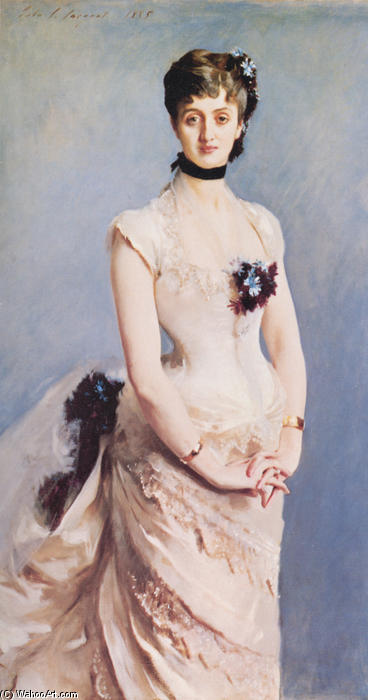
Capturing the luminous elegance of the Gilded Age, John Singer Sargent's 1885 portrait Madame Paul Poirson blends Impressionistic realism with a serene blue palette, inviting you to experience this masterpiece of fine art.
A Vision of Gilded Age Elegance
In the luminous realm of late Victorian portraiture, few works capture the ephemeral grace of a single moment as poignantly as John Singer Sargent’s Madame Paul Poirson. Completed in 1885, this masterpiece serves as a breathtaking window into an era defined by opulence, poise, and a refined social grace. The portrait presents a woman of striking presence, her elongated figure captured in a three-quarter view that suggests a spontaneous encounter. There is an enchanting sense of immediacy in her posture; she appears to have just turned toward the viewer, her inquisitive gaze momentarily arresting her movement. This lifelike quality transforms the canvas from a static representation into a living breathing encounter, inviting anyone who views it to step into the serene, aristocratic atmosphere of the nineteenth century.
The composition is a masterclass in balance and color theory, designed to captivate the eye through subtle contrasts. Sargent utilizes a cool, icy blue background that provides a profound sense of depth, acting as a tranquil stage for the subject to emerge. Against this serene backdrop, the brilliant whites and creams of Madame Poirson’s gown shimmer with an almost pearlescent light. The interplay between the delicate lace detailing of her collar and the rich, heavy textures of her attire creates a tactile experience for the viewer. For the discerning collector or interior designer, this painting offers a sophisticated focal point, bringing a sense of calm, classical luxury to any curated space.
The Mastery of the Sargent Stroke
To behold this work is to witness the technical brilliance of an artist at the height of his powers. Sargent was a pioneer of the alla prima technique, a method of painting directly onto wet canvas that allows for a spontaneous, fluid application of pigment. This approach is evident in the way light dances across the fabric of the gown and the soft, realistic rendering of Madame Poirion’s skin tones. Through the meticulous layering of thin glazes, Sargent achieved an ethereal luminosity that makes the subject appear to glow from within. His brushwork is a beautiful paradox: it is loose and impressionistic enough to convey movement and the fleeting nature of light, yet controlled enough to render the intricate textures of lace and silk with breathtaking precision.
Beyond the mere technical execution, the painting carries a profound emotional weight. There is a certain detached, aristocratic aloofness in Madame Poirson’s expression that speaks to the social codes of her time, yet there is also an underlying warmth found in the softness of her features. This duality—the tension between public persona and private soul—is what makes Sargent’s portraiture so enduringly relevant. Whether displayed in a grand salon or a contemporary study, a high-quality reproduction of this work brings with it a legacy of artistic excellence and a timeless aesthetic that transcends generations.