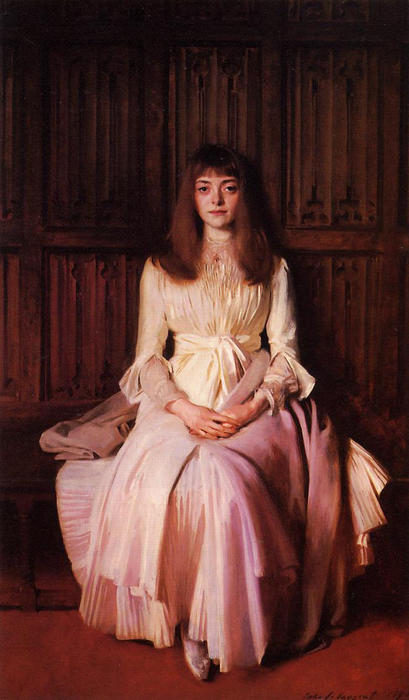
A captivating portrait by John Singer Sargent depicting a woman seated on a bench with serene composure, dressed in white and adorned with flowing hair. Executed in oil on canvas (190 x 114 cm), the painting captures exquisite realism and embodies the artist's masterful skill in conveying subtle emotion.
A Vision of Belle Époque Grace
In the quietude of John Singer Sargent’s 1890 masterpiece, Miss Elsie Palmer, we find ourselves transported to the heart of the Belle Époque—an era defined by a shimmering optimism and an unparalleled fascination with aesthetic beauty. This portrait is far more than a mere likeness of a young woman; it is a meticulously composed meditation on light, posture, and the subtle psychological nuances that define the human experience. As the viewer approaches this canvas, they are immediately struck by the sense of profound stillness. Seated upon a bench, Elsie Palmer exists in a moment of quiet contemplation, her presence anchored by a pyramidal composition that lends the work a classical stability while simultaneously drawing the eye toward the luminous focal point of her face.
Sargent, a master of capturing the fleeting essence of high society, utilizes his signature technique to breathe life into the fabric and flesh of his subject. Through the delicate application of oil on canvas, he achieves an unprecedented level of realism. His brushstrokes are remarkably fluid, blending seamlessly to create an illusion of soft, ambient light that seems to dance across the contours of the sitter's skin. By employing sophisticated glazing techniques—applying thin, translucent layers of pigment—Sargent builds a sense of internal luminosity within the painting. This layering process allows the white drapery of her dress to catch the light with a pearlescent quality, making the subject appear as though she is radiating a soft, inner glow from within the frame.
The Intersection of Realism and Emotion
Beyond the technical bravado lies a deeper exploration of psychological realism, a movement that was beginning to reshape the Victorian artistic landscape. Sargent deliberately moved away from the stiff, overly idealized portraiture of previous generations. Instead, he opted for a pose that conveys an understated elegance and a sense of introspective depth. There is a palpable intimacy in the way Elsie Palmer’s torso subtly angles toward the viewer, creating a dynamic visual relationship that invites us into her private world. The background, featuring the textured warmth of a wooden wall and the quiet presence of nearby chairs, is masterfully flattened to ensure that nothing distracts from the emotional weight of the subject's expression.
For the discerning collector or interior designer, Miss Elsie Palmer offers more than just visual splendor; it provides an atmosphere of timeless sophistication. The painting’s palette, dominated by the purity of white and the earthy tones of the setting, allows it to integrate seamlessly into a variety of luxurious environments, from classical estates to modern, minimalist galleries. It serves as a centerpiece that evokes a sense of history and prestige, acting as a window into a lost world of elegance. To possess a high-quality reproduction of this work is to bring a piece of the Gilded Age into the contemporary home—a permanent reminder of the beauty found in quiet moments and the enduring power of masterful artistry.