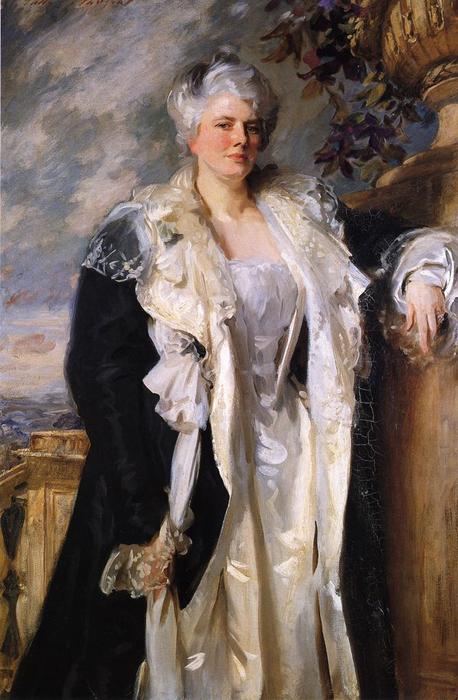
Admire John Singer Sargent's exquisite portrait of Constance Wynne Roberts, 'Mrs. Ernest Hills,' showcasing masterful realism and capturing the grace of Edwardian society within its elegant composition.
Explore the art of John Singer Sargent! Discover iconic portraits like 'Madame X', Impressionistic landscapes & Gilded Age elegance from this American master.
A Portrait Steeped in Elegance: Exploring John Singer Sargent’s “Mrs. Ernest Hills”
The painting "Mrs. Ernest Hills," executed by John Singer Sargent in 1909, stands as a quintessential example of Impressionistic Realism—a stylistic fusion that captures both the fleeting beauty of light and shadow while maintaining meticulous attention to detail. Currently residing within the Bradford Art Galleries and Museums in England, this oil on canvas masterpiece continues to fascinate viewers with its serene depiction of Constance Malanie Wynne Roberts, wife of Ernest Hills, a prominent British financier. Sargent’s masterful handling of pigment and brushwork elevates the portrait beyond mere likeness, transforming it into an embodiment of refined social grace and inner contemplation.
Composition and Style: Light, Texture, and Subtle Movement
Sargent's compositional choices are deliberate and contribute significantly to the painting’s overall impact. The subject is positioned centrally against a backdrop of muted greens and browns—a carefully considered palette that evokes the tranquility of an English country estate. Two potted plants flank Mrs. Hills, providing visual anchors and subtly reinforcing the theme of domestic harmony. However, Sargent doesn't simply present stillness; he employs delicate brushstrokes to create an illusion of movement within the drapery folds and hair strands, hinting at a hidden dynamism beneath the surface composure. The artist’s masterful use of chiaroscuro—the interplay between light and dark—is particularly noteworthy. Light spills across Mrs. Hills’ face and dress, illuminating her features with warmth and inviting the viewer's gaze inward. This technique isn’t merely decorative; it serves to sculpt the form and imbue the portrait with a palpable sense of depth and dimensionality.
Technique: Precision Meets Impressionistic Flair
Sargent’s technical prowess is undeniable. He meticulously blended pigments to achieve subtle tonal variations, capturing the nuances of skin texture and fabric weave with remarkable accuracy—a hallmark of Realism. Yet, he simultaneously embraced Impressionistic principles by applying loose brushstrokes that capture the ephemeral qualities of light and atmosphere. This duality exemplifies Sargent's genius: he achieved photographic realism while retaining an artistic sensibility rooted in Impressionism’s exploration of subjective experience. The artist employed glazing techniques – applying thin layers of translucent paint over underlying colors – to build up luminosity and create a luminous surface finish, enhancing the painting’s ethereal beauty.
Historical Context: The Dawn of Modern Portraiture
“Mrs. Ernest Hills” emerged during a period of significant artistic innovation—the early 20th century—marking a decisive shift away from academic conventions toward more expressive forms of representation. Sargent's work aligns with the broader movement towards capturing psychological portraits, prioritizing inner emotion and character alongside external appearance. The painting reflects the social aspirations of its time, portraying Mrs. Hills as an embodiment of Victorian ideals – femininity, refinement, and domestic virtue—albeit filtered through the lens of Impressionistic observation. It speaks to a fascination with documenting the subtleties of human experience within a rapidly changing cultural landscape.
Symbolism: Hints of Inner Life
Beyond its formal beauty, “Mrs. Ernest Hills” possesses subtle symbolic resonance. The choice of plants – specifically ferns and ivy – symbolizes resilience and growth amidst adversity—a poignant reflection of Constance Wynne Roberts’ life as a woman navigating the complexities of Victorian society. Furthermore, the gaze of Mrs. Hills directs slightly off-center, suggesting introspection and conveying a sense of quiet contemplation. These understated gestures invite viewers to consider not just what is seen but also what lies beneath the surface – hinting at the unspoken emotions and inner thoughts that define human existence.
Emotional Impact: Capturing Graceful Tranquility
Ultimately, “Mrs. Ernest Hills” succeeds in evoking a profound feeling of tranquility and elegance. The painting’s luminous palette and masterful brushwork transport us to a moment of serene beauty—a testament to Sargent's ability to capture the essence of his subject and convey an enduring sense of gracefulness. It remains a captivating portrait not only for its visual splendor but also for its capacity to resonate with viewers on an emotional level, reminding us of the timeless allure of Impressionistic Realism and John Singer Sargent’s unparalleled artistic vision.