A Study in Quiet Intensity: John Singer Sargent’s Portrait of Olimpio Fusco
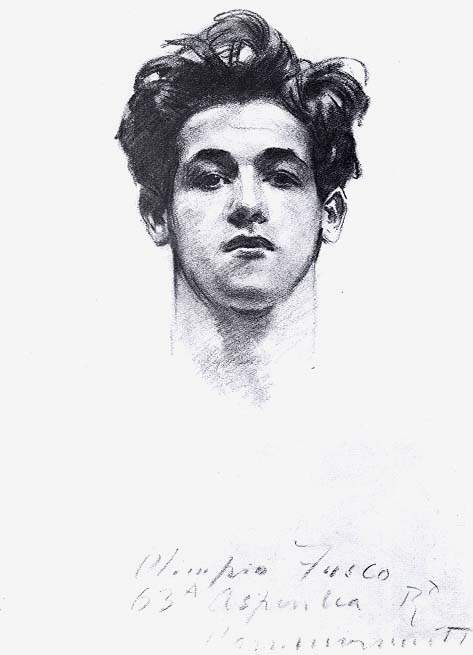
The charcoal portrait by John Singer Sargent, titled “Olimpio Fusco,” transcends mere representation; it embodies the meticulous observation and masterful technique characteristic of Sargent's oeuvre during the height of his artistic career. Executed sometime between 1886 and 1887, this intimate depiction captures a young man with remarkable sensitivity—a testament to Sargent’s ability to distill complex emotion into a deceptively simple visual form. The photograph reveals an arresting composition: tightly cropped, centering Fusco from the shoulders upwards, prioritizing the face as the focal point of attention. Lines dominate the image, skillfully delineating contours and sculpting volume through dense shading – a technique deeply rooted in academic portraiture traditions. Sargent’s meticulous approach is evident in the painstaking layering of charcoal strokes, creating an illusion of palpable texture that mimics the roughness of skin and hair, mirroring the subtle nuances of Fusco's expression.
- Style: Realism – Sargent championed a style prioritizing accurate depiction of form and detail, rejecting Impressionistic tendencies toward capturing fleeting moments of light and color.
- Technique: Dry Media – Primarily charcoal, Sargent employed hatching and stippling techniques to build up tonal values, achieving remarkable depth and luminosity without resorting to glazing or blending.
- Historical Context: The portrait emerged during Sargent’s prolific period in Paris, where he established himself as a leading figure within the European art scene. This era witnessed an explosion of artistic innovation fueled by influences from Impressionism and Japonisme—movements that challenged conventional aesthetic standards.
The artist's masterful use of light – emanating from above and slightly to the side – casts shadows that accentuate facial planes, enhancing the portrait’s three-dimensional quality. While limited perspective contributes to the intimacy of the image, it successfully conveys a sense of profound observation. Fusco’s gaze is direct yet contemplative, hinting at an inner life beyond what is immediately visible—a characteristic feature of Sargent's portraits which aimed to capture not just physical appearance but also psychological character. The absence of overt symbolic elements underscores the portrait’s focus on pure aesthetic beauty and its ability to evoke a feeling of quiet contemplation.
Interior Designers Note: Sargent’s palette – predominantly muted browns and grays—would lend itself beautifully to creating serene, sophisticated spaces. Consider pairing reproductions with complementary textures like linen or velvet to amplify the portrait's understated elegance.