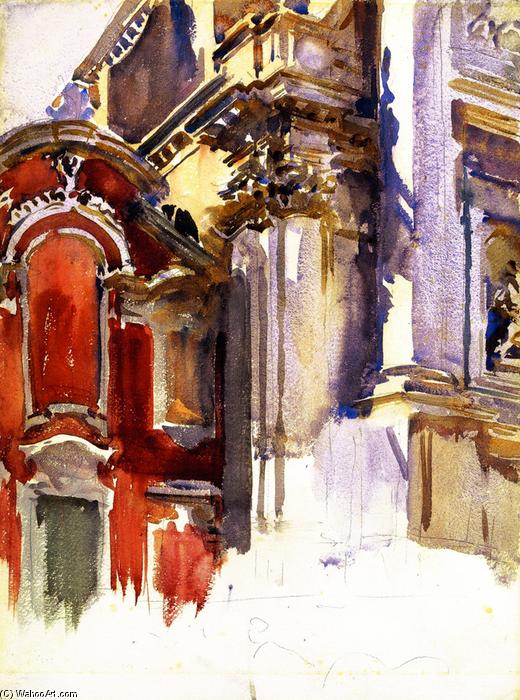
John Singer Sargent’s unfinished watercolor, "San Stae, Venice," captures the timeless beauty of a Venetian cityscape with its red-trimmed building and arched entryway, showcasing the artist's signature style and evoking a sense of historical elegance – discover this captivating artwork.
San Stae, Venice (unfinished): A Glimpse of Timeless Elegance
John Singer Sargent’s “San Stae, Venice (unfinished)” is more than just a watercolor depiction of a Venetian building; it's a poignant meditation on light, atmosphere, and the fleeting beauty of a bygone era. Completed in 1913, this work captures a moment frozen in time – a humble church, the San Stae, bathed in the soft, diffused glow characteristic of the Venetian lagoon. The painting’s unfinished state adds to its allure, inviting the viewer to participate in the artist's creative process and contemplate the inherent impermanence of artistic endeavor.
- Subject Matter: The primary subject is the San Stae church, a significant landmark in Venice, recognizable by its distinctive red-trimmed façade and grand archway. Sargent skillfully renders the architectural details, emphasizing the building’s solidity against the ethereal backdrop.
- Composition: The composition is deceptively simple, yet profoundly effective. Two figures – one standing near the left side of the painting and another further back on the right – introduce a human element, grounding the scene and suggesting a narrative of observation and contemplation.
- Technique: Sargent’s mastery of watercolor is immediately apparent. He employs delicate washes to create a luminous effect, capturing the play of light and shadow with remarkable precision. The loose brushwork contributes to the painting's atmospheric quality, evoking the hazy atmosphere of Venice.
A Window into the Gilded Age
“San Stae, Venice (unfinished)” is firmly rooted in the context of Sargent’s career during the Gilded Age. This period witnessed a surge in artistic patronage and a fascination with luxury and elegance – themes that are powerfully reflected in Sargent's work. His frequent travels throughout Europe, particularly to Italy, provided him with an unparalleled understanding of classical architecture and the nuances of light and color. The painting embodies this knowledge, showcasing his ability to translate complex visual information into a harmonious and emotionally resonant composition.
- Historical Context: Completed in 1913, just before the outbreak of World War I, the painting offers a poignant glimpse into a Europe on the cusp of dramatic change. The serene beauty of Venice contrasts sharply with the impending turmoil, adding another layer of meaning to the work.
- Sargent's Style: This piece exemplifies Sargent’s signature style – characterized by its loose brushwork, atmospheric perspective, and ability to capture fleeting moments of beauty. It shares similarities with his later Venetian landscapes, but possesses a greater sense of immediacy and spontaneity due to its unfinished state.
Symbolism and Emotional Resonance
Beyond its technical brilliance, “San Stae, Venice (unfinished)” is imbued with symbolic resonance. The clock hanging on the wall – a recurring motif in Sargent’s work – serves as a reminder of the passage of time and the inevitability of change. The two figures, seemingly lost in contemplation, invite viewers to reflect on their own place within the grand sweep of history. The overall mood is one of quiet melancholy, tempered by the enduring beauty of Venice.
- Light and Atmosphere: Sargent’s masterful use of light creates a sense of depth and atmosphere, transporting the viewer to the heart of the Venetian lagoon.
- Human Presence: The inclusion of human figures adds a layer of narrative complexity, prompting questions about observation, perception, and the relationship between art and life.
A Statement for Your Space
A hand-painted reproduction of “San Stae, Venice (unfinished)” offers an exceptional opportunity to bring a touch of timeless elegance into any interior space. The painting’s rich colors, intricate details, and evocative atmosphere will undoubtedly become a focal point, sparking conversation and inspiring contemplation. Whether adorning a formal salon or a more casual living area, this artwork is sure to elevate the aesthetic of your home.