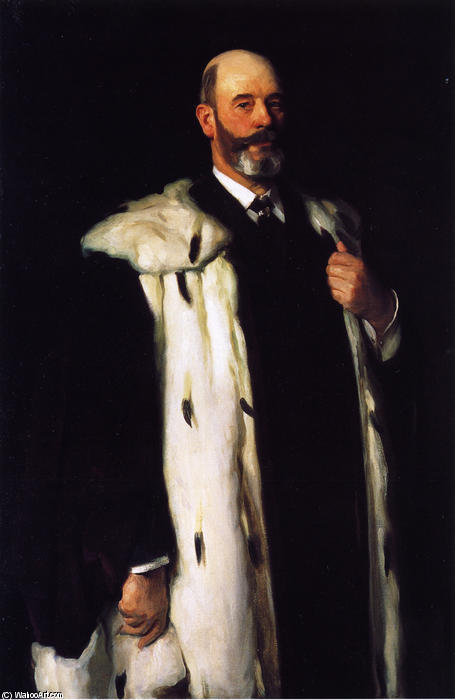
Experience the timeless elegance of John Singer Sargent's "Sir David Richmond," a masterful portrait capturing aristocratic sophistication with bold brushstrokes and meticulous detail.
Explore the art of John Singer Sargent! Discover iconic portraits like 'Madame X', Impressionistic landscapes & Gilded Age elegance from this American master.
Explore the Hunterian Museum & Art Gallery's diverse collections – from ancient Egypt to zoology & art, spanning centuries of scientific and artistic discovery.
A Portrait of Distinction: Exploring John Singer Sargent’s ‘Sir David Richmond’
The painting “Sir David Richmond,” executed in 1899 by the celebrated American artist John Singer Sargent, stands as an emblem of Impressionistic realism—a rare confluence of stylistic innovation and meticulous observation. Currently residing within the Glasgow Art Gallery and Museum, this monumental canvas (147 x 96 cm) transcends mere depiction; it captures a moment of aristocratic repose, imbued with layers of social commentary and artistic brilliance that continue to resonate today.
The Artist’s Vision: Sargent's Embrace of Impressionistic Realism
Sargent’s artistic trajectory was marked by an unwavering commitment to portraying the human figure with unparalleled sensitivity—a pursuit fueled by his formative years spent absorbing European art history firsthand. Rejecting the rigid conventions of academic painting, he championed Impressionism’s embrace of fleeting light and color, prioritizing subjective experience over photographic accuracy. Yet, unlike many Impressionists who sought to capture atmospheric effects above all else, Sargent meticulously rendered Sir David Richmond's anatomy and drapery with astonishing precision—a testament to his mastery of technique and a deliberate defiance of stylistic dogma. This duality – Impressionistic brushwork tempered by anatomical realism – distinguishes “Sir David Richmond” as a singularly compelling work.
Technique and Composition: Layers of Light and Texture
Sargent’s masterful application of oil paint is immediately apparent upon close inspection. Bold, confident strokes cascade across the canvas, creating a palpable sense of movement despite the stillness of the subject. The artist skillfully manipulated tonal variations to sculpt Sir David Richmond's form—emphasizing musculature and conveying an impression of dignified solidity. Furthermore, Sargent’s meticulous attention to detail extends beyond anatomical rendering; he painstakingly recreated the textures of the fur coat and the subtle folds of Richmond’s clothing, achieving a remarkable level of tactile realism. The composition itself is carefully balanced—the figure positioned centrally against a muted background that serves to heighten his presence and underscore the formality of the setting.
Historical Context: Victorian Society Under Scrutiny
“Sir David Richmond” emerged during the twilight years of the Victorian era—a period characterized by rigid social hierarchies and an obsession with appearances. Sargent’s portrayal of Sir David Richmond reflects this societal preoccupation, presenting him as a figure of impeccable status and cultivated refinement. However, beneath the veneer of aristocratic grandeur lies a subtle critique of Victorian morality—the subject's gaze directs towards the viewer, inviting contemplation on themes of power, perception, and social responsibility. The painting’s placement within the Glasgow Art Gallery underscores its significance as a cornerstone of British art history—a symbol of artistic excellence during a transformative epoch.
Symbolism and Emotional Resonance: Capturing Inner Dignity
The fur coat draped over Sir David Richmond's shoulders serves as more than mere decorative element; it symbolizes wealth, status, and perhaps even a degree of emotional detachment. The subject’s gaze—direct yet contemplative—communicates an inner dignity—a quiet confidence that transcends outward appearances. Sargent’s ability to convey emotion through subtle facial expressions is remarkable—capturing the essence of human experience with understated grace. Ultimately, “Sir David Richmond” invites viewers to engage in a dialogue about identity, ambition, and the enduring power of art to illuminate the complexities of human psychology.
Conclusion: An Enduring Legacy of Impressionistic Brilliance
John Singer Sargent’s “Sir David Richmond” remains an extraordinary achievement—a testament to his artistic vision and technical prowess. Its masterful blend of Impressionistic technique and anatomical realism secures its place as a seminal work within British art history—inspiring admiration for generations of artists and collectors alike. The painting's enduring appeal lies in its capacity to transcend time, prompting viewers to contemplate profound questions about human nature and the role of art in shaping our understanding of the world.