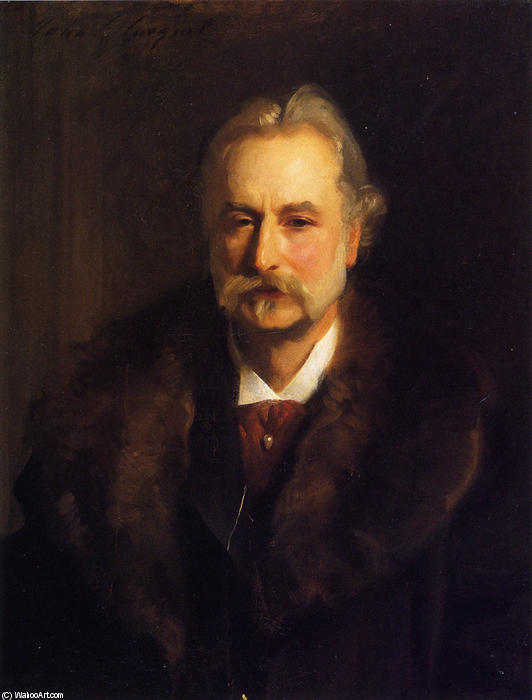
John Singer Sargent's 'Sir George Lewis,' painted in 1896, captures the refined elegance of Edwardian society with meticulous detail—a stunning portrait housed at the Allen County Museum.
Explore the art of John Singer Sargent! Discover iconic portraits like 'Madame X', Impressionistic landscapes & Gilded Age elegance from this American master.
A Portrait Steeped in Elegance: John Singer Sargent’s Sir George Lewis
John Singer Sargent, a titan of portraiture whose canvases captured the spirit of his era with unparalleled grace and precision, gifted us ‘Sir George Lewis,’ completed in 1896. This monumental oil-on-canvas—measuring 80 x 59 cm—isn’t merely an image; it's a distillation of Victorian refinement, meticulously rendered by one of the most celebrated artists of his time. The Allen County Museum and Historical Society proudly houses this masterpiece, ensuring its legacy continues to inspire admiration for decades to come.
The Subject: Embodiment of Distinction
The sitter, Sir George Lewis—a gentleman of considerable stature—is presented with an unwavering gaze that speaks volumes about confidence and composure. Sargent’s masterful observation captures not just physical likeness but also the subtle nuances of personality – a hint of melancholy beneath the surface of dignified bearing. He wears the uniform attire expected of his social standing: a dark suit accented by a crisp white shirt and tie, reflecting the formality prevalent in aristocratic circles during the late nineteenth century. The meticulous detailing extends to every crease of fabric and strand of hair, demonstrating Sargent’s unwavering commitment to realism.
Stylistic Realism: Capturing Essence Through Accuracy
Sargent's artistic approach aligns perfectly with the tenets of Realism—a movement that rejected romantic idealism in favor of unflinching depictions of everyday life. Unlike Impressionists who sought to convey fleeting impressions of light and color, Sargent prioritized capturing the essence of his subject through painstaking accuracy. This technique allows for a profound connection between viewer and artwork, fostering an appreciation for the tangible qualities of form and texture. The dark background serves as a dramatic foil to the gentleman’s attire, directing the eye toward his face—the focal point of the composition—where Sargent expertly portrays expressions of quiet contemplation.
Technique: Layers of Light and Shadow
The painting's surface is characterized by subtle gradations of light and shadow—a hallmark of Sargent’s technique—that imbue the portrait with depth and dimensionality. He employs glazing—applying thin layers of translucent oil paint over previous coats—to achieve luminous effects while maintaining tonal control. This meticulous layering process reveals an astonishing level of detail, capturing the interplay of light reflecting off surfaces like polished leather and silk. Furthermore, Sargent’s masterful blending ensures that transitions between tones are seamless, creating a harmonious visual experience for the observer.
Historical Context: Victorian Society Under Scrutiny
‘Sir George Lewis’ emerges from the crucible of Victorian society—a period marked by rigid social hierarchies and an obsession with appearances. Sargent deftly portrays this cultural milieu, reflecting the values and anxieties prevalent during his time. The gentleman's attire symbolizes status and wealth—a visual shorthand for conveying power within a stratified social order. Simultaneously, the portrait serves as a commentary on the psychological complexities of aristocratic life—suggesting that beneath the veneer of grandeur lies a profound awareness of mortality and vulnerability.
Emotional Resonance: A Moment Frozen in Time
Ultimately, ‘Sir George Lewis’ transcends mere representation; it evokes an emotional response within the viewer. The sitter's gaze invites contemplation—challenging us to consider his inner life alongside his outward persona. Sargent succeeds in conveying a sense of dignified serenity—a quiet triumph over adversity—that lingers long after viewing the artwork concludes. It stands as a timeless testament to the enduring power of portraiture—capable of capturing not only likeness but also the intangible spirit of its subject, securing its place among the greatest achievements of artistic endeavor.