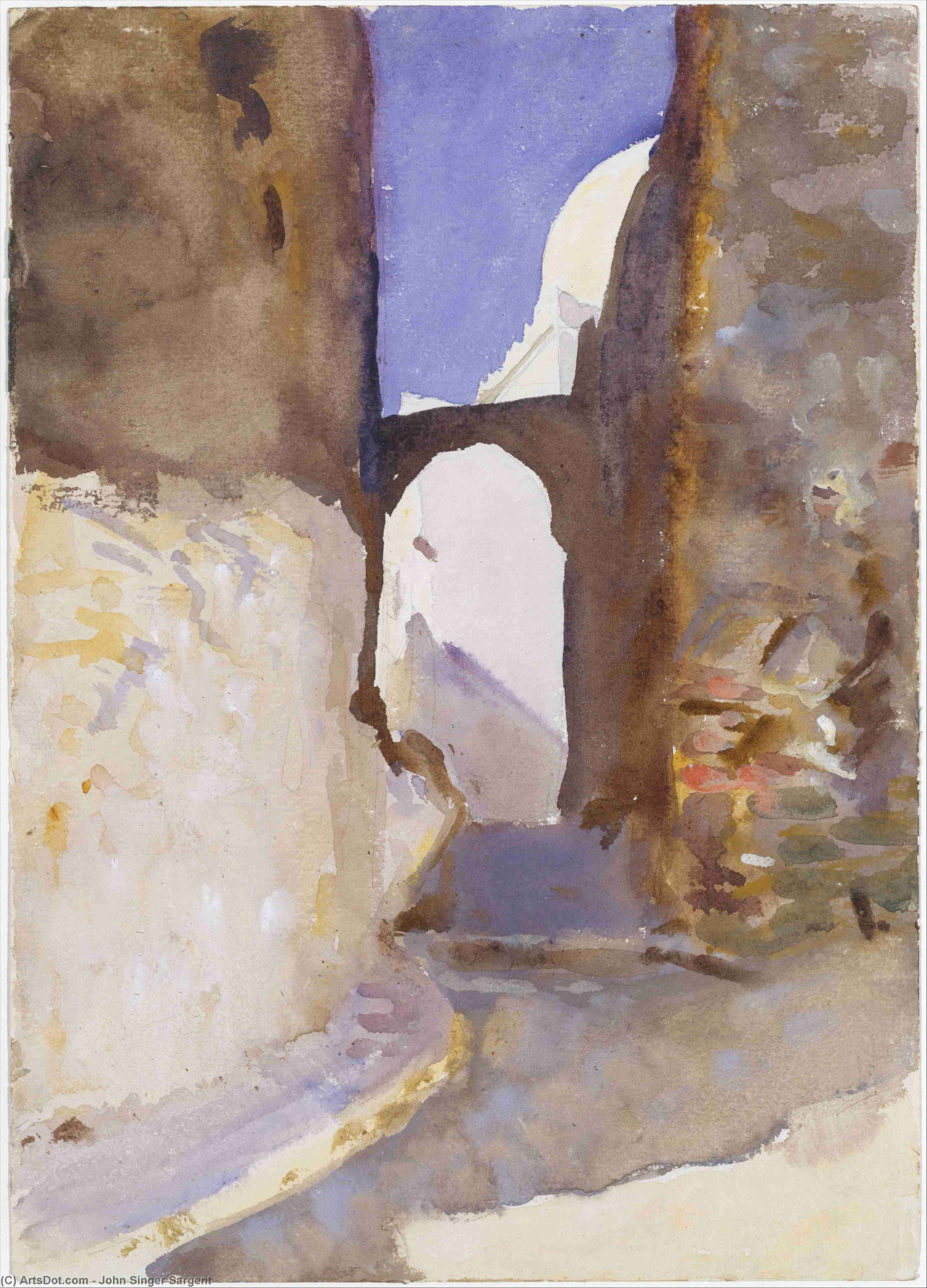
Watercolor depiction of Tangier's streetscape featuring a bridge and two figures alongside a horse; exemplifies Sargent’s masterful use of light and color, capturing the vibrancy of Moroccan urban life.
Explore the art of John Singer Sargent! Discover iconic portraits like 'Madame X', Impressionistic landscapes & Gilded Age elegance from this American master.
A Moment Captured in Moroccan Light: John Singer Sargent’s Street, Tangier
The painting “Street, Tangier,” by John Singer Sargent, isn't merely a depiction of a Moroccan cityscape; it’s an exquisitely rendered distillation of atmosphere and observation—a testament to Sargent’s unparalleled ability to translate fleeting impressions onto canvas. Created in 1895 during his prolific European travels, this watercolor captures the vibrant pulse of Tangier’s Medina, transporting viewers back to a period defined by artistic experimentation and social grandeur.
Style and Technique: Watercolor's Delicate Embrace
Sargent’s masterful use of watercolor is immediately apparent. Unlike bolder oil paints that strive for immediate impact, watercolor allows for subtle gradations of color and luminosity—a technique perfectly suited to conveying the diffused sunlight filtering through the arched bridges and buildings of Tangier. The artist employs a delicate layering process, applying washes of pigment in thin glazes that build upon each other over time, resulting in an ethereal quality that captures the hazy brilliance characteristic of Moroccan summers. Notice how Sargent skillfully blends graphite accents—primarily used for outlining architectural details—to anchor the composition while maintaining the watercolor’s luminous core. This careful balance exemplifies Sargent's artistic philosophy: to capture not just what is seen but also *how* it feels.
Historical Context: The Belle Époque and Artistic Innovation
“Street, Tangier” emerged during the Belle Époque—the “Beautiful Era”—a period of optimism and cultural flourishing in Europe following the Franco-Prussian War. Sargent was at the forefront of Impressionist and Post-Impressionist developments, alongside artists like Monet and Cézanne, pushing boundaries in terms of artistic expression. The painting reflects the broader fascination with capturing transient moments—the interplay of light and shadow, the movement of figures—a hallmark of the era’s aesthetic sensibilities. Furthermore, Tangier itself held a unique position as a crossroads between Europe and North Africa, attracting artists, writers, and intellectuals eager to experience its exotic allure. Sargent's decision to portray this cosmopolitan scene underscores the artistic spirit of his time.
Symbolism: Bridging Cultures, Embracing Movement
Beyond its technical brilliance, “Street, Tangier” resonates with symbolic significance. The bridge itself represents connection—the passage between cultures and continents—a visual metaphor for the complexities of the Belle Époque’s global landscape. The two figures strolling along the street embody human presence amidst urban grandeur, inviting contemplation on themes of leisure and observation. Equally important is the horse—positioned prominently at the edge of the frame—suggesting dynamism and movement, mirroring the energy of Tangier's bustling Medina. Sargent’s careful placement of these elements contributes to a richer narrative experience for the viewer.
Emotional Impact: A Fragile Beauty Preserved
Ultimately, “Street, Tangier” evokes a profound sense of tranquility mingled with melancholy—a recognition of beauty’s ephemerality. The muted palette and soft brushstrokes convey an atmosphere of stillness, capturing the quiet dignity of everyday life in a captivating setting. Yet, there's also an underlying awareness of time passing, reflected in the subtle blurring of edges and the diffused light. This delicate balance encapsulates Sargent’s artistic vision: to distill emotion into visual form—to transform fleeting impressions into enduring images that resonate with viewers long after they have gazed upon them. It remains a stunning example of Impressionist technique and a poignant reminder of a bygone era, beautifully preserved on paper.