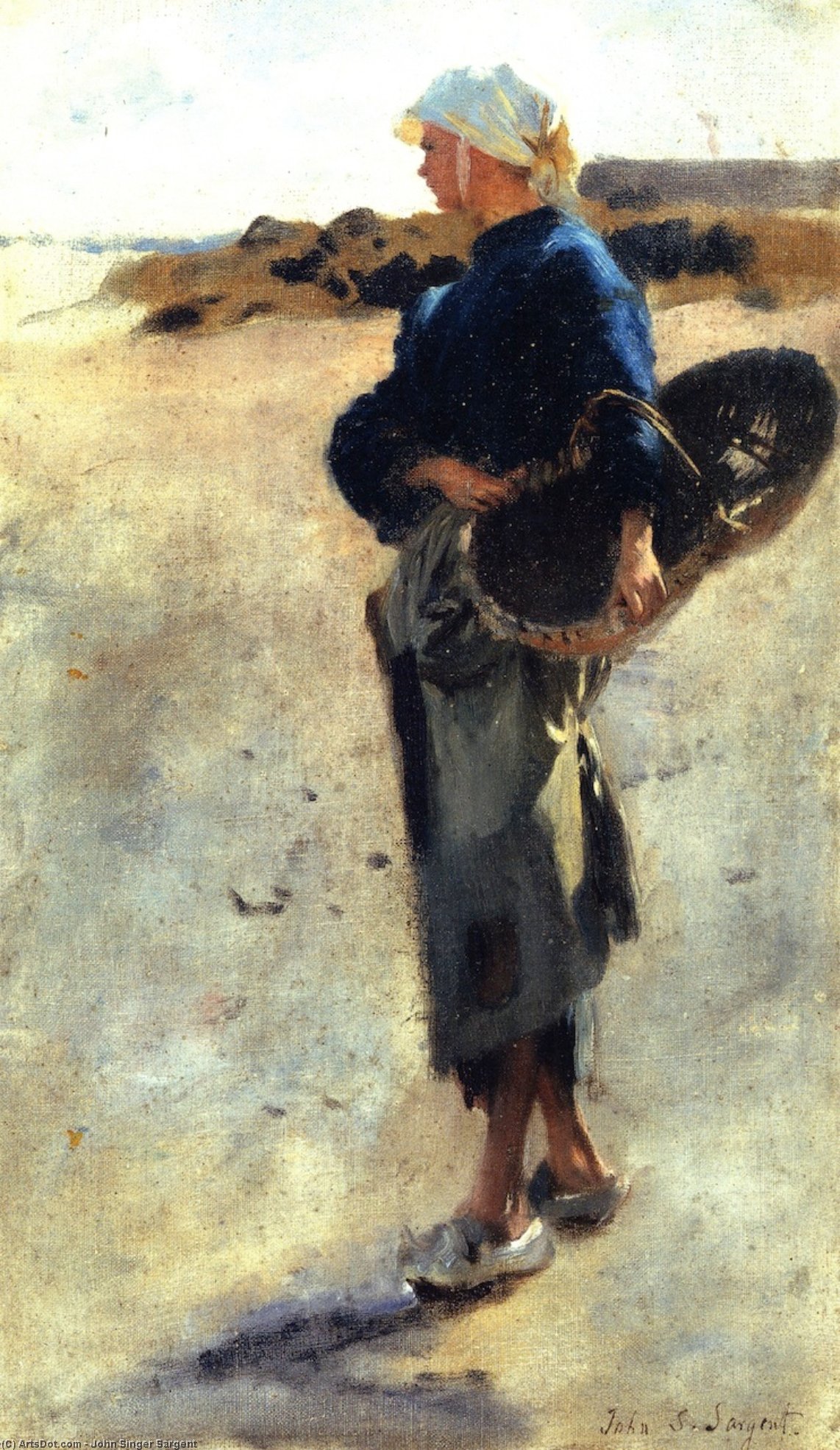
John Singer Sargent's "Study for Oyster Gatherers at Cancale" captures the serene beauty of coastal life with meticulous detail—a captivating portrait embodying elegance and artistic mastery.
Explore the art of John Singer Sargent! Discover iconic portraits like 'Madame X', Impressionistic landscapes & Gilded Age elegance from this American master.
A Moment Frozen in Time: Exploring John Singer Sargent’s Study for ‘Oyster Gatherers at Cancale’
The painting “Study for ‘Oyster Gatherers at Cancale’” by John Singer Sargent isn't merely a depiction of a woman on a beach; it’s an exquisitely crafted distillation of Impressionism infused with the artist’s signature psychological depth. Completed in 1877, this oil on panel masterpiece resides within the Terra Foundation’s collection and serves as a captivating window into both Sargent’s artistic prowess and the cultural milieu of his era—a period defined by opulent leisure and an obsession with capturing fleeting sensations.
Composition and Technique: Light, Texture, and Observation
Sargent's masterful technique is immediately apparent upon close inspection. He eschews dramatic chiaroscuro – the stark contrasts of light and dark favored by Rembrandt – opting instead for a subtle gradation of hues that mimics the diffused sunlight filtering through the coastal foliage. Thick impasto—heavy application of paint—dominates the surface, particularly around the woman’s torso and hands, creating palpable texture that invites tactile engagement. This deliberate layering of pigment isn't simply decorative; it reflects Sargent’s meticulous observation of nature, painstakingly rendered to convey not just what he saw but also how he *felt*. The artist’s keen eye for detail extends beyond the immediate subject matter, subtly incorporating elements of the surrounding landscape—the rocks and grasses—to enrich the overall visual experience.
Historical Context: Belle Époque Elegance and Artistic Innovation
“Study for ‘Oyster Gatherers at Cancale’” emerged during the Belle Époque (roughly 1870-1914), a period of unprecedented artistic innovation fueled by advancements in scientific understanding and a burgeoning fascination with psychology. Impressionism, championed by artists like Monet and Renoir, had irrevocably altered the course of painting, prioritizing subjective perception over objective representation. Sargent embraced this revolutionary spirit, skillfully blending Impressionistic principles with his own distinctive style—one characterized by psychological realism and an uncanny ability to convey inner emotion. The painting reflects the broader societal preoccupation with capturing beauty and tranquility amidst the anxieties of industrialization and political upheaval.
Symbolism: Quiet Contemplation and Female Resilience
Beyond its technical brilliance, “Study for ‘Oyster Gatherers at Cancale’” is laden with symbolic resonance. The woman’s posture—slightly turned away from the viewer, her hands resting on her hips—suggests a state of quiet contemplation, hinting at inner thoughts and feelings beyond what is immediately visible. Her gaze fixed upon the distant ocean speaks to themes of solitude, introspection, and perhaps even longing. Simultaneously, her presence embodies resilience – she stands confidently amidst the natural world, embodying an idealized vision of feminine strength and grace. The basket and surfboard symbolize both practicality and aspiration—the groundedness of everyday life juxtaposed with the pursuit of adventure and discovery.
Emotional Impact: Tranquility and Nostalgia
Ultimately, “Study for ‘Oyster Gatherers at Cancale’” transcends mere visual representation; it evokes a profound emotional response in the viewer. The painting’s serene palette and textured surface conjure up feelings of tranquility and nostalgia—a yearning for simpler times and an appreciation for the beauty of unspoiled landscapes. Sargent's ability to capture not just what he saw but also how he felt elevates his work beyond mere aesthetic pleasure, inviting contemplation on themes of human experience and the enduring power of art to communicate emotion across generations. It remains a testament to Sargent’s genius—a timeless masterpiece that continues to inspire admiration and fascination today.