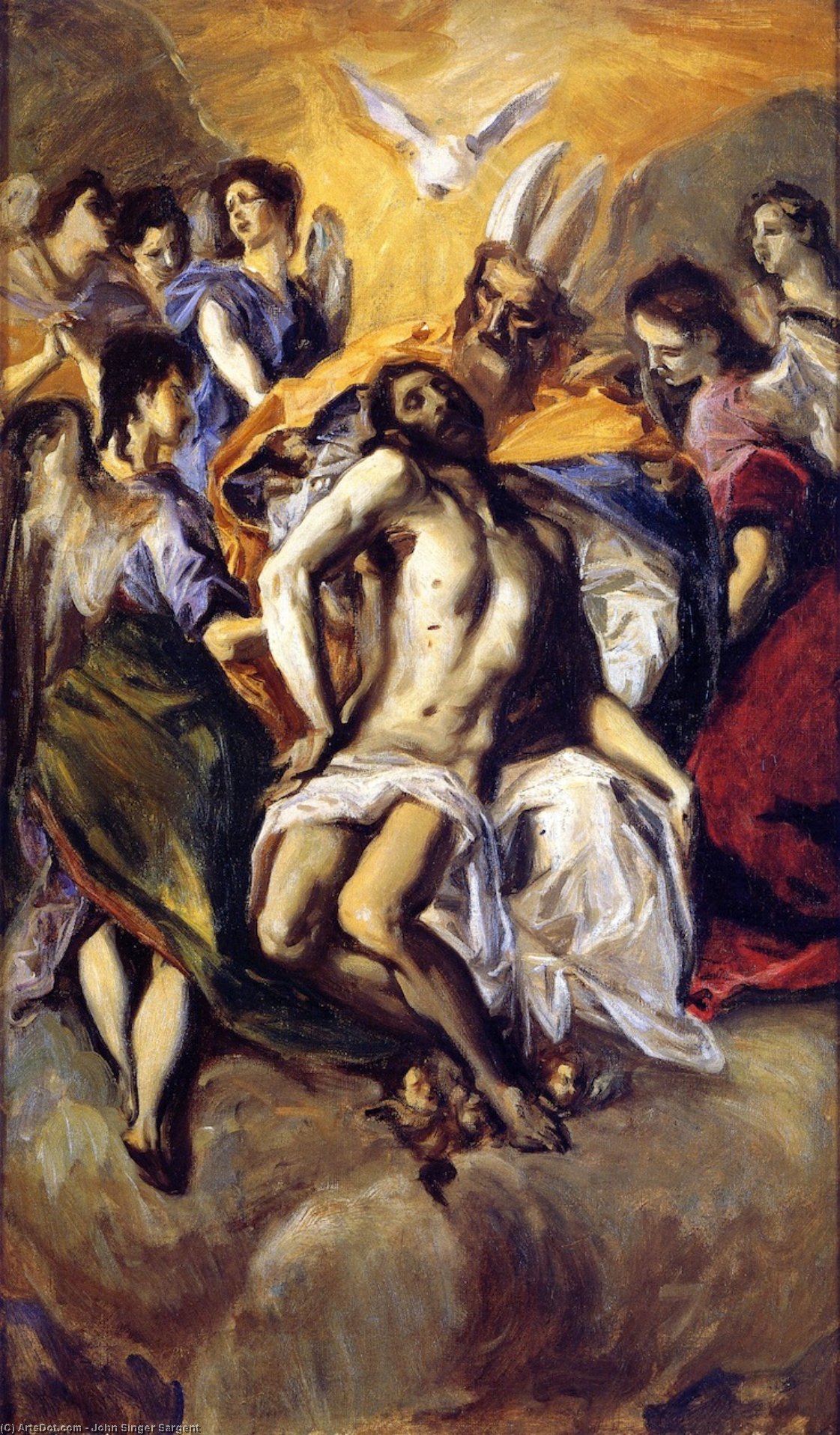
John Singer Sargent's 'The Holy Trinity,' inspired by El Greco’s masterful use of light and composition, portrays Jesus on the cross amidst figures symbolizing faith and compassion. Explore this iconic painting's intricate details & emotive storytelling.
A Symphony of Light and Faith: Exploring John Singer Sargent’s ‘The Holy Trinity’, After El Greco
John Singer Sargent, a name synonymous with the Gilded Age and its shimmering portraits of elegance, was an American artist who spent most of his life cultivating his craft within the European art world. Born in Florence, Italy, in 1856 to American expatriate parents, Fitzwilliam and Mary Newbold Sargent, his upbringing was anything but conventional. The family’s nomadic existence – constantly traversing France, Germany, Italy, and Switzerland – instilled in young John a cosmopolitan sensibility and an early exposure to the artistic treasures of Europe. Rather than formal schooling, his education unfolded within museum halls and ancient churches, fostering a visual literacy that would profoundly shape his artistic vision. This itinerant childhood, while lacking traditional structure, provided a rich tapestry of cultural experiences that fueled his developing talent. His father, a surgeon, and his mother, an amateur artist, encouraged his inclination towards observation and artistic exploration—a foundation that would serve him exceptionally well throughout his illustrious career.
Sargent’s artistic journey began with watercolor landscapes, honing his skills in capturing atmospheric subtleties and conveying emotion through color. However, it was his fascination with portraiture that truly cemented his reputation as one of the era's foremost artists. He possessed an uncanny ability to distill a subject’s essence onto canvas, achieving remarkable likenesses while simultaneously imbuing them with psychological depth. This meticulous attention to detail—coupled with a masterful command of light and shadow—became hallmarks of his distinctive style. Influenced profoundly by Impressionism and Post-Impressionism, Sargent seamlessly blended these movements into his own unique aesthetic, prioritizing expressive brushstrokes and vibrant hues without sacrificing accuracy.
The genesis of Sargent’s artistic inspiration can be traced back to Doménikos Theotokopoulos, better known as El Greco (1541–1614), a Cretan painter who revolutionized religious art with his elongated figures and ethereal luminosity. Sargent's 'Tyrolese Crucifix,' completed in 1875, exemplifies this influence vividly. Painted in watercolor on ivory paper, the piece captures a dramatic depiction of Christ’s crucifixion against a mountainous backdrop—a scene rendered with Impressionistic brushwork that prioritizes capturing fleeting moments of light and emotion. The artist skillfully employs chiaroscuro to sculpt form and convey the solemnity of the occasion, creating an atmosphere charged with spiritual significance.
Beyond its technical prowess, ‘The Holy Trinity,’ after El Greco, resonates deeply on an emotional level. Sargent’s version pays homage to El Greco's original masterpiece while adding his own nuanced interpretation—a testament to his artistic sensitivity and intellectual curiosity. The composition is carefully balanced, drawing the viewer’s eye towards the central crucifix and its surrounding figures. Each character embodies a distinct expression of faith and sorrow, conveying a profound meditation on sacrifice and redemption. Sargent’s masterful use of color contributes significantly to the painting's emotive impact—warm hues dominate the scene, symbolizing divine compassion and illuminating the solemn grandeur of the crucifixion narrative.
The enduring appeal of Sargent’s ‘The Holy Trinity,’ after El Greco,’ lies in its ability to transcend time and cultural boundaries. It continues to inspire artists and collectors alike, serving as a beacon of artistic excellence and spiritual contemplation. Its meticulous execution—characterized by luminous watercolor washes and expressive brushstrokes—represents the pinnacle of Impressionistic technique while simultaneously honoring the legacy of El Greco’s groundbreaking vision. Today, reproductions of this iconic artwork adorn galleries and private residences worldwide, ensuring that Sargent's profound contribution to art history remains accessible to generations to come.
- Artist: John Singer Sargent
- Year Completed: 1875
- Medium: Watercolor on Ivory Paper
- Dimensions: 36 x 24 cm
Explore the captivating beauty and spiritual depth of Sargent’s masterpiece at Violet Sargent.