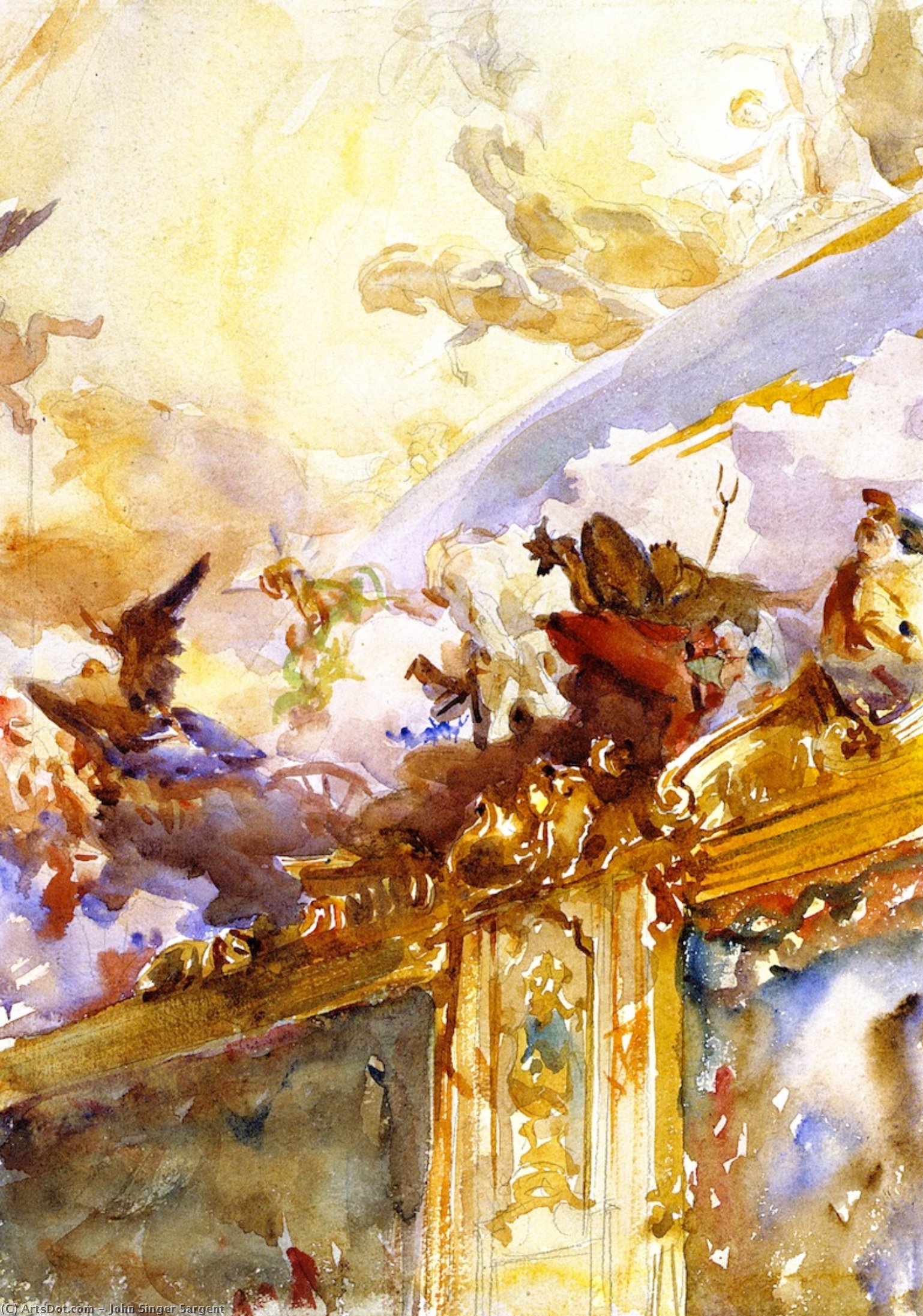
Tiepolo Ceiling, Milan

John Singer Sargent’s watercolor captures the ethereal beauty of Tiepolo's Milan ceiling—a serene expanse of clouds punctuated by angelic figures and a delicate bird. Embracing Impressionistic style, this masterpiece exemplifies Sargent’s masterful technique and invites you to explore its timeless elegance.


John Singer Sargent (1856 - 1925)

Explore the art of John Singer Sargent! Discover iconic portraits like 'Madame X', Impressionistic landscapes & Gilded Age elegance from this American master.

A Celestial Tapestry: John Singer Sargent’s Reverie on Tiepolo

  • Subject Matter The watercolor painting “Tiepolo Ceiling, Milan,” by John Singer Sargent, captures a breathtaking vista of the Palazzo Re Enzo in Milan. It depicts a magnificent ceiling adorned with intricate architectural details and dominated by a luminous sky teeming with clouds—a deliberate homage to Andrea Pozzo’s monumental fresco cycle, "The Glorification of Saint Peter," which adorns the basilica of San Pietro Apostolo.
  • Style Sargent's masterful style exemplifies Impressionistic tendencies blended seamlessly with meticulous observation. While acknowledging the influence of Impressionism in capturing fleeting light and atmosphere—a hallmark of his artistic journey—he eschewed loose brushstrokes for a remarkably detailed rendering, prioritizing accuracy and tonal nuance. This approach distinguishes him from many of his contemporaries who favored looser styles.
  • Technique Sargent employed watercolor on paper, utilizing wet-on-wet techniques to achieve the ethereal quality of the sky. Layers of translucent washes blended together to create a sense of depth and luminosity, mirroring Pozzo’s fresco's dramatic chiaroscuro—the interplay between light and shadow—a technique he skillfully adopted to convey emotion and visual grandeur.
  • Historical Context Created in 1898, “Tiepolo Ceiling, Milan” emerged during the height of Sargent’s European residency. This period coincided with a fervent interest in reviving classical ideals within the decorative arts, fueled by movements like Neo-Classical Revivalism. Sargent's depiction reflects this trend, elevating architectural grandeur and religious iconography into canvases of sublime beauty.
  • Symbolism The celestial sky serves as more than just a backdrop; it embodies spiritual aspiration and divine majesty—themes central to Pozzo’s fresco cycle. The angels depicted within the painting symbolize faith, grace, and heavenly messengers, reinforcing the basilica's sacred character. Furthermore, the bird positioned near the top left corner may represent freedom or vigilance, subtly enriching the artwork’s narrative.
  • Emotional Impact Sargent’s watercolor succeeds in transporting viewers to a realm of serene contemplation. The luminous colors and delicate brushwork evoke feelings of tranquility and wonder, mirroring the grandeur and spiritual significance of Pozzo's masterpiece. It is precisely this ability to capture beauty and inspire awe that secures “Tiepolo Ceiling, Milan” as an enduring testament to Sargent’s artistic genius.