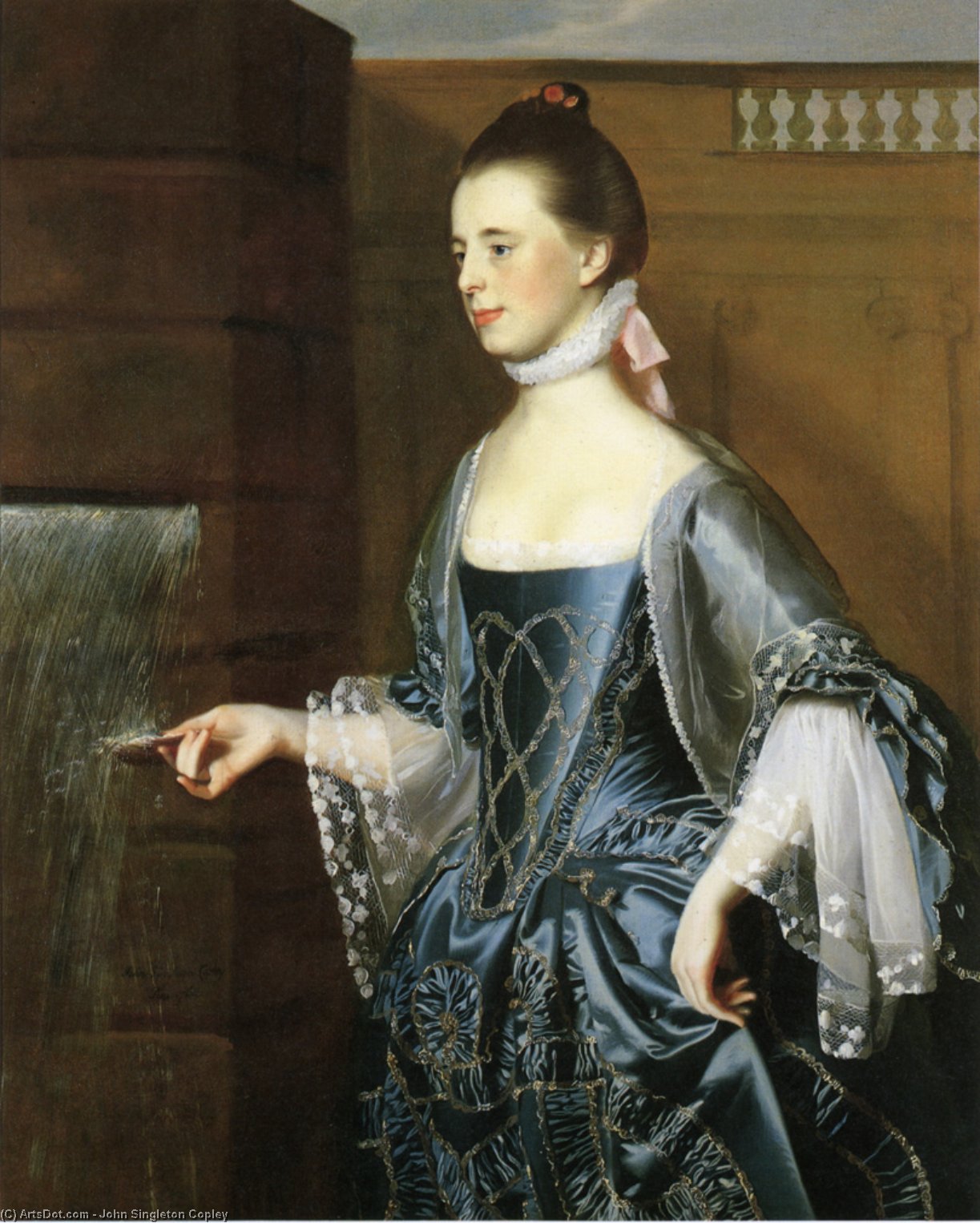
A Portrait of Grace and Dignity: Mrs. Daniel Sargent by John Singleton Copley
John Singleton Copley’s “Mrs. Daniel Sargent (Mary Turner Sargent)” is more than just a portrait; it's a meticulously crafted window into the world of 18th-century Boston, capturing not only the likeness of a woman but also the essence of her social standing and inner composure. Completed in 1763, this oil on canvas painting stands as a testament to Copley’s unparalleled skill in portraying human character with remarkable detail and psychological depth. The work resides within the Fine Arts Museums of San Francisco, a fitting home for an artwork that embodies the elegance and refinement of its era.
Copley's mastery lies not merely in replicating features but in conveying a sense of presence—a quiet dignity that radiates from Mrs. Sargent’s posture and gaze. The composition is carefully balanced, drawing the eye to her face, where subtle expressions hint at intelligence and serenity. Her hands, gracefully positioned, hold a delicate fan – an emblem of social grace and refinement so prevalent in Boston society during this period. The background, rendered with a restrained palette of muted browns and grays, serves to highlight the subject, creating a sense of intimacy and drawing attention to her presence within the space.
Neo-Classicism and the Language of Symbolism
“Mrs. Daniel Sargent” is firmly rooted in the principles of Neo-Classicism, a movement that sought inspiration from the art and ideals of ancient Greece and Rome. Copley’s approach reflects this influence through clean lines, balanced proportions, and an emphasis on moral virtue – qualities highly valued within the context of 18th-century Boston. The painting's formality mirrors the classical tradition, while simultaneously reflecting the burgeoning American identity that was beginning to emerge.
Beyond its formal elements, the portrait is rich in symbolism. The blue dress, adorned with intricate white lace trim, speaks to wealth and status, while the pink bow in her hair adds a touch of youthful charm. Crucially, the scallop shell held delicately in her hand – a direct reference to Venus, the Roman goddess of love and beauty – symbolizes not only marital bliss but also fertility and prosperity, reflecting the hopes and aspirations of a woman within a society that valued family and lineage. The subtle waterfall depicted behind her further reinforces this symbolism, representing virtue, life, and renewal.
The Artist’s Technique: A Study in Light and Shadow
Copley's technical skill is immediately apparent in the painting’s luminous quality. He masterfully employed light to sculpt Mrs. Sargent’s features, creating a sense of depth and volume. The subtle gradations of tone – from the highlights on her face to the shadows beneath her chin – contribute to the portrait’s realism and emotional impact. His brushwork is remarkably controlled, yet imbued with a delicate touch that captures the texture of fabrics and the sheen of polished surfaces.
Notably, Copley spent an extraordinary amount of time perfecting this portrait, reportedly working on it for over six hours at a single sitting. The anecdote surrounding his erasure of her head during one session speaks volumes about his dedication to achieving absolute accuracy and capturing the true likeness of his subject – a testament to his meticulous approach and unwavering pursuit of artistic excellence.
A Window into Colonial Boston
“Mrs. Daniel Sargent” offers a captivating glimpse into the social and cultural landscape of colonial Boston. It’s a portrait not just of an individual woman, but of a family, a community, and a burgeoning nation. The painting embodies the values and aspirations of this era – wealth, status, piety, and a commitment to familial stability. Studying this work allows us to connect with the past in a profound way, appreciating the artistry and insight that Copley brought to his portrayal of everyday life.