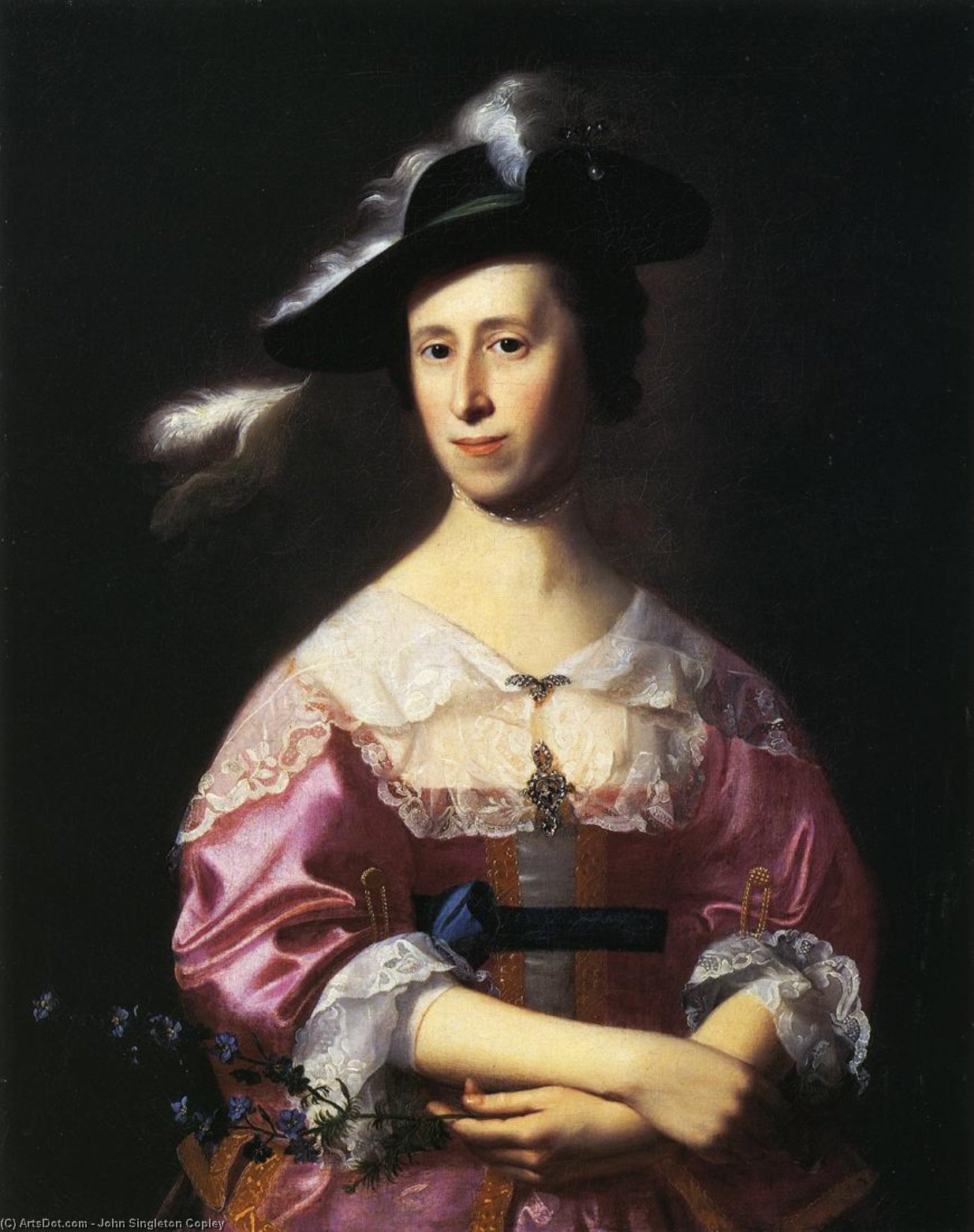
A Portrait Steeped in Refinement: Exploring John Singleton Copley’s Mrs. Samuel Quincy (Hannah Hill)
The Museum of Fine Arts in Boston holds within its walls a painting that transcends mere representation; it embodies the spirit of Enlightenment America – John Singleton Copley's “Mrs. Samuel Quincy (Hannah Hill),” completed in 1761. More than just a depiction of a wealthy Bostonian woman, this portrait is a testament to Copley’s mastery of technique and his profound understanding of capturing psychological nuance within the framework of aristocratic society. It stands as an enduring symbol of elegance, ambition, and the burgeoning confidence of a nation forging its identity.
The Subject: Hannah Hill – Embodiment of Domestic Virtue
Hannah Hill was no ordinary woman; she represented the ideal of feminine virtue—a cornerstone of colonial Boston’s social values. Married to Samuel Quincy, a prominent merchant and landowner, Hannah possessed considerable influence within their circle. Copley skillfully rendered her features with meticulous detail, emphasizing her serene gaze and conveying an aura of quiet dignity. The subtle blush on her cheeks speaks volumes about her inner composure, reflecting the societal expectation for women to embody grace and piety. Beyond mere likeness, Copley sought to portray Hannah as a woman worthy of admiration—a figure embodying the aspirations of her era.
Stylistic Influences: Rococo’s Delicate Embrace
Copley's artistic vision was undeniably shaped by the prevailing Rococo style, which dominated European art circles during his formative years. Unlike the grand narratives favored by Baroque painters, Rococo prioritized ornamentation and sensual beauty—elements subtly woven into “Mrs. Samuel Quincy.” The soft pastel hues of pink and ivory dominate the palette, creating an atmosphere of ethereal tranquility. Delicate lines define the drapery folds and embellishments on Hannah’s gown, mirroring the flowing curves characteristic of the movement. This stylistic choice underscores Copley's desire to elevate his subject beyond a simple portrait; he aimed for an experience that would captivate the viewer's senses and evoke feelings of refined pleasure.
Technique: Light and Texture – A Masterful Dance
Copley’s technique exemplifies the precision demanded by Rococo painting. He employed glazing—a layering process where thin translucent washes of color are applied over underlying layers—to achieve remarkable luminosity and depth. This method allowed him to capture the interplay of light on Hannah's skin, creating a palpable sense of realism that belied the stylized aesthetic. Furthermore, Copley meticulously rendered textures – from the silk sheen of the dress to the delicate lace trim – demonstrating an unparalleled command of artistic craft. The artist’s dedication to detail speaks volumes about his commitment to conveying not just appearance but also feeling—a crucial element in capturing the essence of human character.
Symbolism: Beyond Beauty – Reflections of Societal Values
The inclusion of a potted plant and the subtle gesture of Hannah holding her bouquet of flowers are laden with symbolic significance. Plants represented fertility and prosperity, mirroring the aspirations of the Quincy family as they sought to establish their legacy in Boston. The flowers themselves symbolize beauty, purity, and devotion—values deeply ingrained within colonial society’s moral compass. Copley's careful selection of visual elements reinforces these themes, elevating “Mrs. Samuel Quincy” beyond a mere portrait into a commentary on the social ideals of its time.
Emotional Impact: An Echo of Elegance Enduring Through Time
“Mrs. Samuel Quincy (Hannah Hill)” continues to resonate with viewers today because it captures something profoundly human—a quiet confidence and inner grace that transcends temporal boundaries. Copley’s masterful depiction of Hannah Hill serves as a poignant reminder of the values cherished by Enlightenment America: domestic virtue, refined beauty, and unwavering ambition. It's a painting that invites contemplation, prompting us to consider not only the artistry involved but also the cultural context from which it emerged—a legacy of elegance and sophistication destined to inspire generations of art lovers.
- View more paintings by John Singleton Copley at ArtsDot.com
- Learn about the Museum of Fine Arts and its collection at Wikipedia