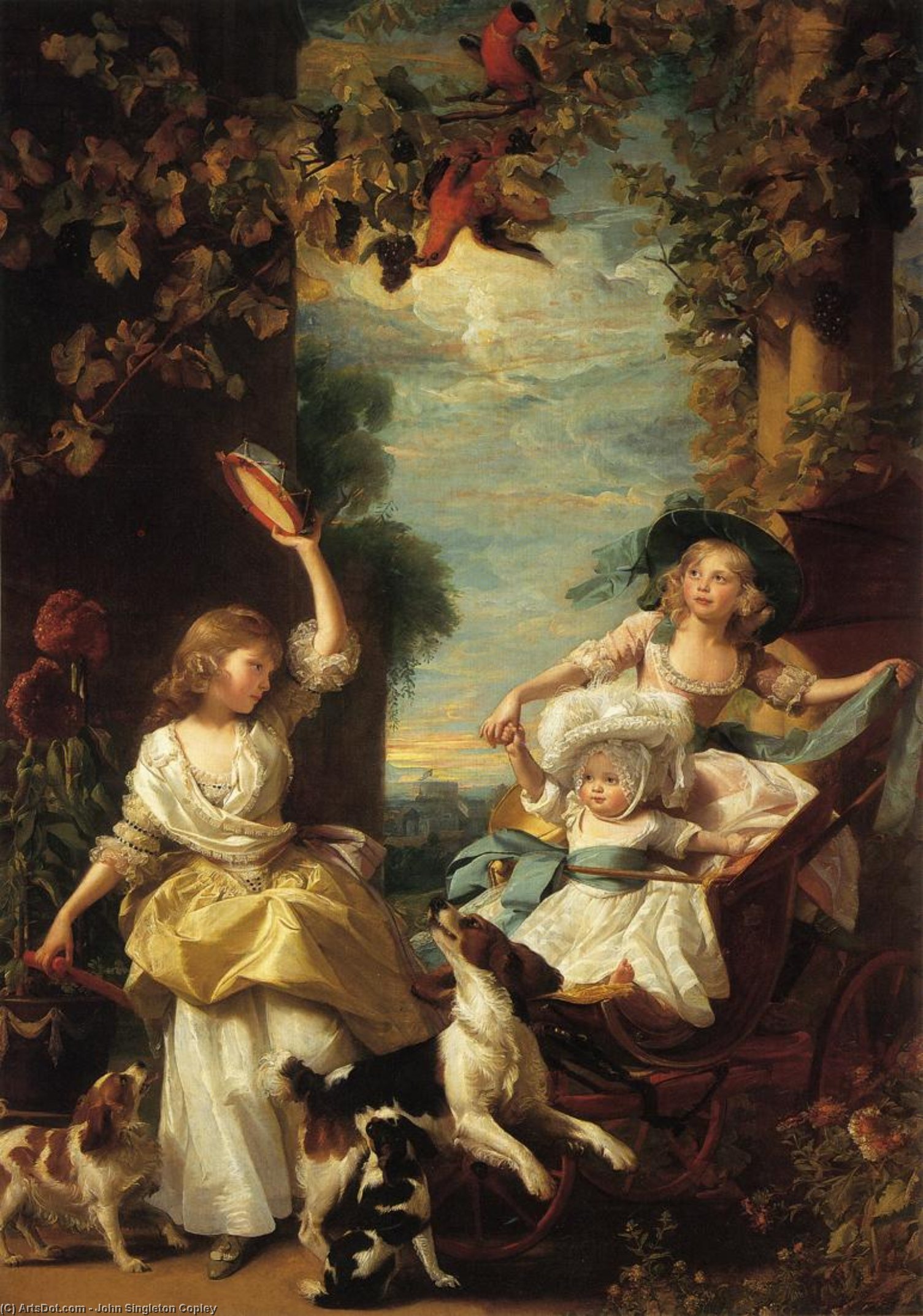
A Window into Georgian Society: Copley’s “The Three Youngest Daughters of George III”
John Singleton Copley's "The Three Youngest Daughters of George III," painted in 1785, is more than just a portrait; it’s a meticulously crafted snapshot of Georgian England and the burgeoning world of colonial America. Measuring an impressive 186 x 265 cm, this neoclassical masterpiece immediately draws the viewer into a scene brimming with youthful grace and understated elegance. Executed in oil on canvas, Copley's signature style – characterized by its sharp realism and attention to detail – is vividly displayed here, capturing not just appearances but also the subtle social dynamics at play within the royal family’s circle.
- Subject Matter: The painting depicts three young princesses, the youngest daughters of King George III, engaged in a seemingly simple activity – enjoying an outdoor moment. This focus on familial relationships and youthful innocence was a hallmark of neoclassical art, reflecting a desire to return to classical ideals of virtue and harmony.
- Neoclassical Style: Copley’s work exemplifies the Neoclassical movement's emphasis on order, reason, and moral values. The composition is rigorously structured, with balanced figures and carefully considered spatial relationships, echoing the principles found in ancient Greek and Roman art.
- Technical Brilliance: Copley’s mastery of technique is immediately apparent. His use of light and shadow creates a remarkable sense of depth and volume, while his brushwork is precise yet fluid, capturing the delicate textures of the girls' clothing and the soft fur of the accompanying dog.
The Artist: John Singleton Copley – A Bridging Figure
Born in Boston in 1738, John Singleton Copley was a truly unique figure in the history of art. He wasn’t simply a painter; he was a cultural translator, navigating the complex relationship between Anglo-American artistic traditions and European influences. His early life, shaped by his father's involvement in the Boston merchant community, instilled within him an acute understanding of wealth, social status, and the visual language of power – all elements that profoundly informed his art. Copley’s decision to establish himself primarily in London, despite his strong ties to colonial America, speaks volumes about his ambition and his desire to engage with the most prestigious artistic circles of the time.
His portraits were not mere likenesses; they were carefully constructed statements about identity and social standing. He possessed an extraordinary ability to capture not just physical appearance but also the personality and character of his subjects, imbuing each portrait with a sense of immediacy and psychological depth. This is particularly evident in “The Three Youngest Daughters,” where the princesses appear remarkably alive and engaged.
Symbolism and Composition – A Dialogue of Forms
The composition of the painting is meticulously balanced, reflecting the neoclassical emphasis on harmony and order. The three young women are arranged around a central table, their gestures and expressions conveying a sense of relaxed conviviality. The inclusion of a dog, carefully positioned on the left side of the image, adds to the scene’s naturalism and reinforces the idea of familial affection. Scattered birds throughout the background contribute to the overall feeling of joy and lightness, symbolizing innocence and freedom.
The white gowns worn by the princesses are not merely decorative; they represent purity, virtue, and the ideals associated with the neoclassical aesthetic. The carefully chosen setting – an outdoor space bathed in soft light – further enhances the painting’s sense of tranquility and beauty. The deliberate arrangement of elements creates a visual narrative that speaks to themes of family, youth, and social grace.
Historical Significance and Legacy
"The Three Youngest Daughters of George III" holds immense historical significance as a key example of neoclassical portraiture and a valuable window into the lives of the British royal family during the late 18th century. Currently residing within the Royal Collection at Buckingham Palace, this painting represents not only Copley’s artistic skill but also the broader cultural exchange between Britain and its American colonies. Its enduring appeal lies in its ability to transport us back to a time of elegance, refinement, and profound social change – a testament to Copley's genius and the timeless beauty of his art.