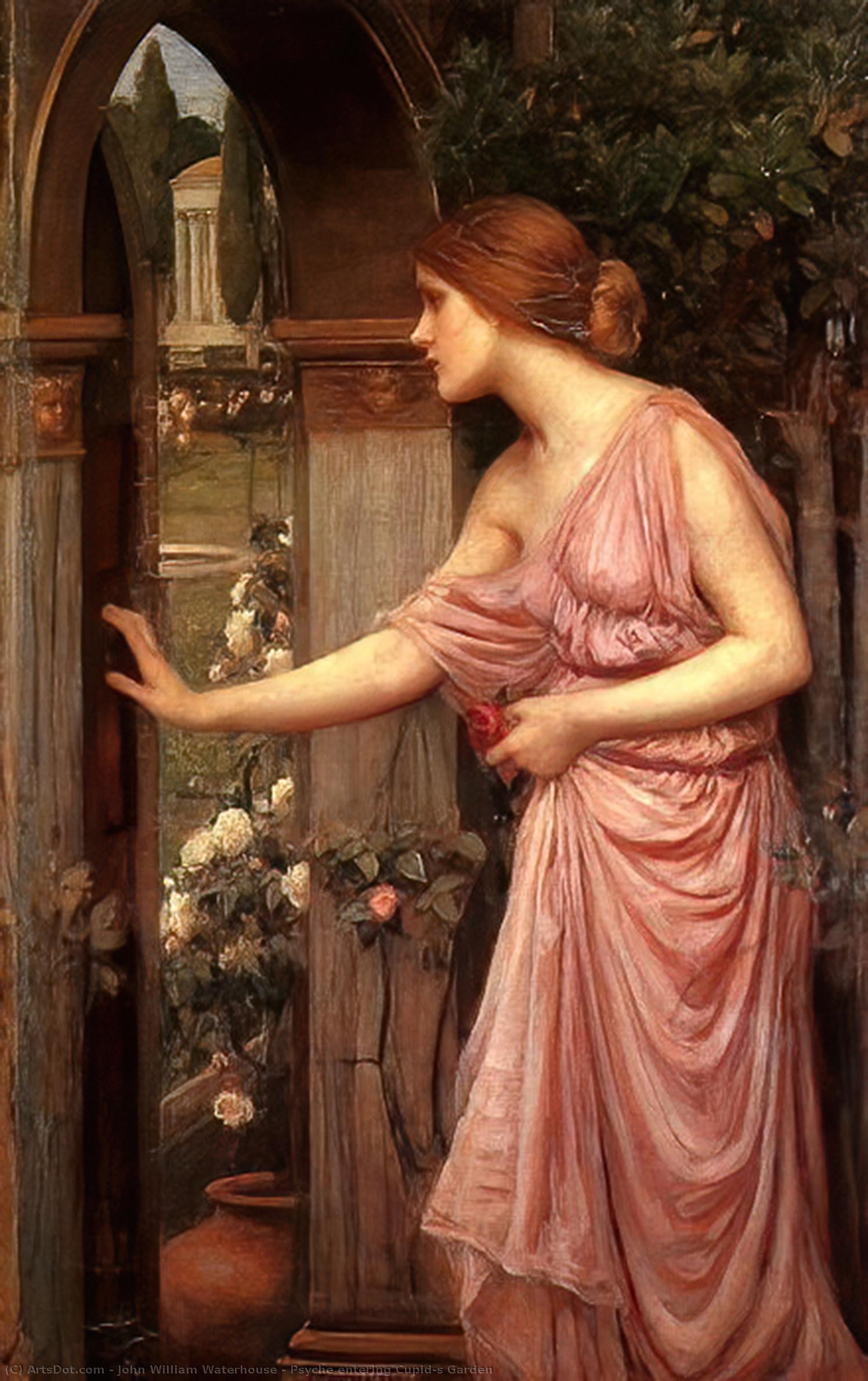
In the realm of art, few paintings have captured the essence of mythology and romance as beautifully as
John William Waterhouse's "Psyche entering Cupid's garden." This enchanting oil on canvas piece, created in 1903, is a testament to Waterhouse's skill in blending mythological narratives with captivating visuals. ### The Mythological Context The painting is inspired by the ancient Greek myth of Psyche and Cupid. Psyche, representing the human spirit or soul, was so beautiful that people began to adore her instead of Venus. To rectify this sacrilege, Venus sent her son Cupid to make Psyche fall in love with an ugly creature. However, upon seeing Psyche, Cupid fell deeply in love and forgot his mother's command. The two became lovers, but their relationship was fraught with challenges set by Venus to prove Psyche's worthiness. ### Artistic Interpretation Waterhouse's interpretation of this myth is a serene and captivating scene. Psyche is depicted standing near a doorway, adorned in a flowing pink dress, holding a red rose. The atmosphere is peaceful, with flowers on either side of the doorway and vases placed within the scene. The painting exudes a sense of tranquility and beauty, drawing the viewer into the mythological world. ### Artistic Style Waterhouse's style, characteristic of the Pre-Raphaelite movement, emphasizes detailed realism and rich colors. His use of oil on canvas allows for a depth and luminosity that brings the characters to life. The romanticism in his work is evident in the dreamy quality of the scene, inviting the viewer to immerse themselves in the mythological narrative. ### Museum and Artistic Significance "Cupid's Garden" is housed at
The Taylor Institution in Oxford, United Kingdom, a museum renowned for its collection of masterpieces. This painting, along with other works by Waterhouse, such as
Psyche Opening the Golden Box, showcases his mastery of capturing mythological themes in a romantic and captivating manner. ### Conclusion "Cupid's Garden" by John William Waterhouse is a masterpiece that combines mythology, romance, and artistic excellence. It stands as a testament to the enduring power of art to capture the human imagination. For those interested in exploring more works inspired by mythology,
The Judgement of Paris by Jean Antoine Watteau and
The Judgment of Paris by Peter Paul Rubens are notable examples. ### List of Relevant Paintings
### List of Relevant Artists
### List of Relevant Museums
This article is a tribute to the captivating world of art and mythology, as beautifully depicted by John William Waterhouse.