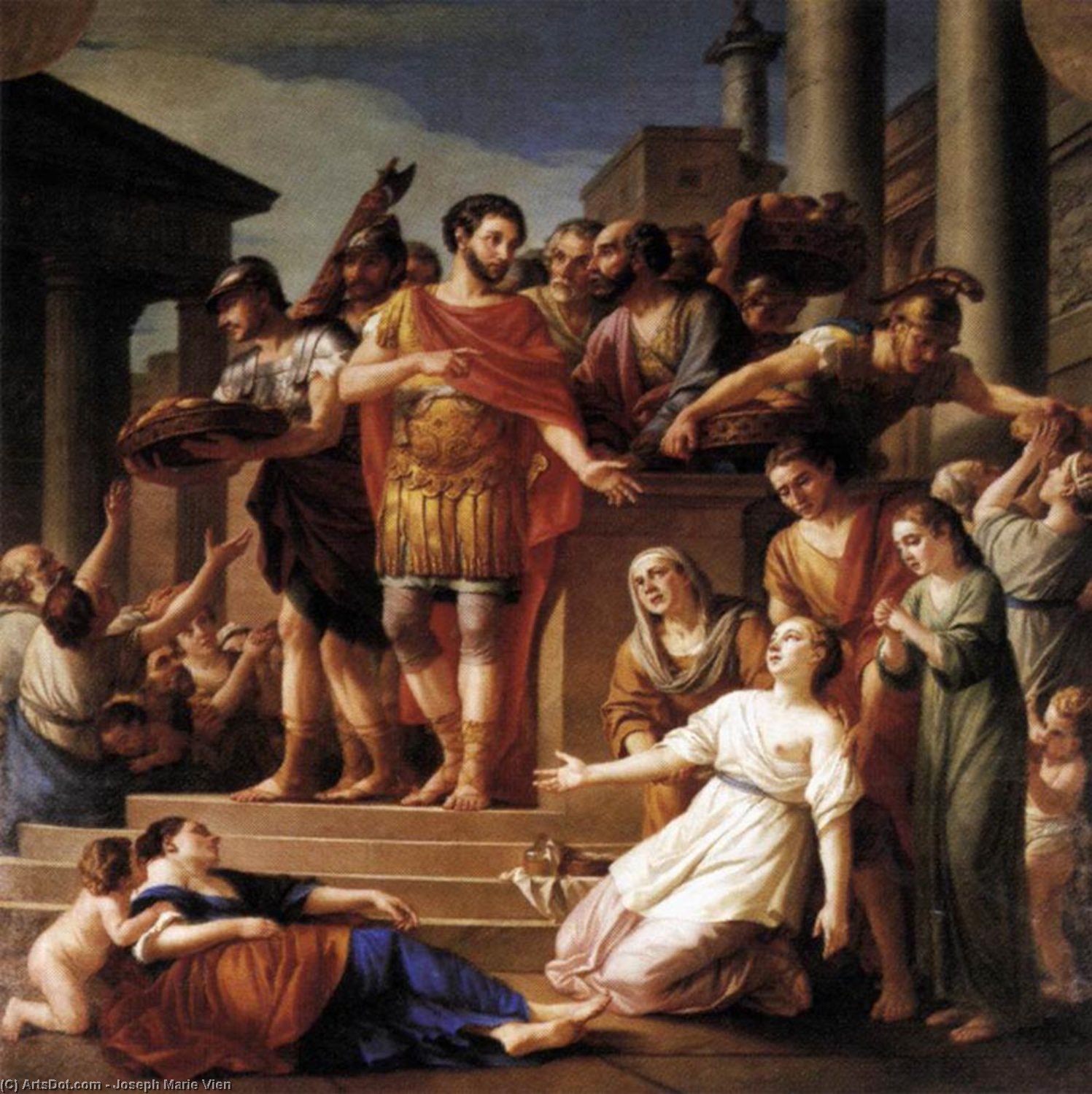
Marcus Aurelius Distributing Bread to the People: A Quiet Revolution of Perception
Joseph Marie Vien’s “Marcus Aurelius Distributing Bread to the People,” completed in 1765, stands as a testament to the transformative power of seemingly simple subjects rendered with extraordinary sensitivity. More than just a depiction of Roman emperor Marcus Aurelius enacting benevolent governance—a commission for Louis XV’s ambitious cycle celebrating royal virtues—the painting embodies a profound philosophical shift within European art circles during the Enlightenment.
Vien, considered by many to be the foremost practitioner of still life painting in Spain at the time, eschewed the grand narratives favored by his contemporaries. Instead, he focused on capturing the essence of human experience through meticulously observed details—a deliberate rejection of theatrical grandeur for a quiet contemplation of everyday life. This stylistic choice aligns perfectly with the burgeoning humanist spirit of the era, where artists sought to elevate the commonplace into something sublime.
The painting itself is executed in oil on canvas and showcases Vien’s masterful technique. Notice the luminous quality of the pigments—a hallmark of his style—which imbues the scene with an ethereal glow. The artist employs subtle gradations of color and meticulous layering to create a palpable sense of depth and texture, mirroring the textures of burlap sacks filled with grain and the weathered faces of the citizens receiving aid.
Beyond its aesthetic merits, “Marcus Aurelius Distributing Bread” carries significant symbolic weight. Marcus Aurelius himself represents Stoic virtue—reason, duty, and acceptance—values championed by Enlightenment thinkers. The act of distributing bread symbolizes compassion and social responsibility, reflecting a growing concern for the welfare of the populace during a period marked by economic hardship.
Diderot’s astute observation that Vien's painting lacked “warmth or liveliness” – dismissing it as merely “pieces of card cut out and placed one over another” – encapsulates the critical debate surrounding Vien’s work. While some critics lamented its perceived lack of dramatic flair, others recognized its profound beauty in its understated elegance. Ultimately, Vien’s masterpiece invites viewers to consider how artistic innovation can flourish within constraints—a lesson that continues to resonate with artists and collectors today.
The painting resides in the Musée de Picardie in Amiens, France, where it is viewed alongside other works by Vien and his contemporaries. Its inclusion in the Web Gallery of Art underscores its enduring significance as a pivotal piece of Neoclassical art history.