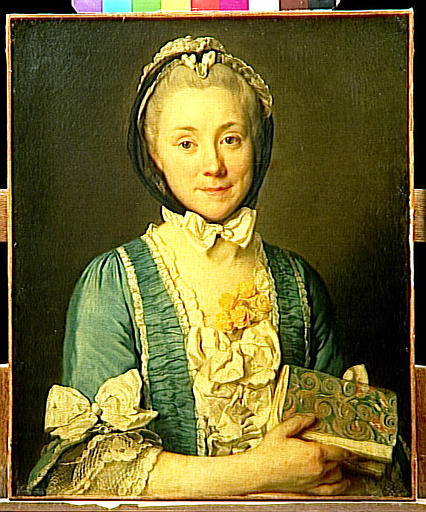
A Portrait of Grace: Madame Lenoir by Joseph Siffred Duplessis
Joseph-Siffred Duplessis’s “Madame Lenoir” is more than just a portrait; it's a carefully constructed tableau of 18th-century French society, imbued with an understated elegance and a poignant sense of intimacy. Painted around 1764, this work offers a rare glimpse into the life of a woman likely belonging to the aristocracy – Madame Lenoir herself, a figure whose identity is inextricably linked to her son, Alexandre Lenoir, the founder of the Musée des Monuments français. The painting’s enduring appeal lies not just in its technical mastery but also in the subtle narrative it unfolds, inviting viewers to contemplate the complexities of social status and familial legacy.
Duplessis, a master of his craft, expertly employs the Rococo style, characterized by its emphasis on delicate detail, soft lighting, and an overall sense of refined beauty. The composition is centered around Madame Lenoir, positioned slightly off-axis to create a dynamic balance within the frame. Her gaze, directed gently towards the viewer, conveys a quiet dignity and composure – a hallmark of the era’s portraiture tradition. The artist skillfully utilizes soft, blended lines, creating a smooth transition between colors and forms, contributing to the painting's overall sense of realism while retaining a distinctly romantic quality.
Color, Texture, and Symbolism
The color palette is remarkably restrained, dominated by muted blues, creams, and flesh tones. These cool hues are punctuated by warmer accents – subtle yellows and oranges within the floral embellishments adorning her dress and subtly illuminating her complexion. This careful orchestration of colors evokes a sense of understated luxury and wealth, reflecting Madame Lenoir’s social standing. Duplessis's meticulous attention to texture is equally noteworthy; he masterfully renders the smoothness of skin, the crispness of lace, and the delicate sheen of the decorative elements on her gown. The folds of fabric are rendered with a remarkable sense of volume, adding depth and realism to the portrait.
Beyond mere representation, “Madame Lenoir” is rich in symbolic detail. The object held delicately in her hands – often interpreted as a fan or perhaps a small book – serves as a subtle emblem of leisure and intellectual pursuits, suggesting a woman engaged with the finer aspects of life. The dark background, devoid of distracting details, effectively isolates Madame Lenoir, drawing attention to her figure and emphasizing her importance within the composition. This strategic use of negative space reinforces the painting’s intimate atmosphere.
Historical Context and Artistic Legacy
To understand “Madame Lenoir,” it's crucial to consider the broader artistic context of its creation. The Rococo period, in which Duplessis flourished, was a time of opulent excess and refined sensibilities. Portraits during this era were not simply representations of individuals; they were carefully crafted statements about social status, wealth, and identity. Duplessis’s work stands as a testament to the enduring appeal of this tradition, capturing the essence of 18th-century French aristocracy with remarkable skill and sensitivity.
Joseph-Siffred Duplessis himself was a pivotal figure in the development of French portraiture. Initially trained by his father, a surgeon, he honed his observational skills through meticulous study – a foundation that would prove invaluable as he transitioned to painting. His time in Rome under Pierre Subleyras exposed him to the techniques and conventions of Italian art, shaping his artistic style and contributing to his mastery of light, shadow, and composition. “Madame Lenoir” exemplifies this evolution, blending academic training with a distinctly personal vision.
A Timeless Portrait
“Madame Lenoir” is more than just a beautiful painting; it’s a window into the past, offering a glimpse into the lives of those who shaped French society. Its enduring appeal lies in its ability to evoke a sense of intimacy, elegance, and quiet dignity. Reproductions of this masterpiece capture not only its visual beauty but also the subtle nuances of Duplessis's artistry – a testament to his skill as a portraitist and a keen observer of human nature. It remains a poignant reminder of the complexities of social status, familial legacy, and the enduring power of art to transcend time.