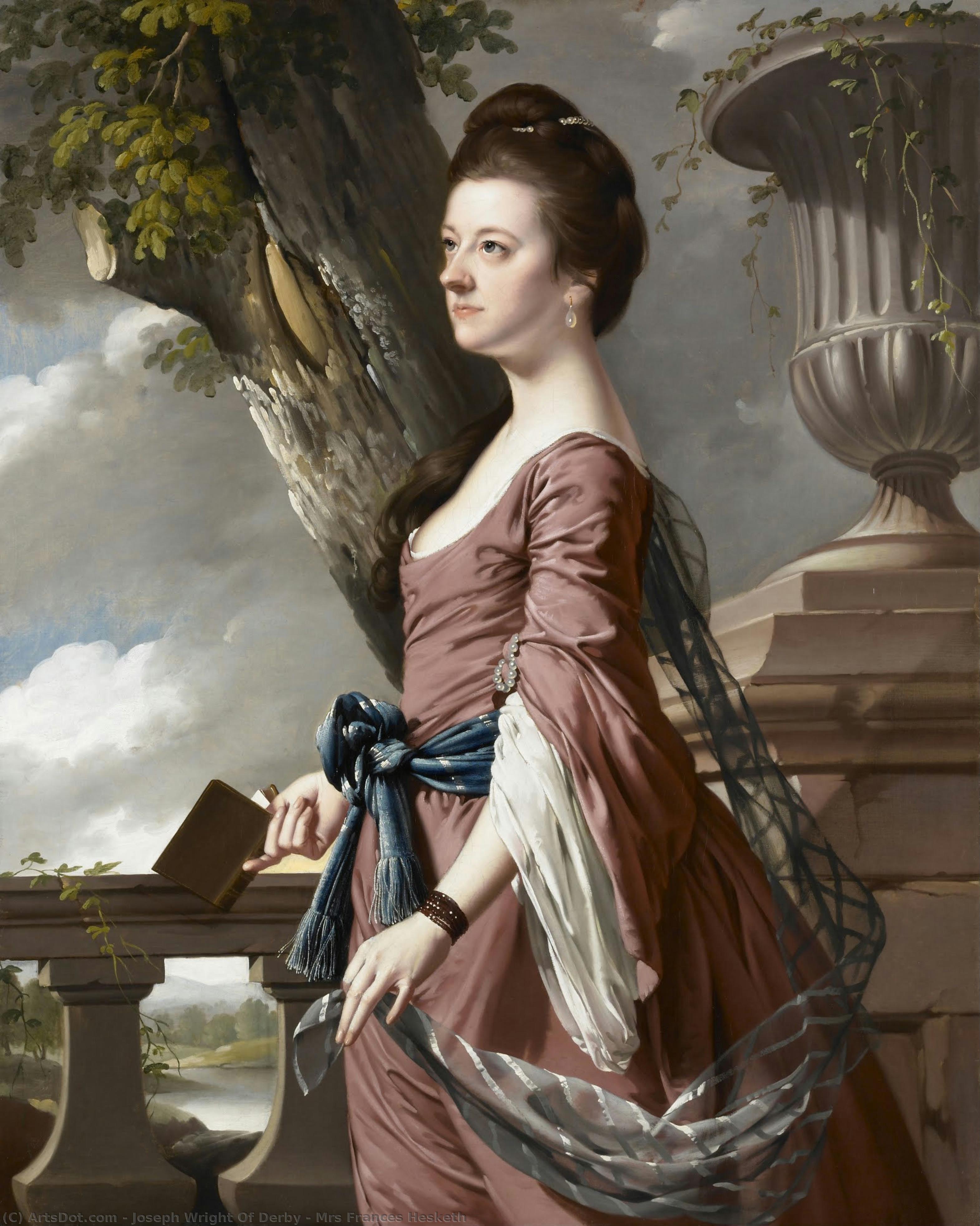
Mrs Frances Hesketh: A Portrait of Lancashire Grandeur by Joseph Wright
Joseph Wright’s “Mrs. Frances Hesketh,” completed in 1769, is more than simply a portrait; it's a meticulously crafted window into the social and artistic currents of late 18th-century England. This arresting image of the wife of Fleetwood Hesketh, daughter of Peter Bold of Bold Hall, transcends the conventions of formal portraiture, revealing Wright’s burgeoning fascination with capturing not just likeness but also character and atmosphere. The painting's power resides in its carefully constructed composition, a testament to Wright’s skill and his engagement with the intellectual debates of the Enlightenment.
- Subject & Context: Frances Hesketh represents the established gentry of Lancashire, a family boasting lineage stretching back before the Norman Conquest. This pedigree is subtly reinforced by the setting – balustrades and an urn evoke grandeur, creating a rectilinear framework that anchors the composition.
- Wright’s Technique: Wright's evident struggles with the near-profile pose add a layer of intriguing complexity to the portrait. The uprightness of Mrs. Hesketh herself contributes to a sober, conventional character, yet it is tempered by Wright’s masterful use of chiaroscuro – the dramatic interplay of light and shadow – which lends the scene an almost theatrical quality.
- Details & Symbolism: Note the inclusion of a book in her hand, suggesting intellectual pursuits and social standing. The clock on the wall subtly introduces the theme of time and place, anchoring the figure within a specific moment. The presence of another person in the background hints at domestic life and reinforces the narrative of leisure.
The Luminary’s Vision: Wright and the Enlightenment
Joseph Wright was a pivotal figure in British art, emerging as one of the first artists to truly embrace the spirit of the Industrial Revolution. Born in 1734, his early life in Derby, steeped in the practical world of his father's legal profession, instilled a precision and observational skill that would become hallmarks of his work. Unlike many of his contemporaries who focused on grand historical narratives or aristocratic portraits, Wright sought to capture the energy and drama of the age – scientific discovery, enlightenment thought, and the transformative impact of industry. “Mrs. Frances Hesketh” exemplifies this shift, moving beyond mere representation to convey a sense of intellectual engagement and social status.
Wright’s approach was deeply rooted in the Enlightenment's emphasis on reason and observation. He meticulously studied light and shadow, employing his signature chiaroscuro technique to create dramatic effects and imbue his subjects with psychological depth. This commitment to scientific accuracy – evident in his detailed renderings of objects and landscapes – aligns perfectly with the intellectual currents of the time.
A Window into 18th-Century Life
Beyond its artistic merit, “Mrs. Frances Hesketh” offers a valuable glimpse into the lives of the English gentry during the mid-18th century. The portrait reflects the importance of social standing, education, and leisure activities within this elite class. The carefully chosen setting – a balcony with balustrades and an urn – speaks to their wealth and status, while the inclusion of a book suggests intellectual pursuits. Wright’s ability to capture not just physical appearance but also the underlying character of his subject is what elevates this portrait beyond a simple likeness.
Collecting & Appreciation
ArtsDot offers meticulously crafted hand-painted reproductions of “Mrs. Frances Hesketh,” allowing you to bring this remarkable work into your own space. Each reproduction captures Wright’s masterful technique and the painting's rich symbolism, ensuring a faithful representation of this significant piece of British art history. Consider this artwork for its ability to evoke a sense of grandeur, intellectual curiosity, and the enduring beauty of the Enlightenment era.