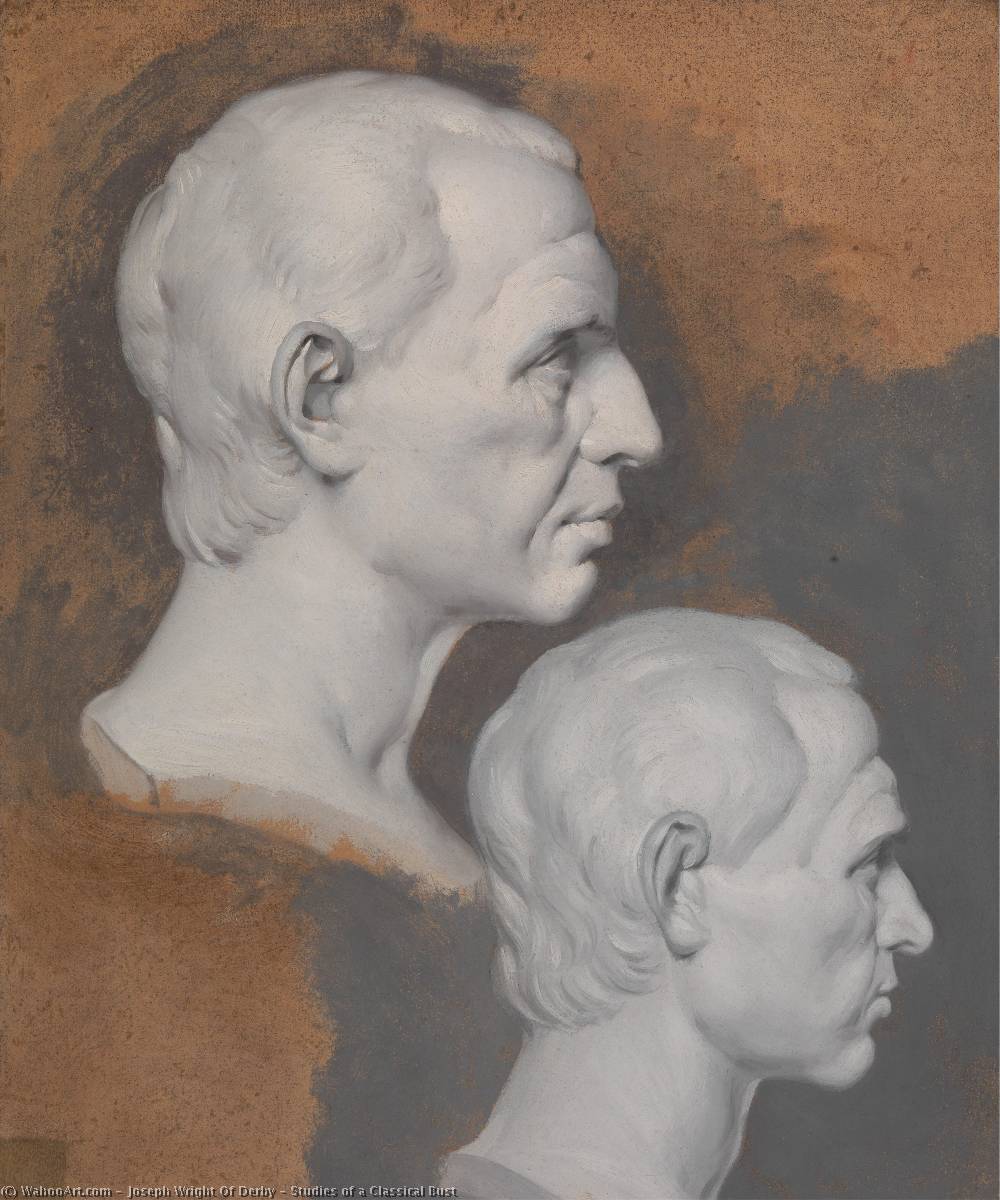
Studies of a Classical Bust

Explore Joseph Wright's masterful depiction of two classical busts, capturing the essence of Enlightenment thought and the dawn of industrial innovation. Admire this detailed oil painting housed at Yale Center For British Art.


Joseph Wright of Derby (1734 - 1797)

Explore the captivating works of Joseph Wright of Derby (1734-1797), a pioneer of Industrial Revolution art. Known for dramatic chiaroscuro, moonlight landscapes & philosophical scenes.

Yale Center for British Art (New Haven, United States of America)

Explore British art's evolution at the Yale Center for British Art! From Hogarth to Turner, discover masterpieces in a Louis Kahn-designed space—a hub for scholarship and vibrant exhibitions.

A Window Into Enlightenment Thought

  • Subject Matter: This striking portrait presents two meticulously rendered heads—likely representations of classical busts—capturing the gaze and repose of contemplative men. The artist’s keen eye focuses on capturing subtle nuances of expression, conveying a profound sense of introspection.
  • Artist: Joseph Wright of Derby (1734-1797) emerged as a pivotal figure in British art during the Industrial Revolution. His upbringing instilled in him a dedication to observation and accuracy, qualities that would become hallmarks of his artistic practice.
  • Style: Wright’s style embodies Neoclassical influences blended with an experimental approach characteristic of his time. While adhering to classical ideals of beauty and proportion—evident in the idealized facial features—he simultaneously pushes boundaries through innovative brushwork and tonal modulation, anticipating Romantic sensibilities.

Technique & Materials

  • Medium: Executed in oil on canvas, this artwork demonstrates Wright’s mastery of chiaroscuro – the dramatic interplay of light and shadow—a technique favored by artists like Rembrandt and Caravaggio. The artist skillfully utilizes layering and blending to achieve remarkable depth and realism.
  • Canvas Size: Measuring 51 x 43 cm, the canvas provides ample space for Wright’s detailed rendering, allowing him to capture every contour of the heads with impressive precision.

Historical Context & Significance

  • Era: Created in 1775, “Studies of a Classical Bust” reflects the intellectual ferment of the Enlightenment. The artwork speaks to the burgeoning interest in reason and observation—values championed by thinkers like Voltaire and Rousseau—as well as the transformative impact of industrial advancements on British society.
  • Location: Currently residing at Yale Center For British Art, New Haven, United States, this piece serves as a testament to Wright’s enduring legacy and its continued relevance in contemporary art discourse.

Symbolism & Emotional Resonance

  • Representation: The two heads symbolize contemplation and intellectual inquiry. Their closed eyes suggest a state of deep thought, inviting viewers to consider the profound questions posed by classical philosophy. The artist’s deliberate positioning captures a moment of serene stillness amidst an era defined by rapid change.
  • Decorative Potential

  • Interior Design: “Studies of a Classical Bust” would lend itself beautifully to interior spaces seeking sophistication and intellectual gravitas. Its muted color palette—primarily earthy tones accented with subtle highlights—harmonizes seamlessly with classic or minimalist aesthetics, creating an atmosphere of calm contemplation.