A Timeless Nativity: Juan de Flandes’s Masterpiece
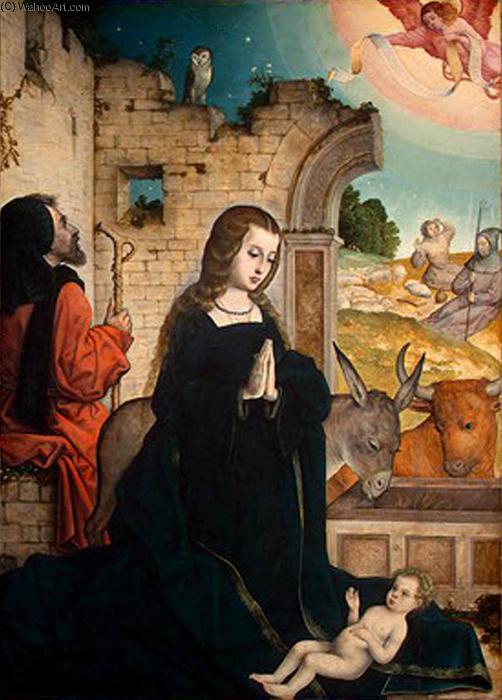
The painting “The Nativity” by Juan de Flandes stands as a poignant and profoundly moving testament to the Early Netherlandish artistic tradition, offering a glimpse into the heart of 16th-century Spanish courtly life. More than simply a depiction of a biblical event, it’s a carefully constructed tableau brimming with symbolic weight and technical brilliance—a work that continues to resonate with viewers centuries after its creation. Commissioned around 1508 for the “capilla mayor” of the church of San Lázaro in Palencia, this oil-on-panel masterpiece reveals the artist's mastery of light, color, and human form, all filtered through a distinctly Spanish sensibility.
Flandes’s approach is immediately recognizable: he seamlessly blends the meticulous detail characteristic of his Flemish training with an awareness of the prevailing aesthetic preferences in Castile. The scene unfolds within a modest stable setting—a deliberate choice that underscores the humility and simplicity at the heart of the Nativity story. The figures, rendered with remarkable realism, are bathed in a soft, diffused light emanating from an unseen source, creating a sense of intimacy and reverence. Note particularly the delicate modeling of Mary’s face, conveying both serenity and profound emotion as she gazes upon her newborn son. The artist's use of chiaroscuro—the dramatic contrast between light and shadow—deepens the emotional impact, drawing our attention to key elements within the composition.
The Language of Symbolism
Beyond its technical merits, “The Nativity” is rich in symbolic meaning. The positioning of the figures – Mary cradling the infant Jesus, Joseph standing protectively beside her, and the angels hovering above – speaks to the core theological themes of faith, hope, and redemption. The presence of the two angels, one holding a lily (a potent symbol of purity) and another offering a star—a direct reference to the prophesied arrival of the Messiah—reinforces this narrative. The carefully chosen details, from the humble furnishings of the stable to the expressions on the faces of the figures, all contribute to a layered interpretation that invites contemplation.
Furthermore, the inclusion of shepherds, traditionally depicted as simple rural folk, highlights the universality of the Nativity’s message—that salvation is offered to all. Their attentive gaze towards the newborn Jesus suggests a profound sense of wonder and reverence. The artist's skillful depiction of their clothing and demeanor reflects the social realities of the time, grounding the sacred narrative within a tangible human context.
A Window into a Renaissance Court
The painting’s journey through history is as fascinating as its artistic merit. Initially part of the “capilla mayor” of San Lázaro in Palencia, it eventually found its way to the royal collection in Madrid and subsequently to the National Gallery of Art in Washington D.C., where it remains a prized possession. Juan de Flandes’s work reflects the artistic tastes of Queen Isabella I of Castile, who commissioned many works for her court. His style demonstrates an ability to adapt Flemish techniques to Spanish sensibilities, creating a unique and compelling visual language.
The acquisition by the Kress Foundation in 1953 marked a pivotal moment in the painting’s history, bringing it to American audiences. Today, “The Nativity” serves as a powerful reminder of the enduring legacy of Early Netherlandish art and its ability to transcend time and cultural boundaries. It is not merely a beautiful image; it's a profound meditation on faith, family, and the promise of hope—a timeless masterpiece that continues to captivate viewers with its exquisite detail and emotional depth.
Technical Details & Artistic Style
Measuring 111 x 79 cm, “The Nativity” is executed in oil on panel, a technique favored by Flandes for its ability to achieve remarkable luminosity and textural richness. The artist’s meticulous attention to detail is evident in every brushstroke—from the delicate folds of Mary's robe to the intricate patterns of the stable walls. His use of color is restrained yet sophisticated, relying on subtle gradations and tonal variations to create a sense of depth and realism. The painting exemplifies the hallmarks of Early Netherlandish art: precise observation, meticulous rendering, and an emphasis on naturalism—all combined with a distinctly Spanish flair.
About the Artist – Juan de Flandes
Juan de Flandes (c. 1460 – by 1519), whose true identity remains shrouded in some mystery, was a pivotal figure in bridging the artistic traditions of Flanders and Spain during the late 15th and early 16th centuries. Born likely in Flanders, he spent much of his career working at the Spanish court under Queen Isabella I, producing portraits of royalty and elaborate religious altarpieces. His work is characterized by a refined elegance, a masterful command of light and shadow, and an ability to seamlessly blend Flemish techniques with Spanish aesthetic preferences. Further research reveals connections to prominent artists like Joos van Wassenhove and Hugo van der Goes, suggesting a strong foundation in the Ghent School tradition.