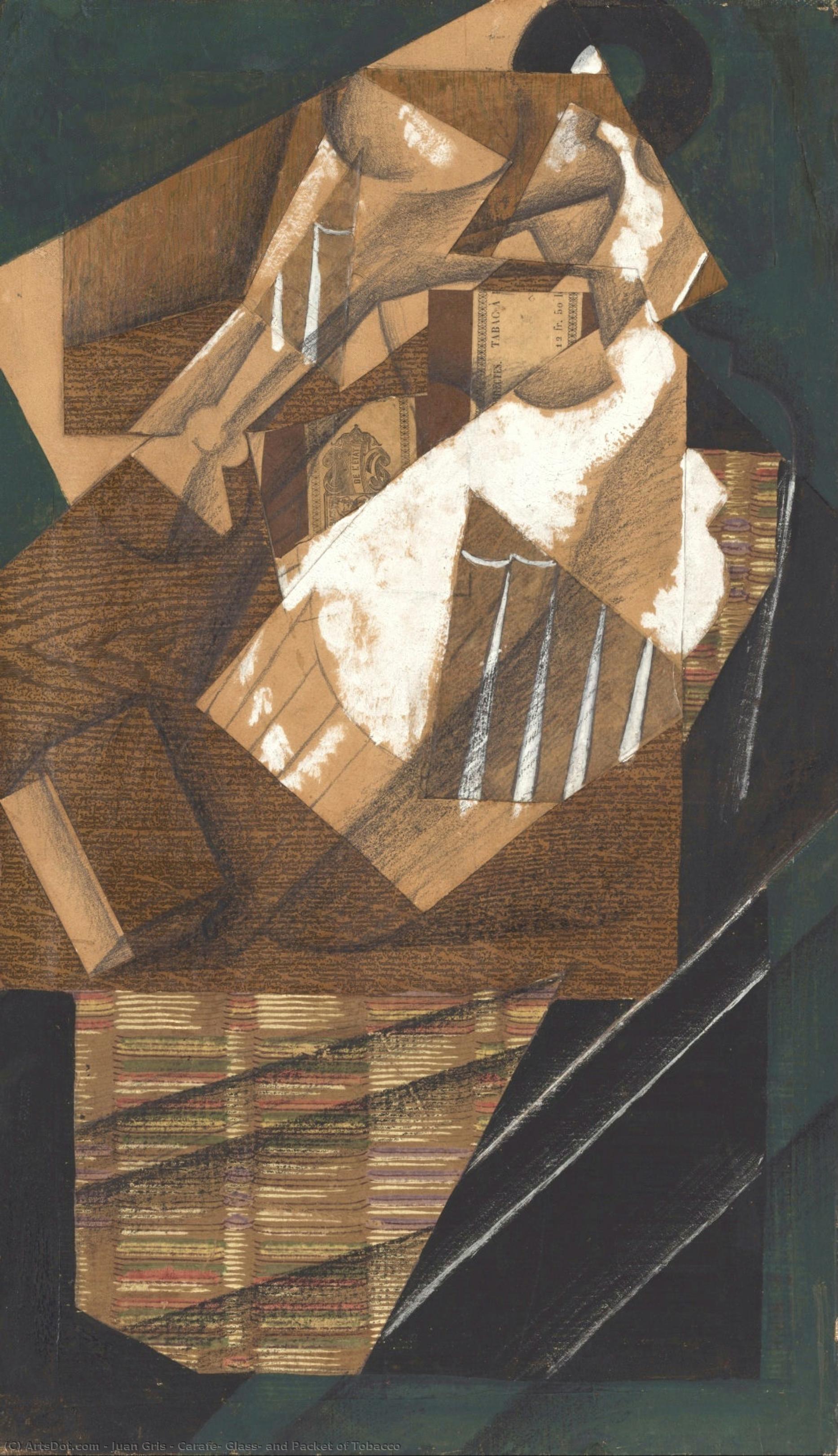
Juan Gris's "Carafe, Glass, and Packet of Tobacco" (1914) exemplifies Synthetic Cubism with meticulous charcoal rendering depicting a man seated on a chair holding a glass and cigarettes—a striking visual narrative displayed at the Virginia Museum of Fine Arts.
Explore Juan Gris (1887-1927), the Spanish Cubist master! Discover his geometric style, Synthetic Cubism & lasting influence on modern art. View artworks now.
Explore world-class art at the Virginia Museum of Fine Arts in Richmond! Discover ancient artifacts, Fabergé eggs & diverse collections – free admission awaits!
Juan Gris’s “Carafe, Glass, and Packet of Tobacco”: A Synthesis of Cubist Vision
The painting "Carafe, Glass, and Packet of Tobacco," created in 1916 by Juan Gris, stands as a cornerstone of Synthetic Cubism—a movement that irrevocably altered the landscape of early 20th-century art. Displayed prominently at the Virginia Museum of Fine Arts in Richmond, United States, this deceptively simple still life transcends mere representation, delving into profound explorations of form and perception. Gris’s masterful manipulation of charcoal lends an austere elegance to the composition, emphasizing geometric precision against a muted tonal palette.
The Genesis of Synthetic Cubism
Synthetic Cubism emerged from the preceding Analytical Cubism phase—characterized by fractured planes and simultaneous viewpoints—as artists sought to distill the essence of their subjects into fundamental shapes. Pablo Picasso and Georges Braque spearheaded this revolution, rejecting illusionistic depth in favor of constructing images from interlocking cubes and prisms. However, Gris pushed beyond these initial explorations, prioritizing a more harmonious aesthetic while retaining the core principles of Cubist fragmentation. He deliberately avoided mirroring reality, instead presenting an idealized version imbued with intellectual contemplation.
Deconstructing Form: Technique and Composition
Gris’s technique is meticulously controlled, employing precise brushstrokes to delineate the contours of each object—the carafe, the glass vessel holding liquid, and crucially, the packet of tobacco—with unwavering accuracy. These forms are not rendered as they appear to the eye but rather dissected into geometric components that exist independently yet contribute to a unified visual experience. The arrangement is deliberately asymmetrical, creating tension and dynamism within the frame. This compositional imbalance mirrors the fragmented nature of Cubist thought itself, reflecting a desire to challenge conventional artistic conventions.
Symbolism Within Geometric Precision
Beyond its formal qualities, “Carafe, Glass, and Packet of Tobacco” carries symbolic weight. The carafe represents stability and domesticity—a counterpoint to the dynamism suggested by the glass and tobacco packet. The tobacco packet symbolizes intellectuality and contemplation—reflecting Gris’s own philosophical engagement with the movement's ideas. These elements are presented not as literal depictions but rather as abstracted forms that evoke emotional resonance, inviting viewers to contemplate the complexities of perception and representation.
A Legacy of Innovation
“Carafe, Glass, and Packet Tobacco” solidified Gris’s position as a pioneer of Synthetic Cubism—a movement that profoundly influenced subsequent generations of artists. Its enduring appeal lies in its ability to convey both intellectual rigor and emotional depth—demonstrating that artistic innovation can coexist with aesthetic beauty. Today, reproductions of this iconic painting continue to inspire collectors and interior designers alike, serving as a testament to Gris’s unwavering commitment to challenging artistic boundaries and redefining the possibilities of visual expression.