Juan Gris's *Fruit Dish and Carafe*: A Symphony of Geometric Harmony
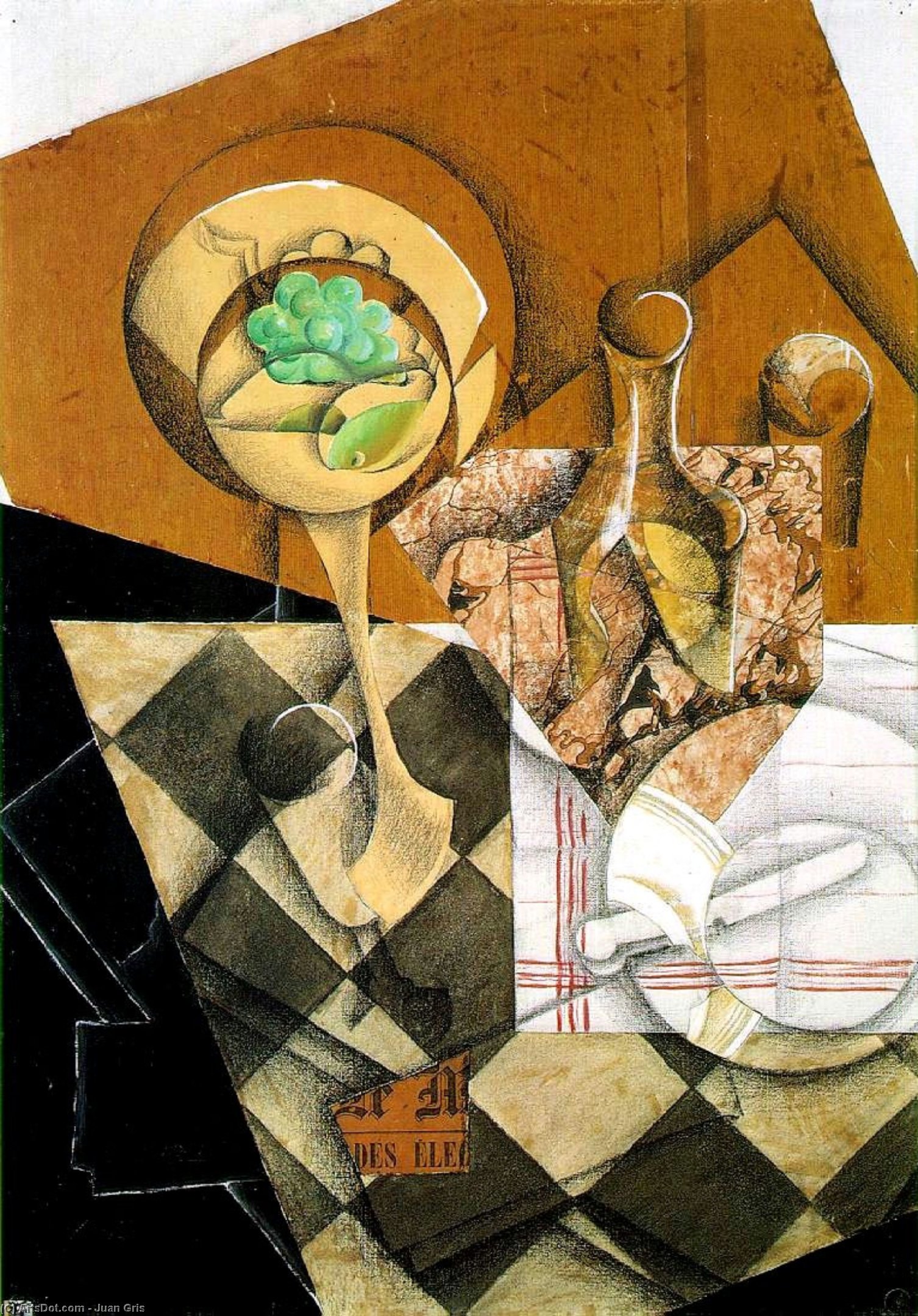
Juan Gris’s *Fruit Dish and Carafe*, painted in 1914, is more than just a still life; it’s a foundational statement of Synthetic Cubism, a movement that irrevocably altered the course of modern art. Measuring 92 x 65 cm, this deceptively simple composition – a fruit dish brimming with apples and oranges, a carafe, bottles, and a wine glass – explodes with intellectual energy and visual dynamism. Created during a period of intense artistic experimentation, it represents a pivotal moment in the evolution of abstraction, showcasing Gris’s mastery of form, color, and spatial illusion.
- Style: Synthetic Cubism - Characterized by flattened planes, fragmented forms, and an emphasis on geometric shapes.
- Technique: Gris employed a meticulous layering technique, building up the image through thin glazes of oil paint, creating a remarkable depth and luminosity despite the predominantly two-dimensional representation. The use of color is deliberate and strategic, enhancing the sense of volume and spatial recession.
The Genesis of Fragmentation
Gris’s approach to depicting everyday objects was revolutionary. He didn't simply represent a fruit dish; he dissected it, analyzed its constituent parts – the curves of the bowl, the rounded forms of the fruit, the angularity of the carafe – and reassembled them in a radically new way. This fragmentation wasn’t arbitrary; it reflected a broader intellectual current at the time, influenced by developments in mathematics, engineering, and music theory. The artist sought to capture not just the appearance of objects but their underlying structure, mirroring the principles of analytical geometry.
A Historical Context: Cubism's Bold Experimentation
*Fruit Dish and Carafe* was born within the crucible of early 20th-century artistic innovation. Following Picasso and Braque’s pioneering work in Analytical Cubism, Gris pushed the style further into Synthetic Cubism, characterized by bolder colors, collage elements (though not present here), and a greater emphasis on decorative qualities. The painting reflects the spirit of intellectual ferment that defined this era – a desire to challenge traditional notions of representation and explore new ways of seeing and understanding the world.
Symbolic Resonance and Emotional Impact
Beyond its formal innovations, *Fruit Dish and Carafe* possesses a subtle emotional resonance. The carefully arranged objects evoke a sense of domestic tranquility, yet the fragmented composition introduces an element of tension and uncertainty. The vibrant colors – reds, yellows, blues – contribute to this dynamic interplay, drawing the viewer’s eye across the canvas and inviting contemplation. The painting's enduring appeal lies in its ability to simultaneously celebrate the beauty of everyday objects and provoke a deeper engagement with the fundamental questions of perception and representation.