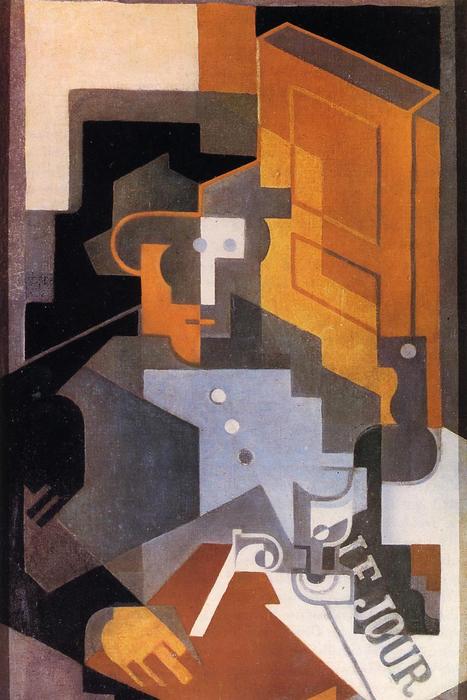
Experience the brilliance of Cubism! Juan Gris's 'Man from Touraine,' a 1918 masterpiece housed at Pompidou Centre, showcases geometric forms and fragmented perspectives – redefining artistic representation.
Man from Touraine: A Fragmented Portrait of Modernity
Juan Gris’s “Man from Touraine,” completed in 1918 during the height of Cubist fervor, isn't merely a depiction of a man; it’s an audacious exploration of perception and representation itself. Painted on canvas measuring 100 x 65 cm and currently residing at the Musée National d’Art Moderne Centre Georges Pompidou in Paris, this artwork encapsulates the revolutionary spirit of its time—a period defined by artists like Picasso wrestling with how to capture reality beyond surface appearances.
- Composition & Style: The painting presents a man seated down, his head tilted slightly as if observing something unseen. Gris employs a masterful technique of geometric fragmentation, dissecting the figure into interlocking planes—a hallmark of Cubism’s challenge to traditional perspective. Notice how the blue uniform is rendered in angular shards, mirroring the fractured reality he seeks to convey.
- Technique: Gris utilized oil paint on canvas, applying thin layers of pigment to build up texture and depth despite the stylized forms. The meticulous attention to detail—evident in the rendering of the hat and the book—demonstrates a commitment to capturing nuances that wouldn’t be possible with more conventional methods.
- Historical Context: Created amidst the turbulent backdrop of World War I, “Man from Touraine” reflects the anxieties and uncertainties of the era. Cubism emerged as a reaction against Impressionism's focus on fleeting impressions, prioritizing intellectual analysis over sensory experience—a deliberate stance against the comforting illusions of the past.
- Symbolism: The book symbolizes knowledge and contemplation, juxtaposed with the man’s gaze directed outwards. This visual dialogue suggests an internal struggle between observation and understanding, mirroring the broader philosophical debates surrounding the nature of consciousness during this period.
More than just a beautiful image, “Man from Touraine” compels us to reconsider our own ways of seeing. Gris’s fragmented portrait isn't simply showing us what is there; it’s inviting us to actively participate in reconstructing the scene—a testament to Cubism’s enduring power as an artistic paradigm and its profound influence on subsequent generations of artists.
For those seeking inspiration or considering a high-quality reproduction, ArtsDot.com offers exceptional prints that faithfully capture Gris's groundbreaking vision. Explore Wikipedia for further insights into Juan Gris’s life and legacy—a story as captivating as the artwork itself.