The
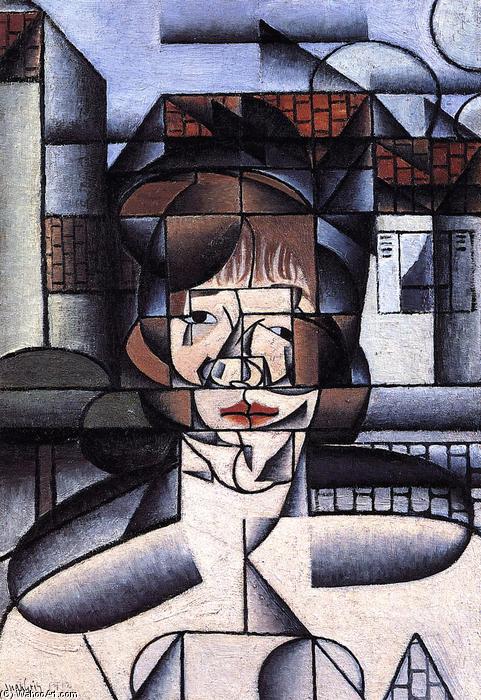
Portrait of Germaine Raynal by
Juan Gris is a seminal work of
Analytical Cubism, a style that revolutionized the art world in the early 20th century. Created in 1912, this oil on canvas piece measures 55 x 38 cm and is a quintessential example of Gris's unique approach to Cubism.
Background and Style
The painting features a woman's face with her eyes closed, depicted in a complex composition of interlocking planes and geometric shapes. The subject's features are abstractly but recognizably rendered through the use of sharp lines and overlapping shapes. The background appears to merge with the figure, demonstrating the Cubist approach to blending figure and space. Gris's signature can be seen clearly in the lower part, adding a personal touch to this striking example of early 20th-century modern art. The
Portrait of Germaine Raynal is characterized by its use of
muted colors and
monochrome, which suggest depth and volume. The painting's Cubist approach influenced many subsequent artists, establishing Gris as a key figure in the development of 20th-century art. For more information on
Juan Gris and his works, visit /art/list/?Filter=8YDNS4-Juan-Gris-Portrait-of-Germaine-Raynal.
Artistic Movement
The
Portrait of Germaine Raynal is part of the
Analytical Cubism movement, which emphasized the breakdown of objects into geometric shapes and overlapping planes. This style was pioneered by artists such as
Pablo Picasso and
Georges Braque, and was characterized by its use of
fragmented forms and
muted colors. For more information on Cubism, visit https://en.wikipedia.org/wiki/Cubism. Some notable works by
Juan Gris include:
The
Museum of Modern Art (New York, United States) and the
Newport Art Museum and Art Association (United States) are just a few examples of museums that have featured works by
Juan Gris in their collections. For more information on these museums, visit /art/list/?Filter=A@D3ALHH-Newport-Art-Museum-and-Art-Association-(United-States).
The
Portrait of Germaine Raynal is a masterpiece of Analytical Cubism, and its influence can still be seen in modern art today. Its complex composition and use of geometric shapes make it a fascinating example of early 20th-century art.