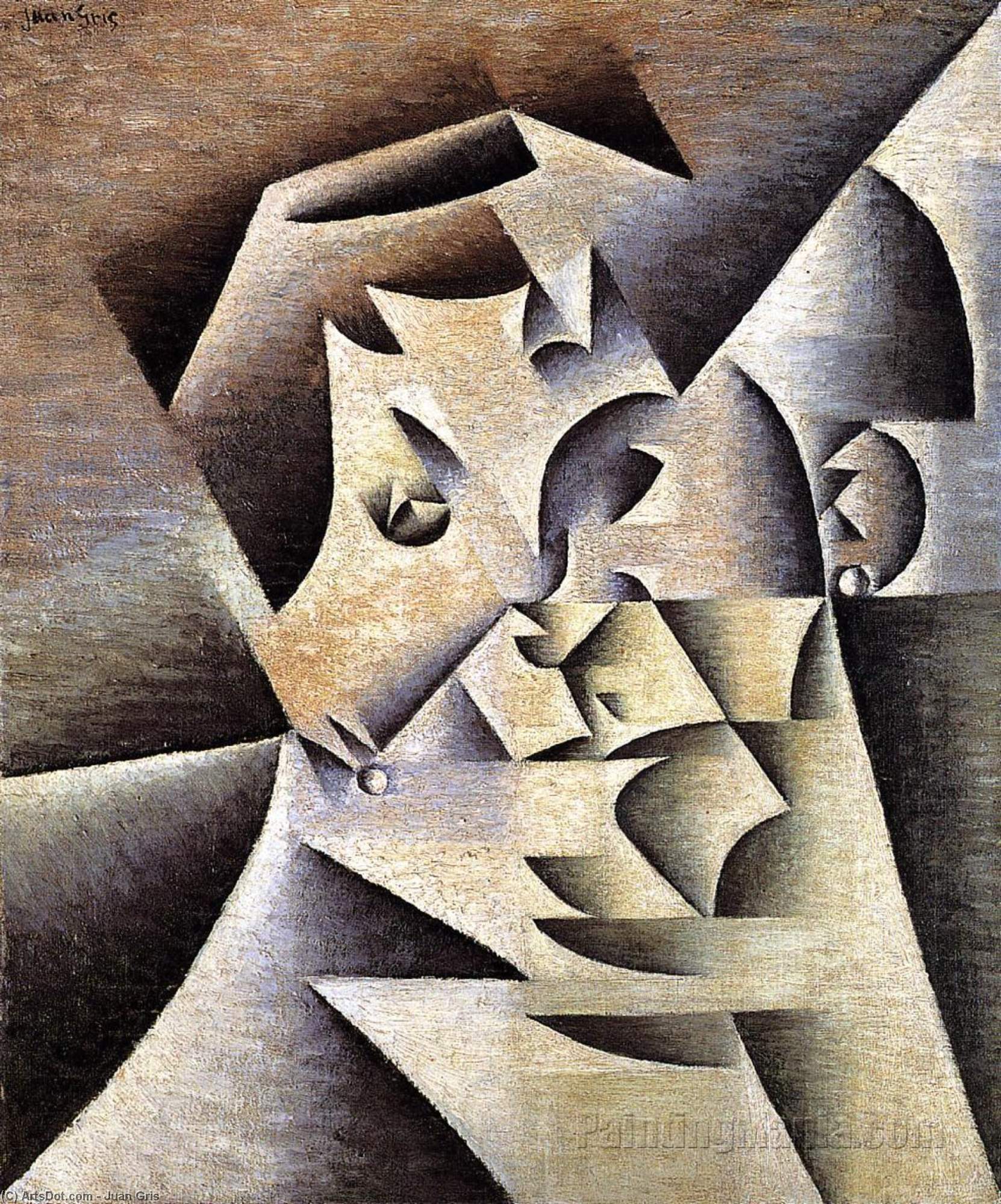
A Tender Fragment of Cubism
In the vast, often fragmented landscape of early 20th-century modernism, few works manage to balance intellectual rigor with profound human intimacy as exquisitely as Juan Gris’s Portrait of the Artist's Mother. Painted in 1912, this masterpiece serves as a cornerstone of Analytical Cubism, a movement that sought to deconstruct reality into its fundamental geometric components. Yet, beneath the complex layers of overlapping planes and intersecting lines, there lies a heartbeat of pure emotion. The painting captures a moment of quiet, sacred connection, where two faces lean toward one another, their noses touching in a gesture so tender it transcends the very abstraction that defines the style.
To gaze upon this work is to witness the precise moment where the analytical mind meets the poetic soul. Gris, who brought an engineer's precision to his canvases, utilizes a sophisticated palette of warm browns and cool, muted tones to create a sense of depth and volume. The background, a rich and earthy brown, acts as a stage that pushes the subjects forward, ensuring that the viewer’s eye is immediately drawn to the central point of contact. This interplay of light and shadow does more than just define form; it breathes life into the geometric shapes, transforming cold polygons into a breathing, feeling presence.
The Architecture of Emotion
The technique employed in this portrait is a masterclass in the Cubist revolution. Unlike the more chaotic deconstructions seen in some works of his contemporaries, Gris’s approach is remarkably systematic. He breaks down the human form into a rhythmic arrangement of facets and edges, yet he retains enough recognizable detail—such as the delicate curve of an ear or the soft contour of a cheek—to anchor the viewer in reality. This duality creates a captivating tension: the eye attempts to reconstruct the whole person while simultaneously being mesmerized by the beauty of the individual fragments.
For the collector or the interior designer, this piece offers a unique opportunity to introduce a sense of intellectual depth and sophisticated warmth into a space. The painting’s complex composition provides a focal point that invites prolonged contemplation, making it an ideal centerpiece for a gallery wall or a prominent position in a study. Its ability to harmonize structured geometry with soft, emotional resonance allows it to complement both minimalist modern interiors and more classical, textured environments. Owning a high-quality reproduction of this work is not merely about acquiring art; it is about bringing a piece of history’s most transformative era into the contemporary home, offering a window into a moment where the world was being reimagined through the lens of light, shape, and love.