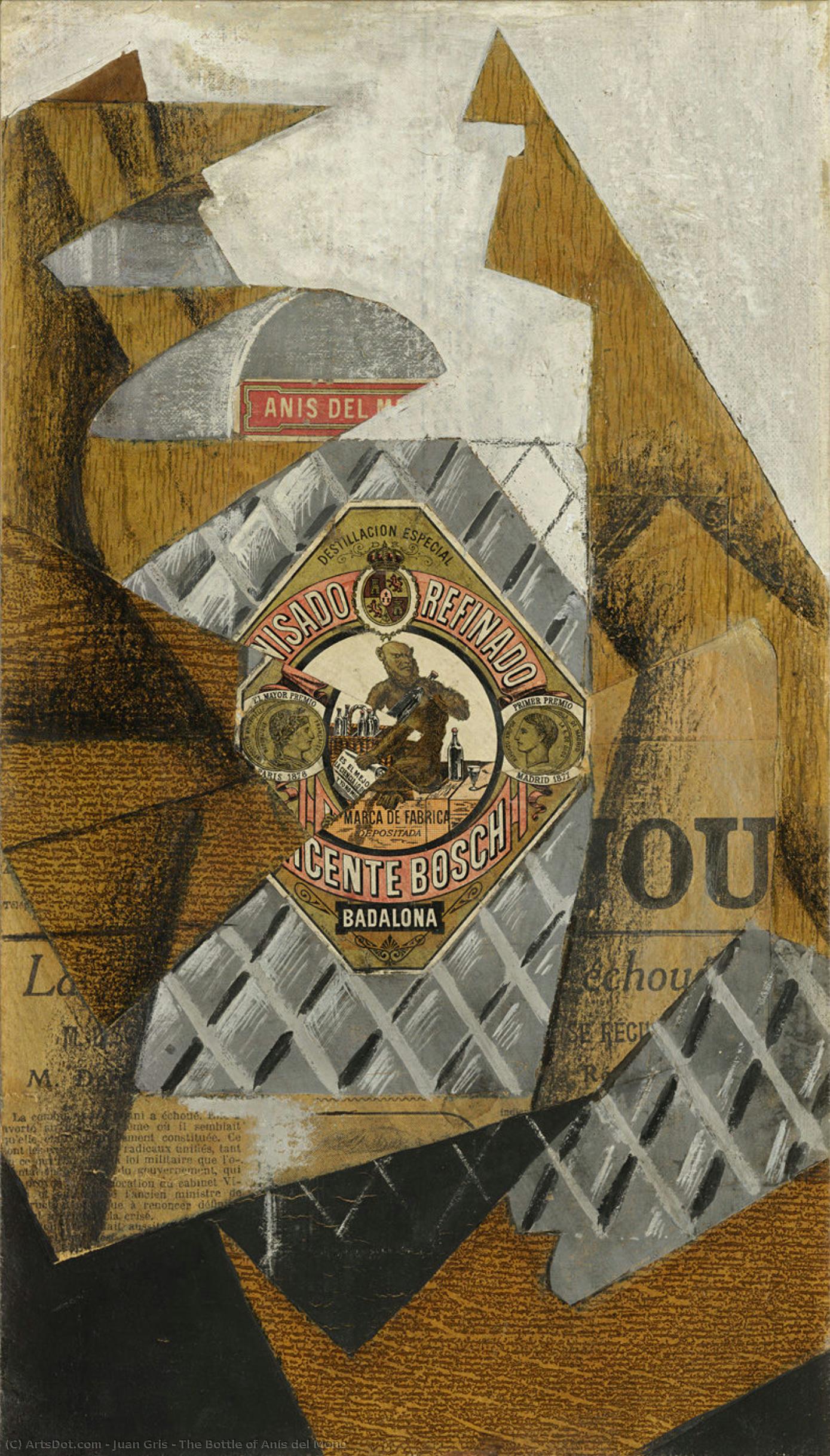
The Bottle of Anís del Mono: A Fragmented Reflection
Juan Gris’s “The Bottle of Anís del Mono,” painted in 1914, isn't merely a still life; it’s a meticulously constructed puzzle box of observation and abstraction. This deceptively simple image—a bottle of the iconic Spanish anise liqueur, Anís del Mono—holds within its carefully arranged elements a profound commentary on identity, displacement, and the very nature of representation itself. Gris, a Spaniard navigating the vibrant, often turbulent, artistic landscape of early 20th-century Paris, used this work as a vehicle to explore his own position as an outsider, a foreigner grappling with belonging within a rapidly changing world.
The painting’s core is rooted in Cubism's revolutionary approach to depicting reality. Gris, alongside Picasso and Braque, abandoned traditional perspective and single viewpoints, instead fracturing objects into geometric planes and presenting multiple facets simultaneously. The bottle itself isn’t rendered as a unified form; it’s dissected and reassembled, its curves and angles broken down into sharp, interlocking shapes. This fragmentation mirrors the artist's own experience of being adrift – a feeling keenly felt by many expatriates in Paris at the time. The background, dominated by a series of triangular planes, further emphasizes this sense of disorientation and instability.
A Collage of Meaning: Layers of Symbolism
Beyond its purely formal qualities, “The Bottle of Anís del Mono” is rich with symbolic layers. The prominent inclusion of the bottle’s label—featuring a monkey with an elongated tail (the "cola de mono") – immediately anchors the work in Spanish culture and tradition. This playful detail hints at a connection to home, yet it's juxtaposed against the stark, almost clinical, presentation of the object itself. The newspaper clipping, strategically placed within the composition, adds another layer of complexity. It references a controversial law regarding military service, subtly suggesting themes of national identity, obligation, and perhaps even resistance.
Notably, the inclusion of medals from Paris and Madrid—cities central to the Cubist movement—positions Gris as an integral part of this groundbreaking artistic circle. However, their placement is deliberately ambiguous, hinting at a complex relationship between personal ambition and broader artistic affiliations. The deliberate cutting off of the words “ou” (or) in the newspaper fragment forces a choice, mirroring the artist’s own struggle to reconcile his Spanish heritage with his adopted French identity.
Technique and Context: A Pioneering Approach
Gris's masterful use of collage—incorporating elements like newspaper fragments and printed text—was a defining characteristic of Synthetic Cubism. He didn’t simply paint *about* objects; he actively integrated them into the artwork, blurring the boundaries between reality and representation. The painting is executed in oil on canvas, employing a technique that balances sharp geometric forms with subtle gradations of color. The muted palette—primarily browns, grays, and ochres—contributes to the work’s overall sense of quiet contemplation.
Created during a period of immense social and political upheaval – the eve of World War I – “The Bottle of Anís del Mono” reflects the anxieties and uncertainties of the era. It's a testament to Gris’s ability to distill complex ideas into a visually arresting composition, offering not just a depiction of an object but a profound meditation on identity, displacement, and the evolving role of art in modern society. The painting remains a powerful example of Cubism’s innovative spirit and its enduring relevance today.
A Timeless Appeal: Reproduction Possibilities
Reproductions of “The Bottle of Anís del Mono” offer an exceptional opportunity to bring this captivating artwork into any space. High-quality prints on canvas or archival paper capture the painting’s rich textures and subtle color variations, faithfully recreating Gris's masterful technique. The dynamic composition—with its fragmented forms and layered symbolism—makes it a striking focal point in a living room, study, or gallery. Consider framing options that complement the artwork’s inherent elegance, allowing this iconic piece of modern art to continue inspiring and engaging viewers for generations to come.