Juan Gris’s “The Fruit Bowl”: A Symphony of Cubist Fragmentation
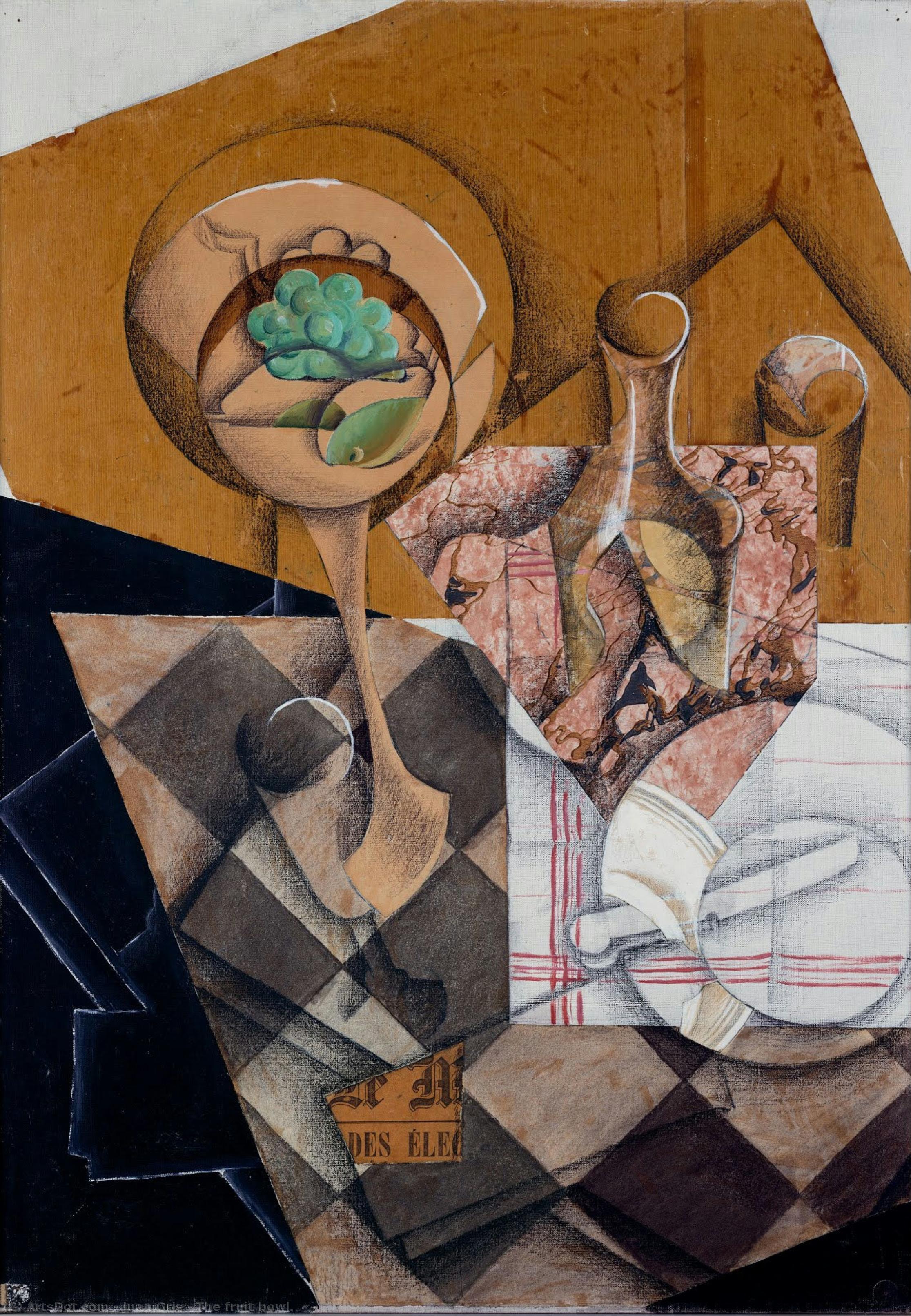
Juan Gris's "The Fruit Bowl," painted in 1914, isn’t merely a still life; it’s a meticulously constructed meditation on perception and reality. Emerging from the vibrant crucible of early 20th-century Paris, this work embodies the radical innovations of Cubism while simultaneously hinting at a profound exploration of visual language. Gris, deeply influenced by the geometric explorations of Picasso and Braque, yet forging his own distinct path, presents us with an image that deliberately disrupts traditional notions of representation, inviting the viewer to actively participate in its construction.
The painting’s subject – a humble fruit bowl overflowing with apples, oranges, and grapes – is rendered through a process of deliberate fragmentation. Rather than offering a faithful depiction of form, Gris breaks down each object into its constituent geometric shapes: cylinders, spheres, planes, and sharp angles. These elements are then reassembled on the canvas in an arrangement that prioritizes structure and spatial relationships over literal accuracy. The bowl itself is not presented as a solid volume but rather as a collection of overlapping planes, creating a sense of depth and dynamism within the confined space of the painting.
The Language of Collage and “Le Vrai et Le Faux”
What truly distinguishes "The Fruit Bowl" is Gris’s masterful incorporation of collage. He meticulously pasted fragments of newspaper – a deliberate choice reflecting the burgeoning interest in mass media at the time – onto the canvas, layering them with painted elements. This technique wasn't simply decorative; it was a conscious effort to blur the boundaries between reality and representation. The inclusion of the phrase “Le vrai et le faux” (The real and the false) on one of the newspaper fragments directly addresses this tension, acknowledging the inherent artificiality of painting itself – the act of creating an illusion of reality. This bold statement underscores Gris’s commitment to exposing the constructed nature of visual perception.
The use of white paint on the canvas—particularly within the bowl's frame—further emphasizes this concept. The untreated, raw material of the canvas becomes a crucial element, visually merging with the painted reality and creating a palpable sense of layering and ambiguity. It’s as if Gris is inviting us to question what constitutes “real” – is it the tangible objects before us, or the representation we perceive through the act of looking?
A Synthesis of Color and Form
Despite the fragmented composition, "The Fruit Bowl" isn't a study in monochrome austerity. Gris employs a carefully considered palette of muted reds, yellows, and browns, punctuated by vibrant splashes of color within the fruit itself. This restrained use of color contributes to the painting’s overall sense of balance and harmony, while simultaneously drawing attention to the individual elements within the still life. The interplay between these colors creates a subtle visual rhythm that guides the viewer's eye through the composition.
Gris’s meticulous attention to detail—the precise rendering of each geometric shape, the careful placement of every newspaper fragment—demonstrates his commitment to both formal innovation and technical mastery. “The Fruit Bowl” is not just a product of Cubist experimentation; it's a testament to Gris’s exceptional skill as an artist and his profound understanding of the power of visual language.
A Legacy of Geometric Vision
Painted in 1914, "The Fruit Bowl" stands as a pivotal work in the development of Cubism. It exemplifies the movement's core principles – fragmentation, abstraction, and the exploration of multiple perspectives—while simultaneously establishing Gris’s unique artistic voice. His innovative use of collage, combined with his masterful control of color and form, cemented his place among the most influential artists of the 20th century. Reproductions of this captivating artwork offer a glimpse into a world where reality is deconstructed, reassembled, and ultimately redefined through the power of art.