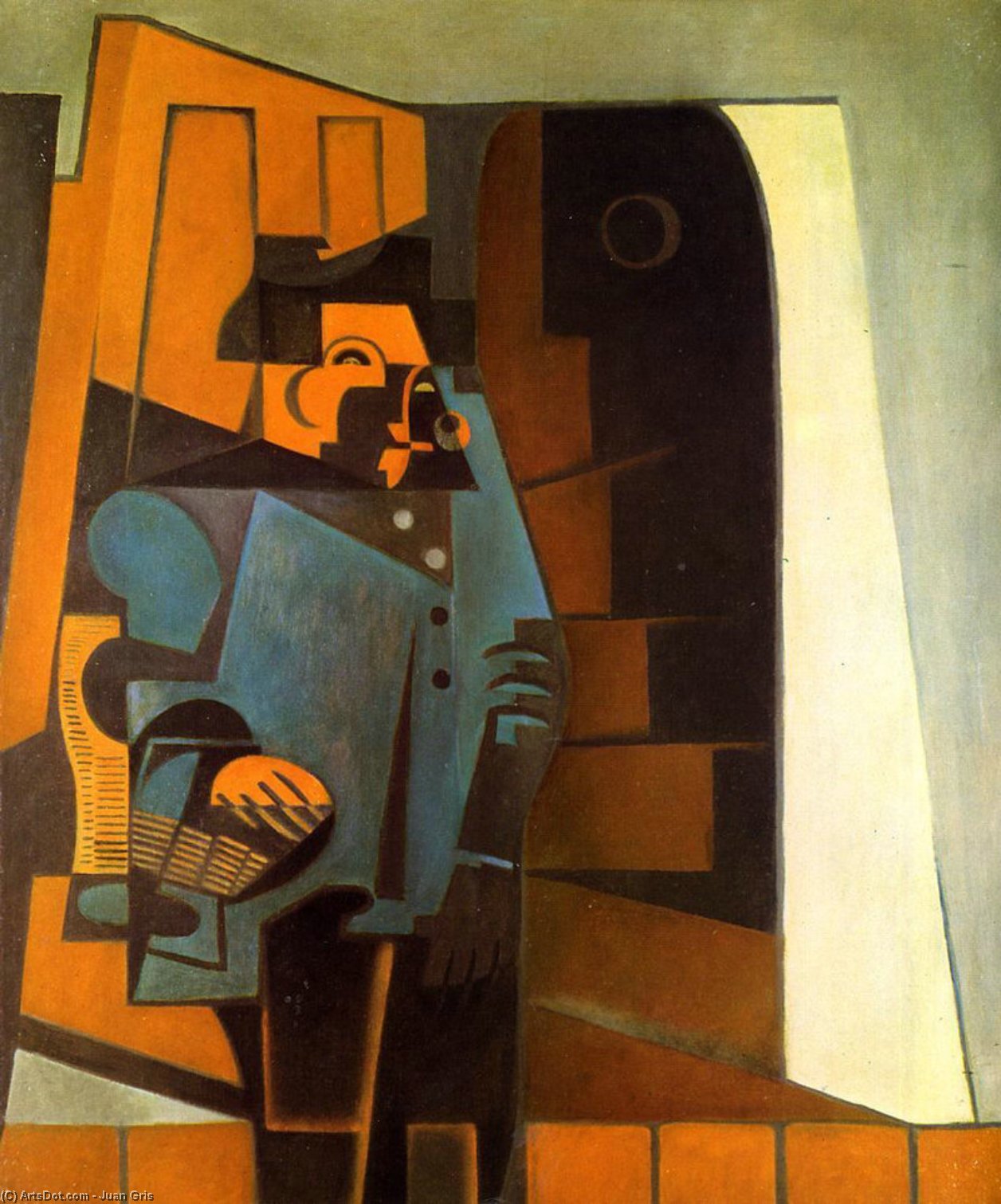
The Geometry of Vision: Exploring Juan Gris's The Miller
To stand before Juan Gris’s The Miller is not merely to observe a painting; it is to step into a meticulously constructed intellectual space where reality itself has been disassembled and reassembled. Created in 1918, this seminal work stands as a profound testament to the power of Cubism—an art movement that dared to shatter the polished veneer of traditional representation. Gris, deeply influenced by the revolutionary breakthroughs of Picasso and Braque, channeled his own analytical mind, honed perhaps even during his early studies in engineering, into a visual language that is both rigorously structured and breathtakingly dynamic. The painting confronts the viewer with a subject—a seated figure at what appears to be an instrument—but renders it through a prism of geometric abstraction.
Mastery of Synthetic Cubism
Technically speaking, The Miller is a quintessential example of Synthetic Cubism. Unlike earlier explorations that merely fragmented forms, Gris’s approach here emphasizes the construction itself. Observe how the figure and its surroundings are broken down into overlapping planes, sharp angles, and simplified geometric components. The artist does not depict what he sees in a single glance; rather, he presents multiple viewpoints simultaneously, forcing the eye to reconcile disparate facets of existence on a single canvas. This masterful layering creates an illusion of depth that is achieved not through traditional linear perspective, but through careful juxtaposition and overlapping forms. The color palette supports this intellectual rigor: warm oranges, earthy browns, and sunny yellows anchor the composition, providing a vibrant counterpoint to cooler blues and grays, all bound together by sharply defined, almost architectural lines.
Symbolism and the Subjective Experience
Beyond its formal brilliance, The Miller invites contemplation on the nature of perception. The solitary figure, enveloped within this geometric matrix, can be read as a profound meditation on consciousness itself. Cubism, at its heart, was an attempt to map the subjective experience—the way our minds process time and space, which is inherently non-linear. Gris seems to suggest that reality is not a single, fixed moment, but rather a complex interplay of angles, memories, and simultaneous perspectives. For the collector or designer, this translates into an object that sparks conversation, suggesting depth and intellectual curiosity within any curated setting.
An Enduring Presence for Modern Interiors
For those seeking art that speaks to both history and modernity, The Miller offers unparalleled resonance. Its bold structure and controlled vibrancy make it a spectacular focal point. While the subject matter is deeply rooted in early 20th-century avant-garde movements, its clean lines and sophisticated color balance allow it to integrate seamlessly into contemporary interiors—be they minimalist galleries or richly decorated drawing rooms. Owning a reproduction of this work is acquiring more than just an image; it is adopting a piece of art history that celebrates the triumph of intellect over mere imitation, offering a permanent visual dialogue with one of the most innovative periods in human artistic endeavor.