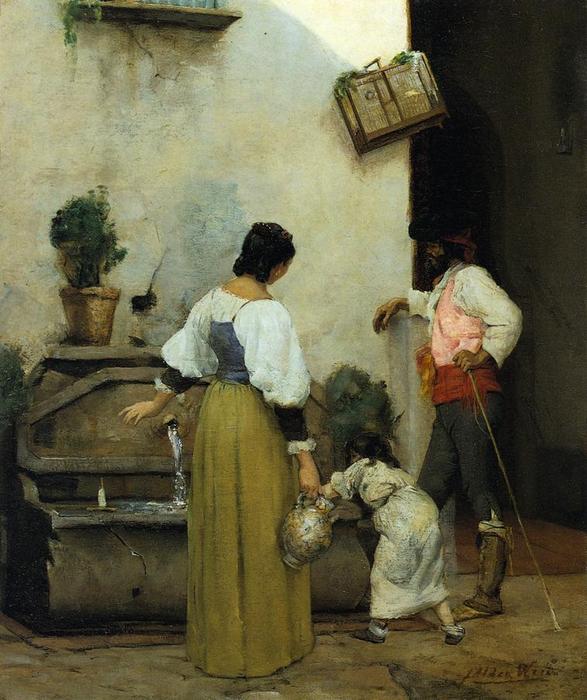
A Glimpse into Pastoral Serenity: Julian Alden Weir's "At the Water Trough"
To stand before At the Water Trough is to step unceremoniously into a sun-dappled moment of quiet domesticity. This exquisite oil on canvas, dating from 1877, by the masterful American Impressionist Julian Alden Weir, does more than merely depict a scene; it captures the very breath of a bygone era. The composition centers around a rustic water trough, an unassuming fixture that nonetheless anchors the narrative of everyday life in a charming village setting. Observe the gentle grouping of figures—a woman attending to her tasks while two children stand nearby, their presence lending an air of innocent vitality to the scene. Scattered amongst them are potted plants, small bursts of cultivated green that soften the edges of the architecture and ground the viewer in the tangible reality of the moment.
The Impressionist Eye on Rural Life
Weir’s handling of light here is nothing short of luminous. As a key figure in American Impressionism, he possessed an unparalleled gift for translating fleeting atmospheric conditions onto canvas. The technique employed allows the sunlight to filter through unseen elements, creating subtle shifts in color and depth that give the painting its characteristic warmth. It is not merely about what is painted, but how the light interacts with the water, the clothing, and the foliage. This commitment to capturing the ephemeral quality of natural light—a hallmark of Impressionism—ensures that even after decades, the scene feels vibrantly immediate, as if the gentle murmur of village life can still be heard.
A Tapestry of Quiet Symbolism
Beyond the technical brilliance lies a profound sense of peace woven into the fabric of the painting. The water trough itself often symbolizes sustenance and continuity, while the gathering of figures speaks to the enduring bonds of community and family. Weir masterfully imbues this seemingly simple tableau with emotional resonance. It invites contemplation on the rhythms of rural existence—the necessary chores, the shared moments of childhood play, and the quiet dignity found in routine. The inclusion of other figures subtly observing from the periphery adds a layer of narrative depth, suggesting that life is always observed, always witnessed.
Bringing the Charm Home: Art for the Modern Dwelling
For the collector or interior designer seeking to infuse a space with history and soulful tranquility, At the Water Trough offers an unparalleled focal point. The soft palette, dominated by earthy tones punctuated by vibrant greens, harmonizes beautifully with both traditional and transitional decor schemes. Owning a reproduction of this work is not just acquiring art; it is curating a mood—a sanctuary of pastoral calm for your home. It serves as a timeless conversation piece, whispering tales of American artistic heritage while its masterful execution ensures that the beauty remains utterly contemporary.