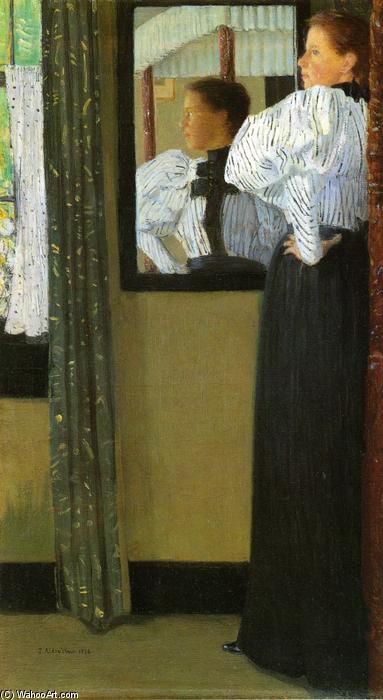
Face Reflected in a Mirror: A Glimpse into Intimacy and Impressionism
Julian Alden Weir's Face Reflected in a Mirror, painted in 1896, is a captivating work housed within the esteemed collection of the Rhode Island School of Design Museum of Art. This oil on canvas painting (61 x 34 cm) exemplifies Weir's mastery of Impressionism and offers a poignant exploration of domesticity, self-awareness, and the subtle nuances of human connection.
Artistic Style and Technique: Capturing Fleeting Moments
The artwork is firmly rooted in the principles of Impressionism. Weir eschews sharp lines and rigid forms, instead employing soft, feathery brushstrokes to capture the fleeting effects of light and atmosphere. The scene depicts two women – one gazing intently at her reflection in a mirror while the other stands discreetly behind her. This composition isn't merely about depicting a physical space; it’s about conveying a mood, an unspoken narrative. The use of oil on canvas allows for rich, vibrant colors and textures, contributing to the painting's overall luminosity. Notice how Weir uses subtle variations in tone to define form and create depth, particularly around the faces and drapery. The chair positioned near the left side adds a sense of spatial context and further enhances the intimate setting.
A Study in Reflection: Symbolism and Narrative
Beyond its aesthetic beauty, Face Reflected in a Mirror invites contemplation on deeper themes. The mirror itself serves as a powerful symbol – representing self-reflection, identity, and perhaps even vanity or introspection. The woman’s focused gaze suggests a moment of personal assessment, while the presence of the other woman hints at a relationship—a confidante, a sister, or simply an observer. Weir masterfully avoids explicit storytelling, leaving room for individual interpretation. The subdued color palette – dominated by muted yellows and greens with accents of black and white in the clothing – contributes to a sense of quiet contemplation and understated elegance. The scene evokes a feeling of domestic tranquility, yet there's also a subtle undercurrent of melancholy or solitude, adding complexity to the artwork’s emotional impact.
Julian Alden Weir: An American Impressionist
Julian Alden Weir (1852-1919) was a prominent figure in American art during the late 19th century. Born into an artistic family, he received formal training at the National Academy of Design and later studied in Paris with Jean-Léon Gérôme. While initially resistant to Impressionism, Weir eventually embraced its principles, becoming known for his lyrical landscapes and intimate genre scenes. He was a founding member of "The Ten," a group of American artists who sought to break away from traditional art institutions. His work can be found in numerous museums and private collections across the United States. Other notable works by Weir include Union Square, Girl in Black, and At the Piano, all showcasing his distinctive Impressionistic style.
Bringing Impressionism Home: A Reproduction for Your Space
Face Reflected in a Mirror is more than just a painting; it's an invitation to step into a moment of quiet reflection. A hand-painted reproduction allows you to experience the beauty and emotional depth of Weir’s masterpiece within your own home or office, adding a touch of timeless elegance and artistic sophistication. Visit ArtsDot.com to explore our collection of high-quality reproductions.