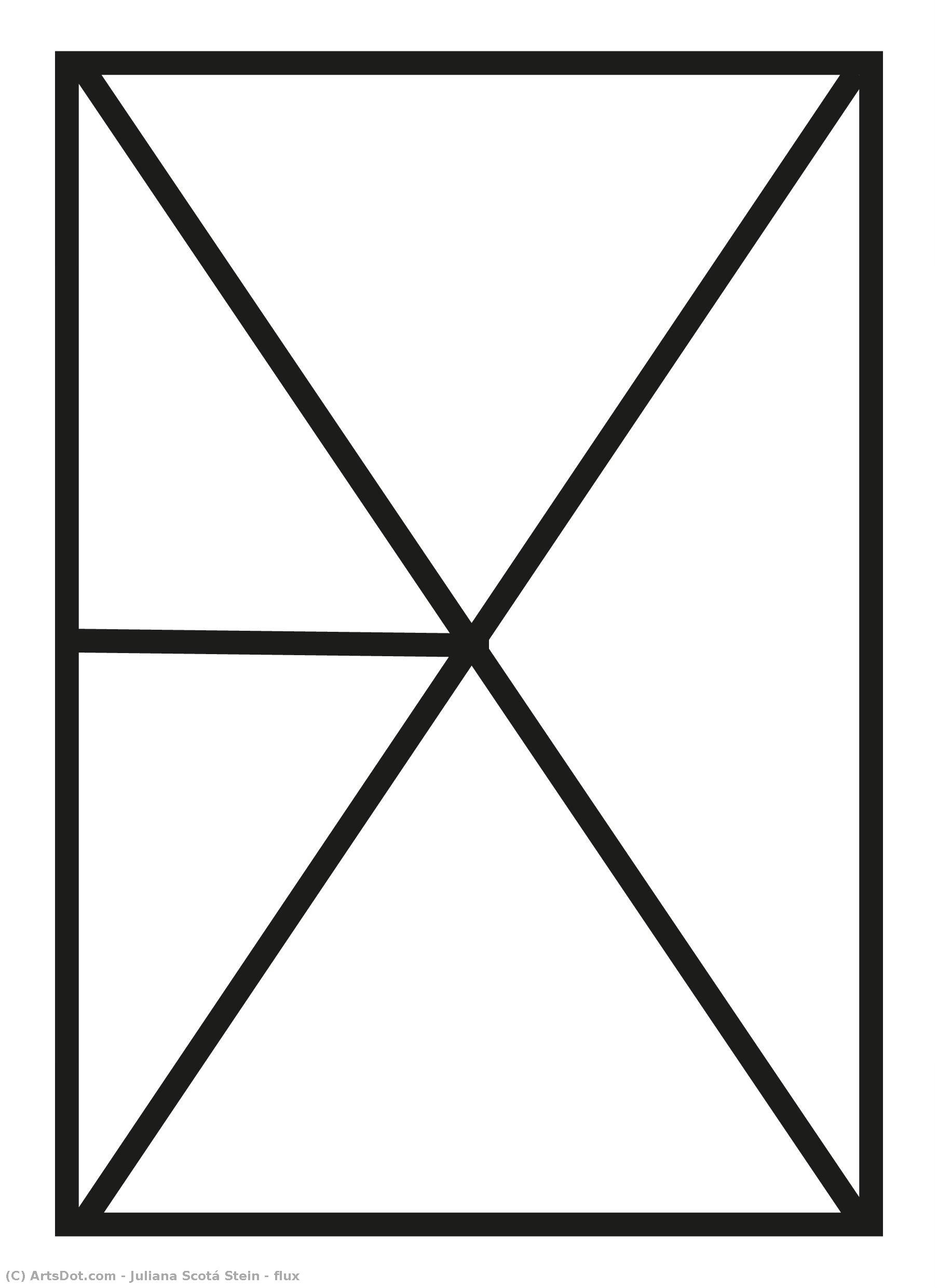
‘Flux’ by Juliana Scotá Stein is a captivating minimalist piece characterized by symmetrical black lines against a pristine white backdrop. Its geometric composition emphasizes order, structure, and subtle emotional resonance.
Minimalist abstract art featuring intersecting black lines on white canvas—a striking exploration of geometric form and precision by Brazilian artist Juliana Scotá Stein.
Flux: A Minimalist Meditation on Structure and Perception
Juliana Scotá Stein’s “Flux” is more than just an abstract composition; it's a distilled essence of artistic contemplation—a testament to the power of simplicity in conveying profound ideas. Born in Passo Fundo, Brazil, in 1970, Stein embarked on her creative journey with a grounding in psychology at UFPR, recognizing that visual perception shapes our understanding of the world.
The artwork itself presents a striking dichotomy: a stark white canvas punctuated by intersecting black lines. These lines don’t merely divide space; they establish a geometric grid—a deliberate structuring force—that subtly guides the viewer's gaze. The dominant square, bisected diagonally, embodies stability and balance, while the horizontal line anchors the lower portion of the image.
Stein’s artistic philosophy revolves around “reflection on process,” acknowledging that the final visual outcome is inseparable from the preceding explorations. This approach informs her meticulous technique—likely achieved through digital illustration or painstaking hand-drawing—resulting in a surface devoid of texture, emphasizing precision and clarity. The deliberate flatness contributes to an atmosphere of serene contemplation.
Stylistically, “Flux” aligns with movements like Constructivism and Suprematism, prioritizing geometric forms and conceptual rigor over representational imagery. It speaks to the enduring fascination with order and abstraction—a desire to capture intangible ideas through tangible visual elements. The repetition of lines reinforces this notion of structure, mirroring perhaps the underlying rhythms of thought itself.
Beyond its formal qualities, “Flux” invites viewers to consider symbolic interpretations. The intersecting lines could represent connections between disparate concepts or pathways toward enlightenment—a subtle suggestion that beauty resides in recognizing patterns and embracing harmonious relationships. Ultimately, Stein’s piece encourages us to appreciate the quiet power of minimalist art to stimulate introspection and evoke a feeling of calm composure.
This artwork would be particularly well-suited for interior design projects seeking understated elegance and visual balance—a sophisticated addition to spaces where contemplation and clarity are valued.