The Divine Confrontation: Pallas Athene Visits Invidia
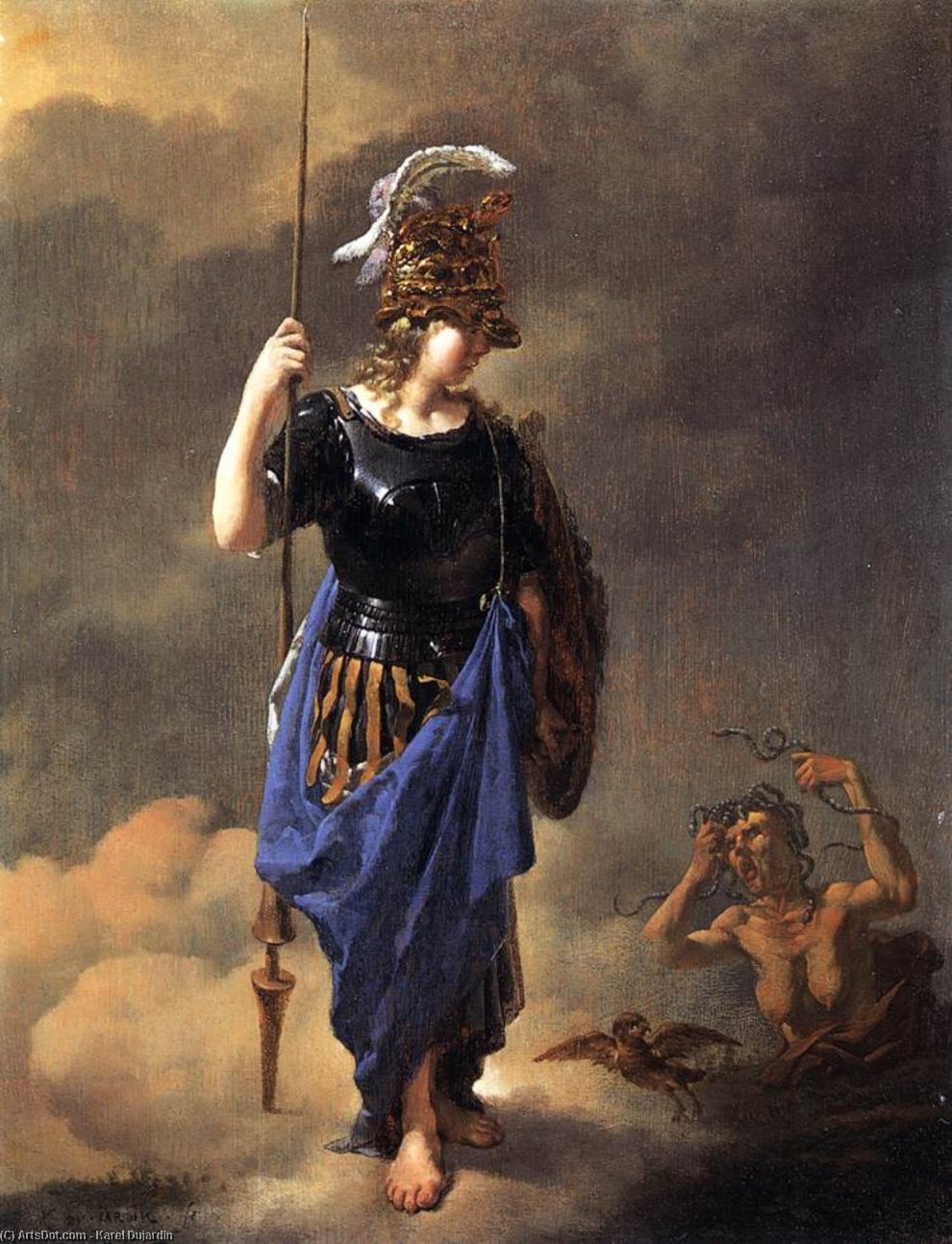
To gaze upon Karel Dujardin's "Pallas Athene Visits Invidia" is to step directly into the charged, mythic atmosphere of the Dutch Golden Age imagination. This painting transcends a mere portrait; it is a dramatic tableau vivant, capturing a moment of profound confrontation between divine order and insidious jealousy. The central figure, embodying the formidable wisdom of Pallas Athene—the goddess of strategic warfare and wisdom—commands attention with her regal bearing. Clad in flowing blue drapery that seems to catch an unseen breeze, she stands poised, spear held ready, a warrior spirit radiating from every line of her form.
Symbolism Woven into Canvas
The narrative tension of the piece is built upon potent classical symbolism. Athene’s confident placement, one foot deliberately resting upon a coiled serpent, speaks volumes of her mastery over primal forces and danger itself. The snake, an ancient symbol often associated with temptation or chthonic power, is subjugated beneath her divine tread. Complementing this martial grace is the shield she carries, suggesting not just defense, but the reasoned protection afforded by intellect. Yet, it is the background that deepens the mystery: the brooding, cloudy sky serves as a dramatic stage for the spectral presence of Invidia, or Envy. This demonic figure looms in the periphery, representing the corrosive power of jealousy—a sin so potent it requires divine intervention to subdue.
Mastery of Light and Atmosphere
Dujardin, whose career unfolded during an era obsessed with capturing fleeting moments of light, demonstrates remarkable technical skill here. While his early training may have leaned toward idyllic landscapes, in this work, he channels that mastery into atmospheric drama. The interplay between the luminous blue of Athene’s garments and the darker, more turbulent tones surrounding Invidia creates a palpable sense of depth. One can almost feel the cool air emanating from the goddess contrasting with the oppressive weight of envy depicted in the background. This careful handling of light is what gives the scene its enduring emotional resonance.
A Timeless Echo for Modern Spaces
For the collector or designer, this reproduction offers more than just decorative art; it offers a conversation piece steeped in mythology and intellectual depth. The composition—the strong vertical lines of Athene contrasted with the swirling chaos around her—provides an immediate focal point capable of elevating any room. Whether placed in a library where contemplation is key, or a formal drawing-room demanding gravitas, "Pallas Athene Visits Invidia" reminds us that true wisdom requires vigilance against the shadows of human failing. It is a powerful meditation on virtue overcoming vice, rendered with the exquisite detail characteristic of 17th-century Dutch painting.