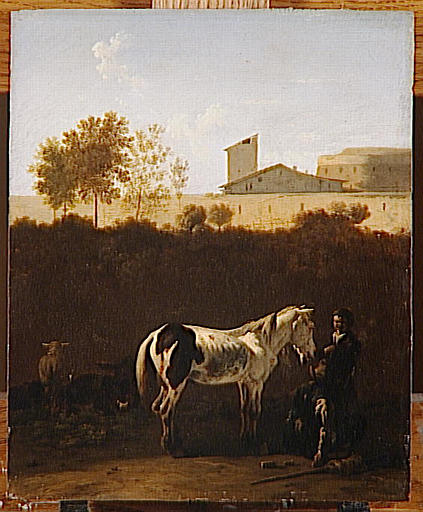
A Pastoral Vision: Karel Dujardin’s “Patres et Cheval Pie”
Karel Dujardin's "Patres et Cheval Pie" (roughly translated as “Father and Horse”) offers a serene yet subtly poignant glimpse into the Dutch Golden Age, capturing a quintessential rural scene imbued with both tranquility and a hint of melancholy. Painted around 1675, this oil on canvas work transports us to an idealized landscape – a carefully constructed tableau of pastoral life dominated by the harmonious relationship between man and beast. Dujardin, a master of atmospheric perspective and meticulous detail, skillfully employs light, color, and composition to evoke a profound sense of peace while simultaneously hinting at the complexities inherent in human interaction with nature.
The scene unfolds within a modestly sized horizontal format, immediately establishing a sense of groundedness. A central figure – a man seated near a magnificent chestnut horse – anchors the composition. This isn’t a dynamic action scene; rather, it's a moment of quiet contemplation. The horse, rendered with remarkable realism and exhibiting patches of white and black that create visual interest against the earthy tones, appears to be receiving care or perhaps simply enjoying the companionship of its rider. To the left, a scattering of sheep or goats adds to the authenticity of the setting, while a low hedge and a substantial building – likely a fortified farmhouse or even a small castle – recede into the distance, establishing depth and framing the central narrative.
The Language of Light and Color
Dujardin’s palette is deliberately restrained, dominated by the warm browns, tans, and muted greens characteristic of Dutch landscape painting. These earthy hues create a sense of groundedness and stability, mirroring the scene's tranquil mood. The artist masterfully utilizes atmospheric perspective – a technique perfected during this period – to suggest distance. Objects in the background, particularly the building, appear paler and less distinct than those closer to the viewer, creating an illusion of depth and drawing our eye towards the central figures. Subtle highlights on the horse’s coat catch the light, lending it volume and vitality, while the diffused lighting throughout the scene contributes to its overall sense of serenity.
The brushwork itself is remarkably smooth and blended, indicative of Dujardin's meticulous technique. Layers of thin glazes are applied to build up color transitions and create a soft, almost velvety texture. While visible brushstrokes exist, they’re carefully controlled, contributing to the painting’s overall sense of refinement and polished beauty. The use of horizontal lines – particularly in the landscape itself and the building walls – reinforces the feeling of stability and order, while vertical lines emphasize the height of the tower, adding a subtle element of grandeur.
Symbolism and the Dutch Golden Age
"Patres et Cheval Pie" is more than just a pretty pastoral scene; it’s a window into the values and sensibilities of the Dutch Golden Age. The presence of the imposing building in the background subtly suggests notions of authority, ownership, and perhaps even nobility – themes frequently explored in Dutch art during this period. However, the painting's core message is one of harmony between humanity and nature, a sentiment deeply rooted in the Calvinist worldview that shaped much of Dutch society. The quiet interaction between man and horse speaks to a reverence for the natural world and a recognition of its inherent beauty.
Dujardin’s work aligns perfectly with the broader artistic trends of his time – a focus on realism, meticulous detail, and an appreciation for atmospheric effects. Drawing inspiration from artists like Nicolaes Berchem, who mentored him, Dujardin inherited a deep understanding of how to capture the subtleties of light and shadow, creating landscapes that are both visually stunning and emotionally resonant. “Patres et Cheval Pie” stands as a testament to his skill and a captivating example of Dutch Golden Age artistry, offering a timeless meditation on the beauty of rural life and the enduring connection between humans and the natural world.