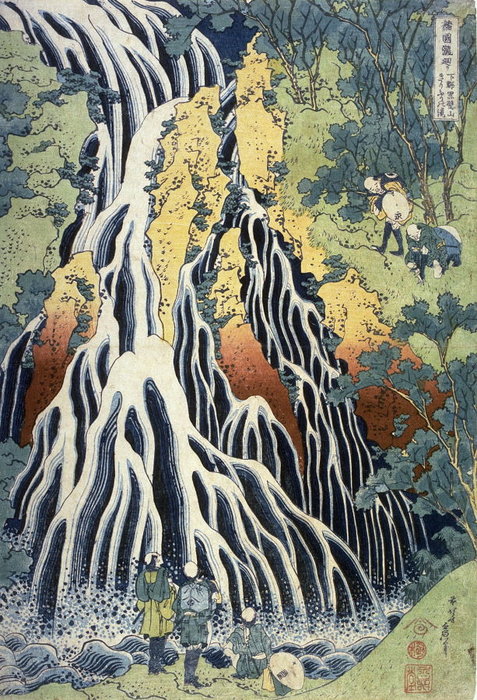
A Symphony of Movement and Tranquility: Exploring Katsushika Hokusai’s *Kirifuri Waterfall At Mount Fuji*
The painting, tentatively titled *Kirifuri Waterfall At Mount Fuji*, embodies the spirit of Edo-period Japan—a time defined by both breathtaking natural beauty and profound artistic innovation. Captured by the legendary Katsushika Hokusai (1760-1849), this artwork transcends mere depiction; it’s an invitation to contemplate the sublime, a testament to Hokusai's unparalleled ability to convey emotion through meticulous observation and masterful technique. While precise details regarding its provenance remain elusive—the date of creation and specific commission are unknown—its significance within Hokusai’s oeuvre is undeniable, cementing his place as one of Japan’s greatest artists.
- Subject Matter: The scene portrays Kirifuri Waterfall, a dramatic cascade plunging from Mount Fuji during the autumn season. This iconic location served as inspiration for numerous prints by Hokusai, reflecting Japan's fascination with its mountainous landscapes and seasonal cycles.
- Style: Hokusai’s style is firmly rooted in *Ukiyo-e*, or “pictures of the floating world,” a genre that flourished during his lifetime. Characterized by bold outlines, flattened perspective, and vibrant color palettes—though muted compared to Western standards—Ukiyo-e aimed to capture fleeting moments of beauty and evoke emotional responses in viewers.
Technique: Mastering Prussian Blue and Atmospheric Perspective
Hokusai’s genius lay not only in his compositional choices but also in his innovative use of pigment. Notably, he incorporated Prussian blue—a synthetic pigment imported from Europe—a groundbreaking feat for Japanese art at the time. This bold hue dramatically enhanced the depiction of the waterfall's spray and sky, demonstrating Hokusai’s willingness to embrace new materials and techniques to achieve artistic goals. Furthermore, he skillfully employed atmospheric perspective, subtly shading distant elements to create a sense of depth and realism—a technique remarkably advanced for its era. Careful layering of thin washes of color allowed him to capture the misty haze characteristic of autumn weather, transporting viewers into the heart of Kirifuri’s grandeur.
Historical Context: Edo Period Aesthetics and Shinto Influence
The painting emerged during Japan's Edo period (1603-1868), a time of relative peace and prosperity under Tokugawa rule. This era fostered a burgeoning artistic culture, fueled by the patronage of samurai lords and merchants alike. Japanese aesthetics prioritized harmony, simplicity, and contemplation—values deeply intertwined with Shinto beliefs concerning the sacredness of nature. Kirifuri Waterfall At Mount Fuji exemplifies these principles perfectly; its serene composition invites viewers to appreciate the majesty of Mount Fuji alongside the ephemeral beauty of the waterfall’s spray. The depiction reflects a broader trend toward elevating landscapes as subjects of artistic expression, mirroring Shinto reverence for mountains as dwelling places of gods.
Symbolism: Representing Resilience and Transformation
Beyond its visual splendor, *Kirifuri Waterfall At Mount Fuji* carries symbolic weight. The waterfall itself symbolizes resilience—the ceaseless flow of water representing perseverance amidst challenges—a concept central to Shinto cosmology. Simultaneously, the mountain embodies permanence and stability, contrasting with the transient nature of earthly existence. The presence of figures within the scene adds another layer of interpretation, suggesting humanity’s relationship with the natural world: observers are humbled by the grandeur of Kirifuri, acknowledging its power while appreciating its beauty.
Emotional Impact: Capturing a Moment of Sublime Beauty
Ultimately, Hokusai's masterpiece succeeds in conveying an overwhelming sense of awe and tranquility. The artist’s meticulous attention to detail—from the delicate rendering of foliage to the subtle gradation of color—creates an immersive experience for the viewer. It is precisely this ability to capture a fleeting moment of sublime beauty that secures *Kirifuri Waterfall At Mount Fuji*'s enduring legacy, inviting contemplation on the grandeur of nature and the transformative power of art.