A Moment of Shared Journey: Exploring Hokusai’s “Mendicant and Two Travelers”
Katsushika Hokusai's "Mendicant and Two Travelers," a captivating woodblock print from the mid-19th century, offers more than just a picturesque scene; it’s a poignant meditation on human connection amidst the vastness of nature. Created during the Edo period, a time of relative peace and burgeoning commercialism in Japan, this artwork embodies the spirit of *ukiyo-e*, or “pictures of the floating world,” a genre renowned for its vibrant depictions of everyday life, landscapes, and popular culture. The print’s enduring appeal lies not only in its exquisite detail but also in its subtle narrative—a quiet story of shared experience and perhaps even a hint of melancholy.

The Composition: A Bridge to Reflection
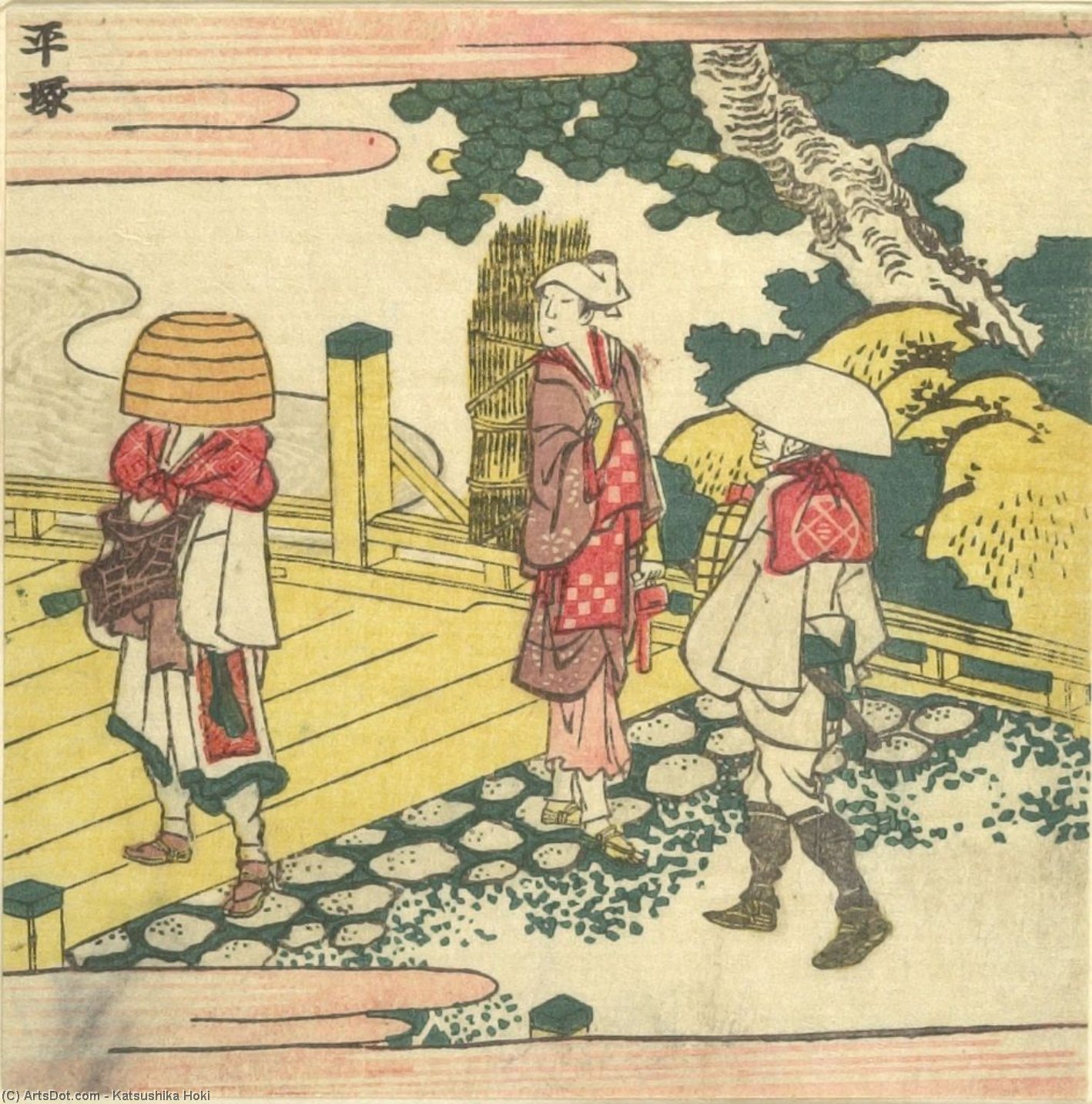
The scene unfolds on a weathered stone bridge, its uneven surface hinting at the passage of time and countless journeys. Three figures traverse this structure – a man carrying a large sack over his shoulder, a woman with a vibrant red scarf wrapped around her neck, and a younger traveler clutching a smaller bag. Each figure is rendered with remarkable precision, their clothing and postures conveying a sense of purpose and weariness. The placement of the two umbrellas, one positioned centrally and another slightly to the right, adds a layer of visual interest and subtly suggests protection from an unseen storm – perhaps representing the challenges of life’s journey.
Hokusai masterfully employs perspective to draw the viewer into the scene. The bridge recedes into the distance, creating a sense of depth and emphasizing the figures' isolation within the expansive landscape. The background features a stylized depiction of trees, rendered in delicate brushstrokes that evoke both tranquility and a hint of foreboding. The overall composition is balanced yet dynamic, inviting contemplation rather than immediate judgment.
Technique and Style: A Master’s Hand
As a leading figure in *ukiyo-e*, Hokusai was renowned for his innovative use of color and technique. This print showcases his signature approach to woodblock printing – a collaborative process involving the artist, carver, and printer. The colors are rich and vibrant, achieved through the careful application of pigments to the blocks before each print is made. Hokusai’s meticulous attention to detail is evident in the rendering of textures—the rough surface of the bridge, the folds of the clothing, and the delicate branches of the trees.
The use of Prussian blue, a relatively new pigment at the time, is particularly striking. Hokusai was one of the first artists to embrace this color, which he used to create the deep blues of the sky and water in his landscapes. His mastery of *moku-hanga* (woodblock printing) allowed him to achieve remarkable tonal variations and subtle gradations of color – a testament to his artistic skill and experimentation.
Symbolism and Context: Echoes of Edo Japan
“Mendicant and Two Travelers” is deeply rooted in the social and cultural context of Edo-period Japan. The mendicants, or *minyo*, were a common sight in urban areas, often relying on charity for survival. Their presence in the print serves as a reminder of the inequalities inherent in society and the vulnerability of those living on the margins. The travelers themselves could represent any number of individuals—pilgrims seeking enlightenment, merchants embarking on trade expeditions, or simply people searching for new opportunities.
Furthermore, the bridge itself can be interpreted as a symbol of transition – a passage from one state to another, whether it be physical location or spiritual awakening. The umbrellas offer a sense of protection and guidance, suggesting that even in times of uncertainty, there is always hope for finding one’s way.
A Timeless Reflection: The Enduring Power of Hokusai
“Mendicant and Two Travelers” remains a powerful and evocative work of art. Its quiet beauty, combined with its subtle symbolism, continues to resonate with viewers today. Reproductions of this print have graced the walls of museums and private collections around the world, serving as a reminder of Hokusai’s genius and his enduring legacy as one of Japan's greatest artists. Whether displayed in a modern home or a historic setting, this artwork invites us to pause, reflect, and contemplate the shared human experience of travel, resilience, and connection.