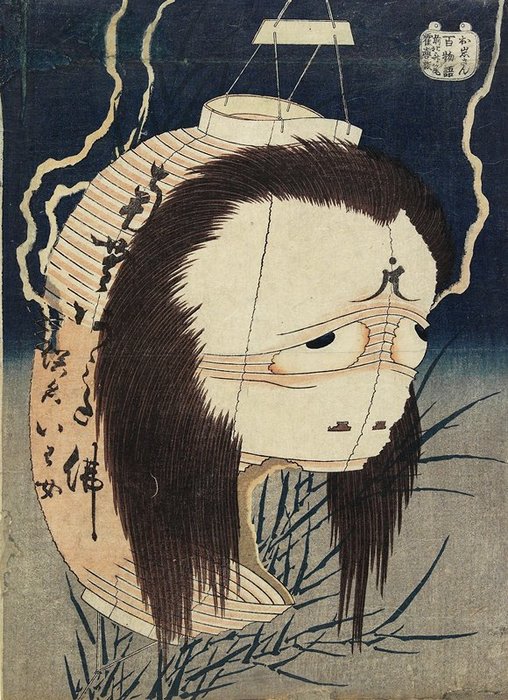
Delve into the haunting beauty of Katsushika Hokusai’s ‘The Lantern Ghost,’ inspired by Japanese folklore and featuring Oiwa, a vengeful spirit from Yotsuya Kaidan. Explore its symbolism & influence on Impressionist art.
The Lantern Ghost, Iwa: A Haunting Echo of Japanese Folklore
Katsushika Hokusai’s *The Lantern Ghost*, or Oiwa, from the celebrated series “One Hundred Ghost Tales” (Hyaku monogatari), transcends mere visual representation; it embodies a profound meditation on mortality and retribution rooted in the rich tapestry of Edo-period Japanese folklore. Executed in 1831–32 with masterful Berlin blue pigment—a hue associated with death and the supernatural—this color woodblock print offers more than just an aesthetic experience; it invites contemplation about themes central to Japanese cultural heritage.
- Subject Matter: The image depicts Oiwa, a woman driven by obsessive desire for her husband’s affections. Driven by jealousy and fueled by dark magic—a common motif in kaidan mono—she orchestrates a cunning deception involving a topical poison disguised as cream. This tale explores the consequences of unchecked ambition and the inescapable grip of fate.
- Style & Technique: Hokusai's signature style is evident in the print’s meticulous detail, achieved through the painstaking process of woodblock printing—a technique perfected during his lifetime. The artist skillfully captures a moment of intense emotion, portraying Oiwa’s despair and imminent demise with remarkable sensitivity.
- Historical Context: Produced during Hokusai's prolific artistic output, *The Lantern Ghost* reflects the anxieties surrounding death and spirits prevalent in Edo society. It aligns perfectly with the genre of kaidan—ghost stories—which served as a popular form of entertainment and moral instruction during the period.
- Symbolism: The lantern itself symbolizes illumination but also confinement, mirroring Oiwa’s trapped existence and her futile quest for unattainable love. The bird perched atop the lantern represents hope amidst darkness, yet its posture conveys vulnerability—a poignant reminder of Oiwa's fragile spirit. Furthermore, the clock serves as a visual representation of time passing relentlessly, emphasizing the inevitability of death and the futility of resisting fate.
- Emotional Impact: Viewing *The Lantern Ghost* evokes a palpable sense of unease and melancholy. Hokusai’s masterful composition compels the viewer to confront themes of obsession, betrayal, and ultimately, tragic self-destruction—a timeless exploration of human psychology that continues to resonate with audiences today.
This haunting depiction stands as a testament to Hokusai's artistic genius and his ability to distill complex narratives into visually arresting images. Its enduring appeal lies in its capacity to provoke reflection on fundamental questions about life, death, and the human condition—a legacy that secures *The Lantern Ghost*, Iwa’s place among Japan’s most iconic artworks.