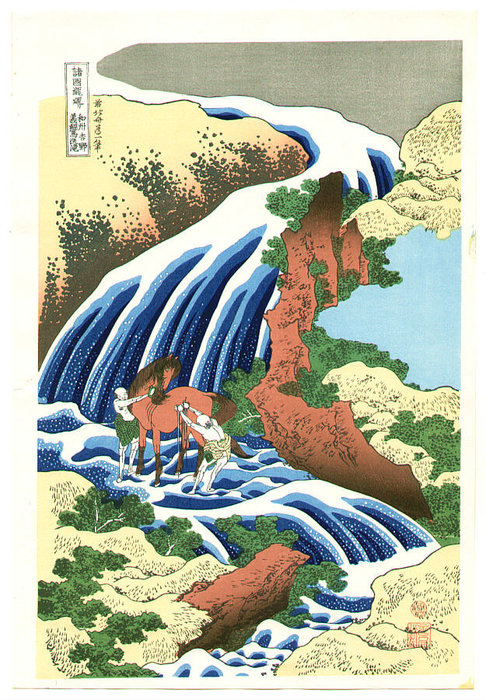
This breathtaking woodblock print depicts Yoshitsune washing his horse at Yoshino Falls, part of Hokusai's acclaimed 'A Tour of Waterfalls.' Featuring vibrant colors, meticulous linework, and evocative seals, it exemplifies Japanese artistic excellence.
Admire Katsushika Hokusai's iconic 'The Waterfall Where Yoshitsune Washed His Horse at Yoshino,' a masterpiece from Japan’s Edo period, showcasin
A Vision of Tranquility Amidst Turbulent Times
The Waterfall Where Yoshitsune Washed His Horse at Yoshino in Yamato Province (Washū Yoshino Yoshitsune Uma-arai no Taki), created by Katsushika Hokusai around 1832, stands as a cornerstone of Japanese landscape art and arguably the most recognizable image from his monumental series *A Tour of Waterfalls in Various Provinces* (*Shokoku taki meguri*). More than just a depiction of natural beauty—though undeniably stunning—this woodblock print encapsulates a profound meditation on impermanence and resilience, reflecting anxieties prevalent during Japan’s Edo period.
- Subject Matter: The artwork portrays a dramatic waterfall cascading down a rocky hillside in Yoshino Province, Yamato Domain. At the base of the falls stands Yoshitsune Tokugawa, Japan's shogun at the time, symbolically washing his horse—a gesture representing purification and renewal amidst the challenges of warfare.
- Style: Hokusai’s style is characterized by *hokuyo-ga*, or “mountain water view,” a genre that sought to capture the grandeur of nature while subtly conveying philosophical ideas. It exemplifies Romanticism's fascination with sublime landscapes, prioritizing emotional impact over precise topographical accuracy.
Technique: This print is executed using *sumi-e* (ink wash painting) combined with vibrant Prussian blue pigment—a revolutionary color introduced to Japan from Europe during this period. The meticulous layering of ink creates textured surfaces and subtle gradations of tone, skillfully conveying the misty atmosphere characteristic of Yoshino’s autumn season. Hokusai's masterful use of perspective draws the viewer into the scene, emphasizing the scale and majesty of the waterfall.
Historical Context: Produced during a time of political instability—the Tokugawa shogunate faced increasing pressure from rebellious clans—the print transcends mere visual representation. The image speaks to the broader anxieties surrounding dynastic succession and the fragility of power. Yoshitsune’s act of cleansing symbolizes an attempt to restore harmony amidst chaos, mirroring the spiritual aspirations of the era.
- Symbolism: The waterfall itself represents constant change and the cyclical nature of existence—themes central to Buddhist philosophy. Yoshitsune's horse washing signifies purification and rebirth, suggesting that even in times of adversity, renewal is possible.
- Emotional Impact: Viewing *The Great Wave* evokes a feeling of awe and contemplation. The print’s serene composition contrasts sharply with the turbulent political landscape, prompting reflection on beauty amidst hardship and reminding us of the enduring power of nature to inspire wonder.
Legacy: Hokusai's masterpiece continues to captivate audiences globally. Its influence can be seen in Impressionist painters like Claude Monet who were profoundly moved by its aesthetic qualities. *The Waterfall Where Yoshitsune Washed His Horse at Yoshino* remains a testament to Hokusai’s artistic genius and his ability to distill complex philosophical ideas into an unforgettable visual experience—a timeless symbol of Japanese art and culture.