A Visionary Collision of Worlds
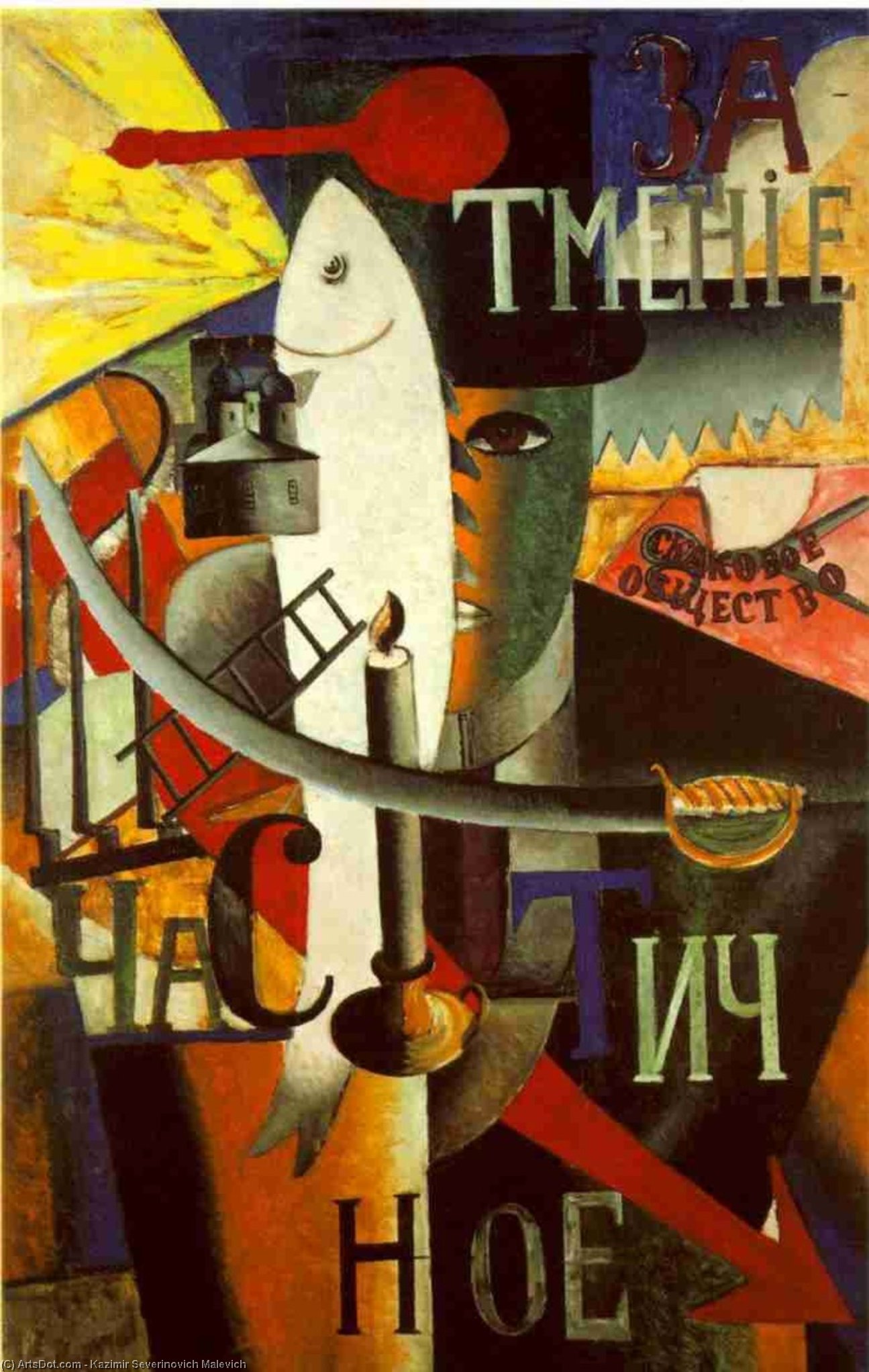
In the transformative landscape of the early 20th century, few works capture the electric tension of modernity as profoundly as Kazimir Malevich’s “An Englishman in Moscow.” Created in 1914, this masterpiece serves as a breathtaking threshold between the recognizable world and the radical frontier of pure abstraction. At first glance, the viewer is met with a striking, almost cinematic fragmentation; a figure emerges through a sea of geometric planes, wearing the unmistakable silhouette of a top hat and overcoat. Yet, this is no traditional portrait. Malevich employs a sophisticated Cubo-Futurist language to deconstruct his subject, weaving together a complex tapestry where the organic and the mechanical begin to merge. The presence of a stylized fish, partially obscuring the man's face, introduces an element of surreal mystery, inviting the observer to look beyond the surface and into a realm of deep, symbolic inquiry.
The emotional resonance of the piece lies in its ability to evoke both the sterile precision of the industrial age and the vast, untamed spirit of nature. The color palette is a masterclass in restraint and impact, dominated by ethereal blues and crisp whites that suggest the infinite expanse of the sky or the cold, clean lines of a burgeoning metropolis. This cool atmosphere is punctuated by sharp, angular shapes—rectangles, triangles, and squares—that dance across the canvas with a rhythmic, almost musical energy. For the collector or interior designer, this work offers a profound sense of movement and structural depth, making it an ideal centerpiece for spaces that demand intellectual stimulation and a sophisticated, avant-garde aesthetic.
The Architecture of Abstraction
Technically, “An Englishman in Moscow” is a triumph of texture and materiality. Executed in oil on canvas, the painting possesses a palpable physical presence, characterized by thick, deliberate brushstrokes that catch the light and create a rugged, tactile surface. This heavy application of paint rejects the flat illusionism of classical art, instead celebrating the artwork as a physical object in its own right. Malevich’s use of collage-like layering creates a sense of architectural depth; shapes overlap and intersect in a way that defies traditional perspective, forcing the eye to navigate a multidimensional space. This technique is central to the Constructivist spirit, where the structural integrity of the composition mirrors the industrial progress of the era.
Beyond its visual splendor, the painting functions as a powerful metaphor for the cultural shifts occurring at the dawn of the modern era. As noted by historians, the "Englishman" serves not as a specific individual, but as a symbol of the intersection between East and West, between the traditional countryside and the encroaching urban machine. The juxtaposition of mechanical components—gears and pistons—with organic motifs creates a dialogue about the collision of life and technology. To possess a high-quality reproduction of this work is to bring into one's home a fragment of history’s most radical revolution, offering an enduring inspiration that speaks to the eternal human quest for progress, structure, and the sublime.