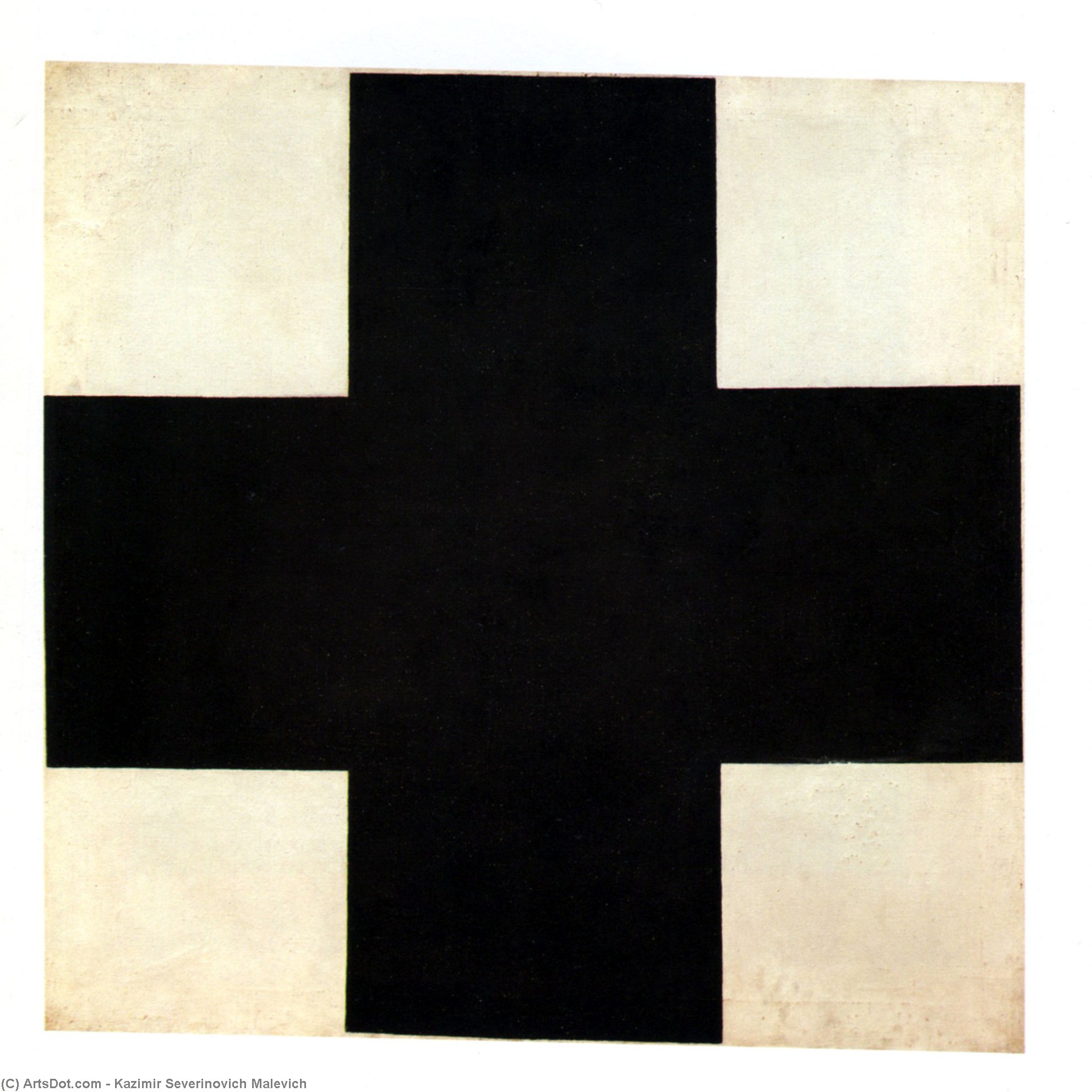
Black Cross by Kazimir Malevich: A Revolution in Geometric Abstraction
Kazimir Severinovich Malevich’s *Black Cross*, painted in 1915, stands as an emblem of Suprematism—a radical artistic movement that irrevocably altered the landscape of early 20th-century art. Born in Kyiv Oblast, Ukraine, in 1879 to a Polish family steeped in cultural traditions, Malevich’s formative years instilled within him a profound appreciation for visual narratives and folk artistry – an influence subtly woven into his groundbreaking explorations of pure geometric abstraction. This movement, spearheaded by Malevich himself in 1913, rejected the conventions of representational art, asserting that true artistic expression resided not in mirroring reality but in distilling it to its fundamental elements: simple shapes and colors devoid of illusionistic depth.
- The Composition: At first glance, *Black Cross* presents a deceptively austere scene—a large black cross dominating a pristine white background punctuated by a smaller black square positioned centrally. This stark contrast immediately establishes a dynamic tension between opposing forces, mirroring Malevich’s philosophical conviction that art should transcend the limitations of objective observation and tap into the realm of pure feeling.
- Suprematism's Core Principles: Understanding *Black Cross* necessitates grasping the tenets of Suprematism. As articulated in “The Suprematism Art Movement: A Revolution in Abstract Art,” Malevich’s audacious démarche challenged established artistic dogma, questioning whether art could truly capture the essence of human experience beyond mere visual depiction.
- Technique and Materiality: Executed in oil on canvas, *Black Cross* exemplifies Malevich's meticulous attention to detail—a hallmark of his disciplined approach. The artist employed a layering technique, applying thin washes of white pigment to create subtle gradations within the background, thereby enhancing the perceived depth and dimensionality of the artwork despite its apparent simplicity.
Historical Context: Challenging Artistic Tradition
Painted during the turbulent years preceding World War I and amidst the burgeoning fervor for avant-garde experimentation across Europe, *Black Cross* arrived on the artistic scene as a defiant rebuke to prevailing stylistic trends—particularly Cubism’s fragmentation of form. Malevich's decision to abandon representational imagery was not merely aesthetic; it represented a profound epistemological assertion – a belief that art could liberate itself from the constraints of mimetic reproduction and unlock access to a more primal, spiritual dimension. The painting embodies the spirit of its time—a yearning for innovation and a rejection of inherited artistic conventions.
Symbolism Beyond Representation
Despite its apparent lack of recognizable imagery, *Black Cross* resonates with layers of symbolic significance. The black cross itself harkens back to Christian iconography—representing sacrifice, faith, and redemption—yet Malevich deliberately stripped away any explicit religious connotations. Instead, he sought to convey a more universal concept: the primacy of pure artistic feeling over objective observation. The juxtaposition of black and white serves as a powerful visual metaphor for duality – darkness and light, silence and dynamism – reflecting Malevich’s preoccupation with exploring the fundamental forces shaping human consciousness.
Emotional Impact and Legacy
*Black Cross* continues to captivate viewers today with its arresting simplicity and profound emotional resonance. Its austere palette—confined to monochrome hues—forces contemplation upon the observer, prompting a visceral response rooted in intuition rather than rational analysis. As exemplified by other artists of his era, such as Wassily Kandinsky’s *Concerning the Spiritual in Art*, Malevich's pioneering work paved the way for subsequent movements in abstract art—inspiring generations of artists to pursue radical experimentation and redefine the boundaries of artistic expression. Its enduring influence testifies to the transformative power of Suprematism and its indelible mark on the history of modern art.