Kazimir Malevich (1878-1935): Ukrainian founder of Suprematism & pioneer of abstract art. Explore iconic works like Black Square, geometric forms, & pure feeling's impact on 20thC art.
A Singular Vision: Kazimir Malevich’s “Blue Space”
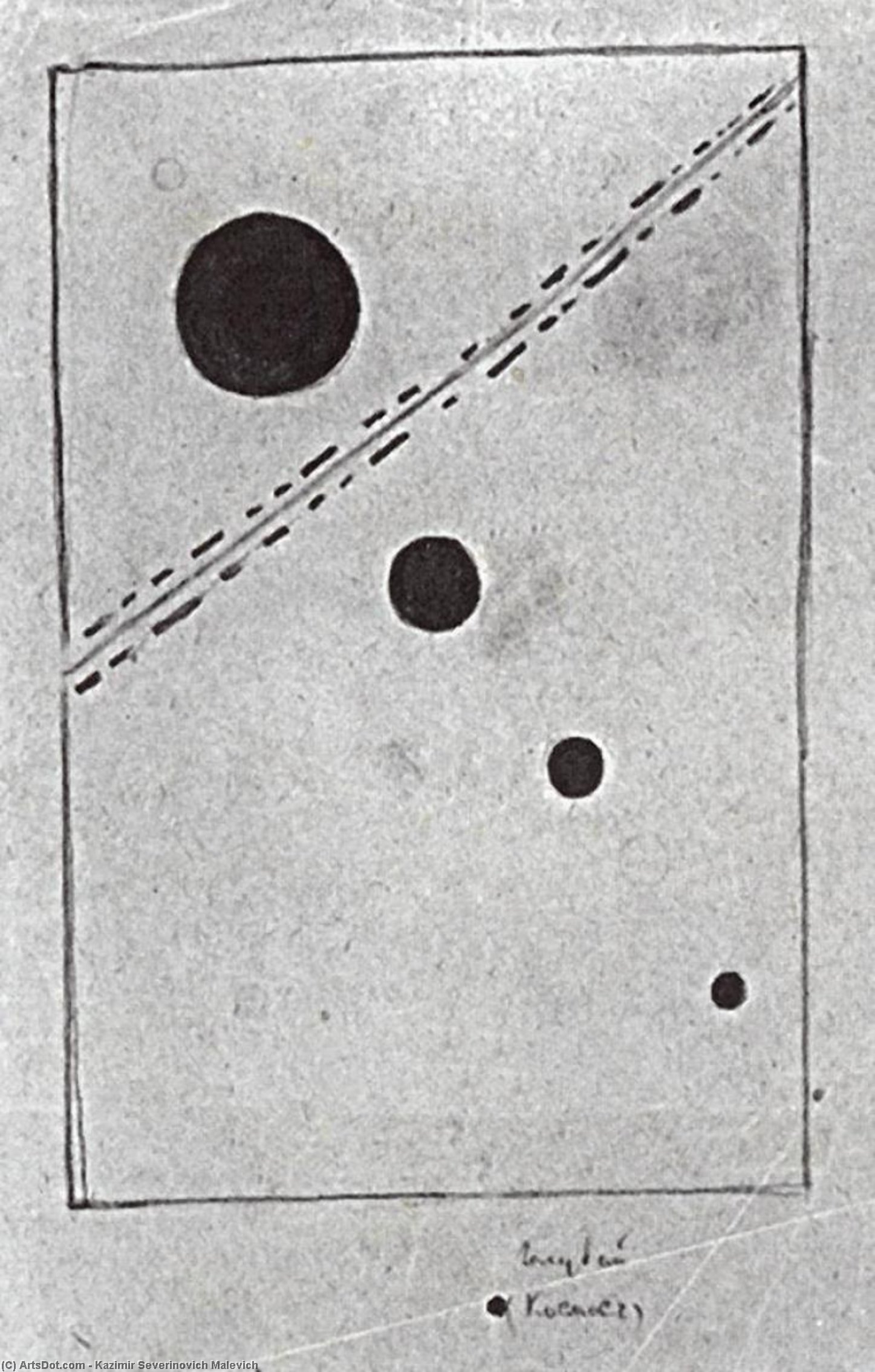
Kazimir Malevich's "Blue Space," painted in 1917, stands as an emblem of Suprematism—a revolutionary artistic movement that fundamentally challenged the conventions of Western art. More than just a geometric abstraction, it embodies a profound philosophical statement about perception and spirituality, reflecting the anxieties and aspirations of its time. The artwork’s stark simplicity is deceptive; within its unassuming appearance lies a complex exploration of visual language and conceptual ideas.
The Geometry of Silence
At first glance, “Blue Space” presents itself as remarkably austere. Three circles dominate the composition—one large central circle flanked by two smaller ones—all rendered in solid black against a muted gray background. A diagonal line bisects this arrangement, injecting an element of dynamism into what might otherwise appear static. Malevich deliberately eschewed representational imagery altogether, prioritizing pure geometric forms as vehicles for conveying emotion and thought. This decision aligns perfectly with the broader Suprematist ethos, which sought to liberate art from the constraints of depicting the external world. The artist’s meticulous attention to detail—the precise placement of each circle and the subtle variations in the gray tone—contributes to an overall sense of deliberate control and intellectual rigor.
Roots in Folk Art and European Avant-Garde
Malevich's artistic journey began with explorations of Impressionism, Symbolism, Fauvism, and Cubism – styles that were prevalent during his formative years. However, a transformative encounter with Parisian avant-garde artists in 1912 ignited his passion for abstraction. Influenced by thinkers like Nikolai Bulgakov and Vladimir Tatlin, Malevich wrestled with questions of artistic purpose and the role of art in shaping human consciousness. He sought to distill visual experience down to its most essential elements—the circle and the square—believing that these forms could express universal truths beyond the realm of sensory perception.
Symbolism Beyond Color
The absence of color is arguably “Blue Space’s” most striking characteristic, yet it's precisely this deliberate omission that amplifies its symbolic resonance. Malevich famously declared that he wished to eliminate "color," arguing that it distracted from the viewer’s contemplation and obscured the underlying spiritual essence of art. The gray background serves as a neutral canvas upon which the black circles project their impact—a visual metaphor for emptiness, purity, and transcendence. Some scholars interpret the diagonal line as representing the axis mundi—the cosmic center—suggesting that Malevich aimed to depict not just space but also the interconnectedness of all things.
A Legacy of Minimalism
“Blue Space” remains a cornerstone of Suprematism’s legacy, influencing generations of artists who followed in Malevich's footsteps. Its enduring appeal lies in its ability to evoke contemplation and provoke questions about perception and representation. Today, reproductions of this seminal artwork continue to inspire interior designers and collectors alike—serving as a testament to the power of minimalist aesthetics and the transformative potential of abstract art. It’s a piece that invites viewers to consider what is truly essential in visual experience, reminding us that beauty can reside in simplicity and silence.