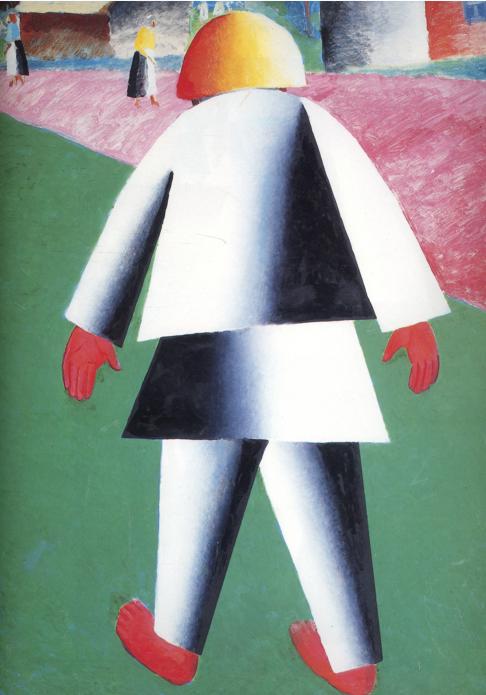
Kazimir Malevich’s surreal ‘Boy,’ painted in 1932, embodies Suprematism's radical simplification—a floating head against a grassy backdrop—capturing the artist’s pioneering vision of abstract art and inviting you to explore this iconic masterpiece.
Kazimir Malevich (1878-1935): Ukrainian founder of Suprematism & pioneer of abstract art. Explore iconic works like Black Square, geometric forms, & pure feeling's impact on 20thC art.
A Singular Vision: Kazimir Malevich’s “Boy”
The painting "Boy," executed by Kazimir Malevich in 1932, stands as an arresting testament to the artist's unwavering commitment to abstract expression and his profound influence on the trajectory of modern art. Measuring 72 x 51 cm, this artwork transcends mere depiction; it embodies a conceptual exploration of form and color that speaks volumes about Malevich’s artistic philosophy and the broader context of Suprematism—the movement he spearheaded.
The Essence of Suprematism
Malevich's Suprematism emerged from the disillusionment following World War I and the perceived failures of representational art to grapple with the anxieties of the era. Rejecting illusionism altogether, Malevich sought to distill painting down to its purest essence: geometric forms—primarily squares and circles—arranged in a deliberate hierarchy. “Boy” exemplifies this principle perfectly. The central figure is rendered as an oversized head floating above a simple rectangle representing the body, prioritizing visual impact over detailed anatomical accuracy. This reductive approach wasn’t merely stylistic; it was intended to liberate art from the constraints of objective observation and tap into a realm of pure feeling and spiritual contemplation.
Technique and Material Considerations
Malevich employed tempera paint on canvas—a technique favored by Russian avant-garde artists—to achieve a luminous surface finish that emphasizes color saturation and tonal variation. The dominant hue is a striking crimson, boldly juxtaposed against the muted white rectangle of the body. This deliberate contrast underscores Malevich’s fascination with chromatic relationships and his desire to convey emotional intensity without resorting to figurative imagery. Careful attention was paid to layering pigments to build up depth and texture, creating an illusionistic effect despite the absence of recognizable objects.
Historical Context: Russia's Artistic Revolution
“Boy” emerged during a period of intense artistic experimentation in Soviet Russia following Lenin’s ascension to power. Malevich’s Suprematism aligned with the Bolshevik government’s ambition to forge a new cultural identity rooted in rationality and geometric abstraction—a deliberate rejection of the decadent traditions of Tsarist Russia. The painting's simplicity and uncompromising aesthetic resonated powerfully with the intellectual currents of the time, representing not just an artistic breakthrough but also a symbolic declaration of liberation from bourgeois conventions.
Symbolic Resonance: Beyond Representation
While devoid of recognizable figures or narrative content, “Boy” is laden with symbolic significance. The oversized head represents intellect and spiritual awareness—a deliberate elevation of consciousness above materiality. The rectangle symbolizes stability and grounding, providing a counterpoint to the ethereal head. Together, they convey a profound meditation on human existence and the pursuit of inner harmony. Malevich’s intention was not to depict something “out there,” but rather to engage the viewer in an internal dialogue—a quest for understanding beyond the surface appearance of things.
Emotional Impact: A Momentary Pause
Ultimately, "Boy" compels contemplation. Its stark simplicity forces us to confront fundamental questions about perception and representation. The bold crimson hue evokes feelings of passion and urgency, while the luminous white rectangle offers a sense of serenity and stillness. It’s a painting that lingers in the mind long after viewing, prompting reflection on the power of abstract art to communicate emotion and provoke intellectual curiosity—a legacy that continues to inspire artists and collectors alike.