A Vision in Stone and Spirit
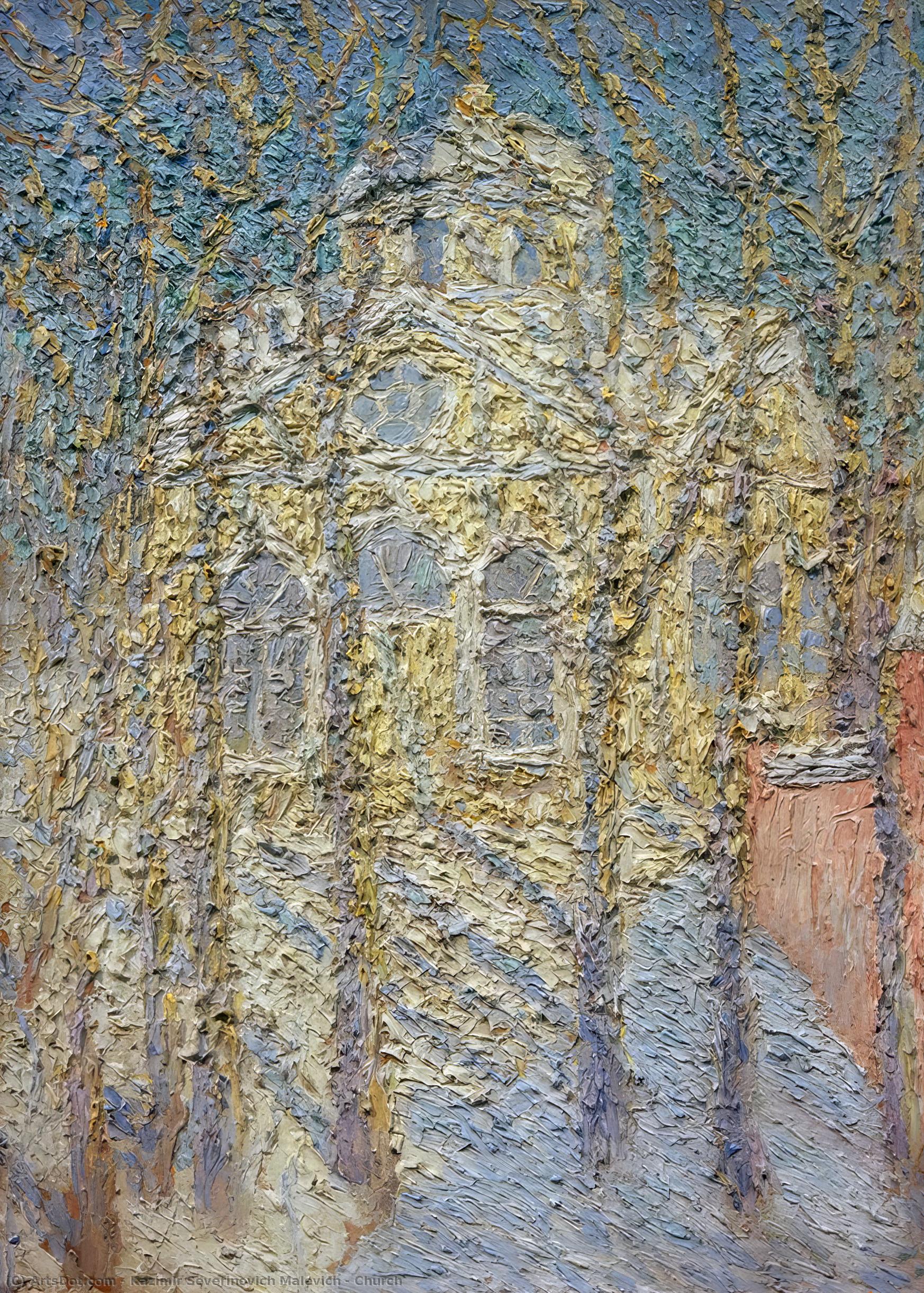
In the quiet, transformative year of 1905, Kazimir Malevich captured something far more profound than mere architecture in his work, Church. At first glance, the viewer is met with a powerfully abstracted depiction of a building facade—perhaps a grand palace or a sacred cathedral—yet to linger on the canvas is to realize that Malevich was not interested in the literal stones of construction, but in their spiritual essence. The composition is defined by a soaring verticality, a deliberate upward movement that draws the eye toward the upper reaches of the structure. Through layered brushstrokes and a masterful rejection of traditional perspective, the artist suggests a sense of aspiration and transcendence, inviting the observer to look beyond the physical world and into a realm of pure, atmospheric depth.
The painting occupies a fascinating transitional space in the history of early Modernism. While it lacks the radical geometric purity of Malevich’s later Suprematist period, it vibrates with the emotional intensity of Expressionism. There is a palpable tension within the work, an echo of Post-Impressionist exploration through color and visible texture that hints at the revolutionary shifts occurring in the Russian avant-garde. This piece serves as a crucial stepping stone, capturing the moment when art began to shed its duty to mimic reality and started to embrace the power of suggestion and emotional truth.
Texture, Tone, and Tactile Majesty
To encounter Church is to experience a sensory engagement with the very materiality of paint. Malevich utilized a striking impasto technique, applying thick, heavy layers of oil paint directly onto the canvas to create a surface that feels incredibly tactile. This rugged application gives the building a weathered, ancient quality, reminiscent of aged stone or the rough bark of an old-growth tree. The texture is not merely a visual element; it provides a physical weight to the composition, grounding the ethereal subject matter in something deeply substantive.
The color palette is masterfully restrained, relying on a sophisticated arrangement of cool tones—deep blues, somber grays, and muted, sun-bleached yellows. These colors work in harmony to build a sense of atmosphere and mystery, casting soft, diffused light across the abstracted forms. For the discerning collector or interior designer, this piece offers a unique balance of strength and subtlety. Its muted tones allow it to integrate seamlessly into sophisticated, contemporary spaces, while its heavy texture provides a commanding focal point that commands attention without overwhelming the room.
An Enduring Legacy for the Modern Collector
Beyond its aesthetic brilliance, Church carries a profound historical weight. Painted during a period of significant social and artistic upheaval in Russia, the work reflects a world in flux—a desire to break from tradition and find new languages for expression. The building itself becomes a symbol: it can represent the enduring strength of faith, the grandeur of human achievement, or the mysterious decay of time. It is an artwork that invites endless reinterpretation, making it a timeless addition to any curated collection.
For those seeking to bring a piece of art history into their personal environment, a high-quality reproduction of this masterpiece offers more than just decoration; it offers an invitation to contemplation. Whether placed in a quiet study or as a centerpiece in a grand living area, the painting’s ability to evoke a sense of "unsettling beauty" and ancient mystery ensures that it remains a conversation piece for generations. It is a work that does not merely occupy space—it transforms it.