A Vision of Emerging Abstraction: Kazimir Malevich’s ‘Complex Presentiment’
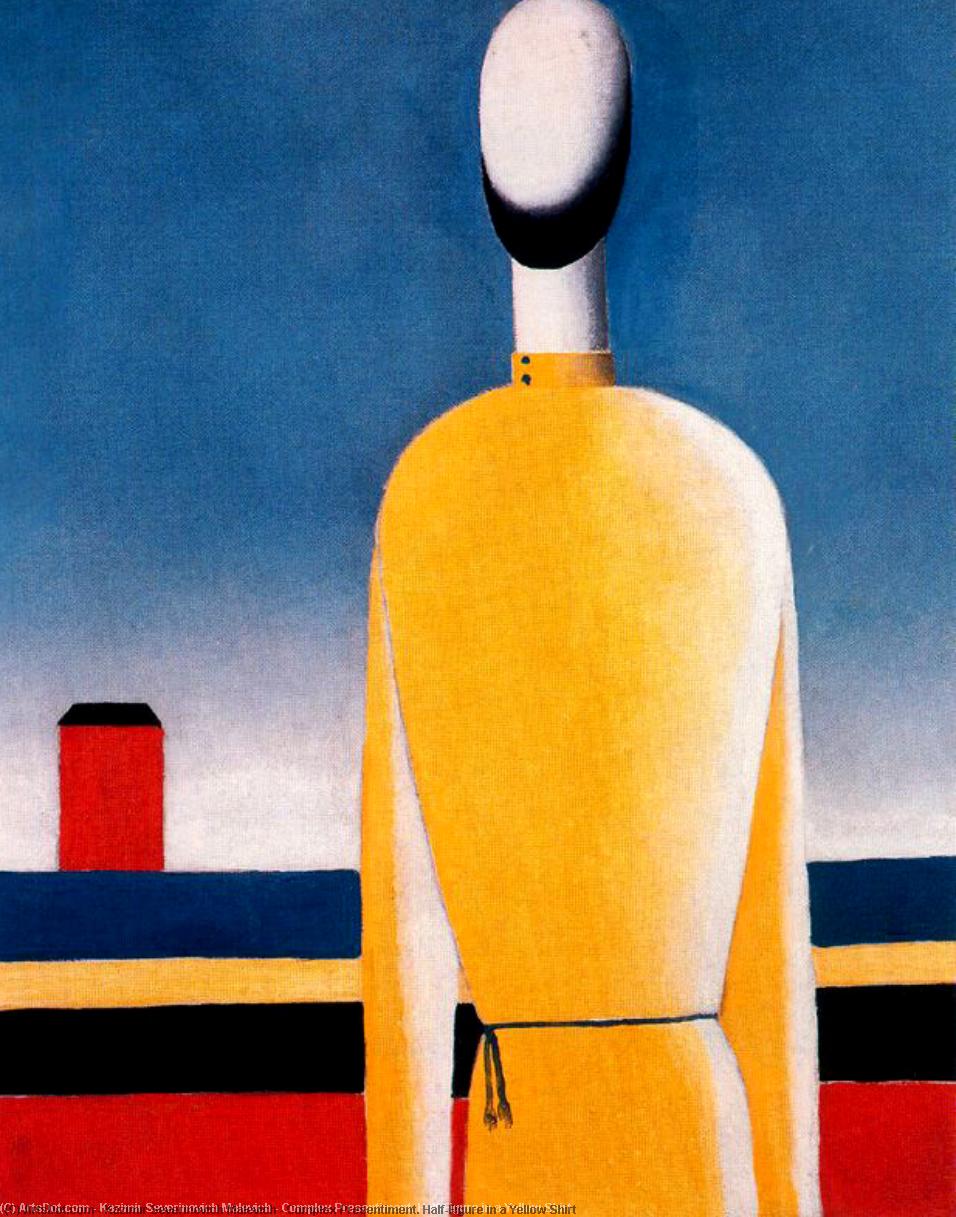
‘Complex Presentiment. Half-Figure in a Yellow Shirt’ is a pivotal work by Ukrainian avant-garde master, Kazimir Malevich, offering a compelling glimpse into the genesis of his revolutionary Suprematist style. Painted around an unknown date, this piece exists at a fascinating crossroads – departing from representational art while not yet fully embracing the pure geometric abstraction that would define his most iconic works like ‘Black Square’.
Deconstructing Form and Color
The artwork presents a stylized figure, reduced to essential forms and bathed in striking color. A tall, slender form dominates the canvas, clad in a vibrant yellow garment. The head and neck are rendered in stark white, creating an immediate focal point. Below, rectangular blocks of red, blue, and black suggest a stage-like setting or perhaps a fragmented architectural space. Malevich employs a limited palette with bold contrasts, prioritizing color as a fundamental expressive element rather than descriptive one. Lines are predominantly straight and geometric, emphasizing the constructed nature of the composition. The texture, achieved through visible brushstrokes, hints at the materiality of the paint itself – a deliberate acknowledgement of the canvas as an object.
The Birth of Suprematism
To understand ‘Complex Presentiment’ is to understand Malevich's artistic journey. Born in Ukraine to a Polish family, he initially explored Impressionism, Symbolism, and Cubism before forging his own path. This painting represents a crucial step in that evolution. It embodies the transition *from* depicting objects *to* exploring pure feeling through form and color – the core tenet of Suprematism, which Malevich would formally articulate shortly after this work was created. He sought to liberate art from the constraints of representing the visible world, believing true artistic expression lay in accessing a “supremacy of pure feeling.”
Symbolism & Interpretation
The ambiguity inherent in ‘Complex Presentiment’ invites multiple interpretations. Is the figure a human form, a mannequin, or an allegorical representation? The lack of detail and the simplified shapes contribute to this sense of mystery. Some scholars suggest the work explores themes of isolation, artificiality, and the constructed nature of identity – ideas that resonated with the anxieties of a rapidly changing world in the early 20th century. The ‘presentiment’ alluded to in the title suggests an anticipation of something new, a premonition of the abstract future Malevich was actively creating.
Technique and Materials
Executed in oil on canvas, the artwork showcases Malevich's skillful handling of paint. The visible brushstrokes contribute to the textured surface and add depth despite the overall flatness of the composition. This technique is characteristic of his early explorations with abstraction, where he sought to balance geometric precision with a tangible sense of materiality.
Emotional Resonance & Interior Design
‘Complex Presentiment’ evokes a range of emotions – from intrigue and contemplation to a subtle unease. Its bold colors and simplified forms create a striking visual impact that can energize any space. This artwork would be particularly well-suited for modern or minimalist interiors, where its abstract qualities can complement clean lines and uncluttered aesthetics. It serves as a powerful statement piece, sparking conversation and inviting viewers to engage with the fundamental questions of form, color, and perception.
- Style: Early Suprematism / Abstract Expressionism
- Medium: Oil on Canvas
- Themes: Abstraction, Form, Color, Identity, Modernity
- Emotional Impact: Intriguing, Contemplative, Energetic